

What is fiscal drag?
Fiscal drag is what happens when tax thresholds stay put while pay and prices rise. More of your income lands in higher bands without any headline tax rate going up.
The Office for Budget Responsibility (OBR) uses the term in its October 2026 Economic and fiscal outlook. It says Budget 2025 extended the income tax and National Insurance threshold freezes to April 2031, "meaning the majority will be frozen for most of the 2020s" (paragraph 4.14).
The OBR also shows how much this matters for the public finances. Under the freeze, a 1 percentage point rise in earnings and CPI would raise income tax and National Insurance receipts by an average of £7 billion a year. That's about £2.5 billion a year more than if thresholds rose with CPI (paragraph 4.14).
It forecasts these receipts at £520 billion in 2026-27, up 7.6% on the year before. It puts that rise down to "strong nominal earnings growth combining with frozen tax thresholds" (paragraph 4.13).
For an investor, the point is narrower. Your tax band decides how much interest, dividend income and gains you can take tax-free outside an ISA or pension. It also sets the rate you pay above that. When the band boundary is frozen, more people cross it every year.
Which tax thresholds are frozen and until when?
The main income tax thresholds are frozen at their 2021-22 levels until April 2031. Several investment allowances are fixed in cash terms too, so they shrink in real terms each year.
| Threshold or allowance | 2026-27 | 2027-28 | Status |
|---|---|---|---|
| Personal allowance | £12,570 | £12,570 | Frozen to April 2031 |
| Higher-rate threshold (England, Wales and NI) | £50,270 | £50,270 | Frozen to April 2031 |
| Additional-rate threshold | £125,140 | £125,140 | Frozen |
| Personal allowance taper starts | £100,000 | £100,000 | Unchanged |
| Personal savings allowance (basic / higher / additional) | £1,000 / £500 / £0 | £1,000 / £500 / £0 | Unchanged |
| Dividend allowance | £500 | £500 | Unchanged |
| Capital gains tax annual exempt amount | £3,000 | £3,000 | Unchanged |
| ISA subscription limit | £20,000 | £20,000 | Frozen to April 2031 |
Source: GOV.UK Budget 2026 overview of tax legislation and rates, Annex A, published 28 October 2026. The additional-rate savings allowance is from GOV.UK Tax on savings interest. We took the date the freeze ends from paragraph 4.13 of the OBR's October 2026 outlook.
The ISA limit sits at £20,000 for the same period. The full £20,000 can still go into cash ISAs. Budget 2026 also lifts savings tax to 24%, 44% and 49% from April 2027. The detail lives in our guide to the Budget 2026 ISA and savings tax changes.
What would the 40% threshold be if it had kept up with inflation?
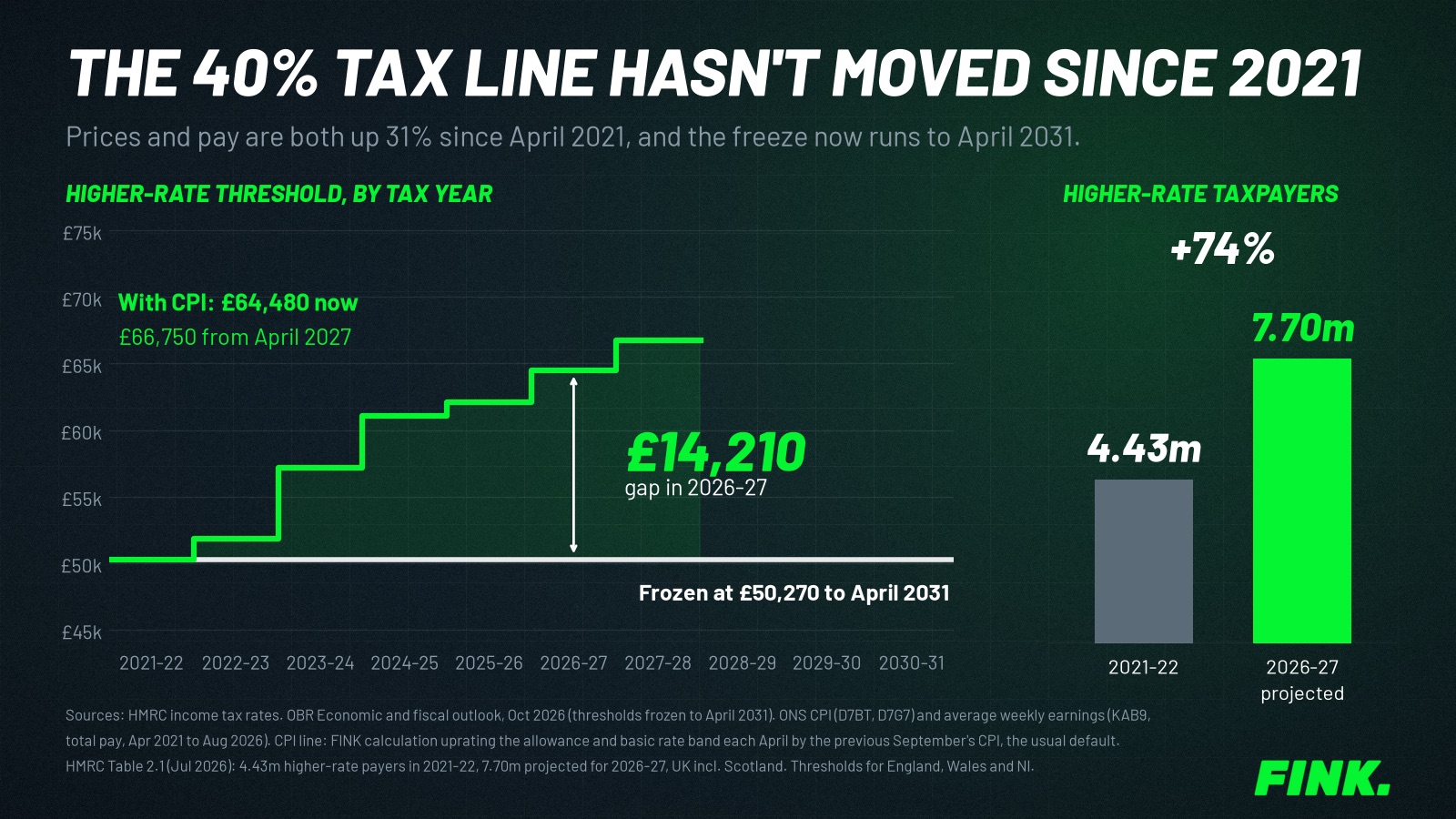
About £64,480 in 2026-27, rising to £66,750 from April 2027. That's FINK's calculation, using the method the law used before the freeze.
The government set the threshold at £50,000 for 2019-20 and 2020-21. Its Budget 2018 tax information note said the personal allowance and basic rate limit would then be "indexed with the Consumer Price Index". Here's how we rebuilt that path:
- Start from the 2021-22 figures: a £12,570 personal allowance and a £37,700 basic rate band, which add up to £50,270.
- Each April, raise both by CPI inflation for the previous September, from ONS series D7G7.
- Round the allowance up to the next £10 and the band up to the next £100, as the indexation rules do.
- Add them back together to get the higher-rate threshold.
| Tax year | September CPI used | CPI-linked threshold | Actual threshold | Gap |
|---|---|---|---|---|
| 2022-23 | 3.1% (Sept 2021) | £51,860 | £50,270 | £1,590 |
| 2023-24 | 10.1% (Sept 2022) | £57,170 | £50,270 | £6,900 |
| 2024-25 | 6.7% (Sept 2023) | £61,030 | £50,270 | £10,760 |
| 2025-26 | 1.7% (Sept 2024) | £62,090 | £50,270 | £11,820 |
| 2026-27 | 3.8% (Sept 2025) | £64,480 | £50,270 | £14,210 |
| 2027-28 | 3.5% (Sept 2026) | £66,750 | £50,270 | £16,480 |
The 2022 inflation spike did most of the damage. The September 2022 and September 2023 readings added £9,170 to the gap on their own. Seen the other way, £50,270 today buys what about £38,400 bought in April 2021, because the CPI index rose 30.9% between April 2021 and September 2026.
How many more people pay 40% tax because of the freeze?
HMRC projects 7.70 million higher-rate taxpayers in 2026-27, against 4.43 million in 2021-22. That's a 74% rise in five years.
The numbers come from HMRC Table 2.1, last updated in July 2026. Figures up to 2023-24 are outturn. The three years after that are projections HMRC says are provisional and will be revised. The table covers the whole UK. That includes Scotland, which sets its own bands for earnings.
Higher and additional-rate taxpayers together made up 15.0% of all taxpayers in 2021-22. HMRC's projection for 2026-27 puts them at 22.0%. Additional-rate taxpayers go from 520,000 to a projected 1.29 million over the same period, though that also reflects the additional-rate threshold being cut from £150,000 to £125,140 in April 2023.
Not all of this is the freeze. Real pay growth and more people in work push numbers up too. But the history in the same table shows how much the threshold matters. When it rose from £46,350 in 2018-19 to £50,000 in 2019-20 (HM Treasury), the count of higher-rate taxpayers fell from 4.23 million to 3.83 million in one year.
Which salaries have been pulled over £50,270?
On average pay growth, anyone earning more than about £38,250 in April 2021 is now a higher-rate taxpayer. On the OBR's forecast, a salary of about £45,640 today crosses the line before the freeze ends in April 2031.
The method is simple. Average weekly earnings, total pay, rose from £576 in April 2021 to £757 in August 2026, a 31.4% increase (ONS series KAB9). Divide £50,270 by 1.314 and you get the April 2021 salary that would have grown into the higher-rate band by now.
Looking forward, the OBR forecasts average weekly earnings growth of 2.9% in 2027-28, 2.1% in 2028-29, 2.3% in 2029-30 and 2.5% in 2030-31 (Table A.3). Compounded, that's about 10.2%. Divide £50,270 by the exact compounded figure and you get £45,632, which we round up to £45,640.
| Earning this in 2026-27 | Grows with OBR's average earnings forecast | First tax year over £50,270 |
|---|---|---|
| £48,860 or more | 2.9% in 2027-28 | 2027-28 |
| £47,850 or more | then 2.1% in 2028-29 | 2028-29 |
| £46,780 or more | then 2.3% in 2029-30 | 2029-30 |
| £45,640 or more | then 2.5% in 2030-31 | 2030-31 |
These are averages, not predictions for any one person. Plenty of people had smaller pay rises than 31% and some had bigger ones. The figures also use gross pay and ignore pension contributions, salary sacrifice and any other income, all of which change where your taxable income actually lands.
What changes for your savings and investments when you cross £50,270?
Four things change at the 40% line for money held outside an ISA or pension. Your savings allowance halves, your tax on interest doubles, your dividend tax rate more than triples and your capital gains tax rate goes from 18% to 24%.
| Money outside a wrapper | Basic-rate taxpayer | Higher-rate taxpayer | Source |
|---|---|---|---|
| Tax-free savings interest | £1,000 | £500 | GOV.UK |
| Tax on interest above that, 2026-27 | 20% | 40% | Annex A |
| Tax on interest above that, from April 2027 | 24% | 44% | Annex A |
| Tax on dividends above £500 | 10.75% | 35.75% | Annex A |
| Capital gains tax above £3,000 | 18% | 24% | Annex A |
| Can receive a Marriage Allowance transfer | Yes | No | Annex A |
Two details catch people out.
First, savings interest counts towards your band. The government's guidance says that to work out your band you "add all the interest you've earned to your other income" (GOV.UK). So a salary of £49,000 plus £2,000 of interest can tip you over.
Second, a basic-rate taxpayer's gains are added to their taxable income to decide the rate. The part that lands above the basic rate band is taxed at 24%, so a large gain can straddle the line (GOV.UK).
What does that cost on real sums?
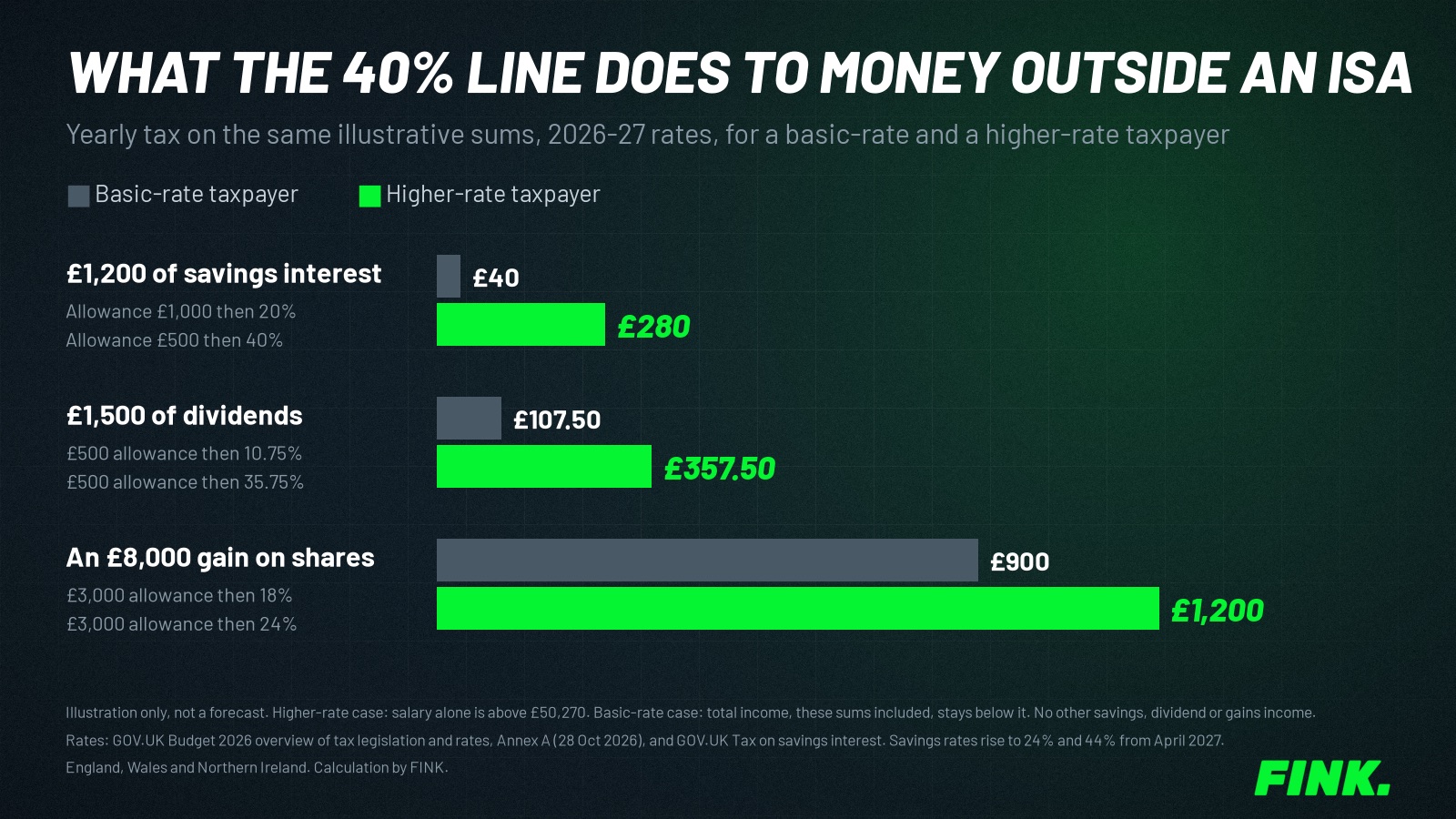
Here's an illustration. Say you have £1,200 of interest from savings accounts, £1,500 of dividends from shares held outside an ISA and an £8,000 gain from selling shares, all in 2026-27. Your salary alone is above £50,270. We compare that with someone on a lower salary, where all of it stays inside the basic rate band.
- Interest. The first £500 is tax-free. The other £700 is taxed at 40%, which is £280. A basic-rate taxpayer gets a £1,000 allowance, so they'd pay 20% on the other £200, which is £40.
- Dividends. The first £500 is tax-free. The other £1,000 is taxed at 35.75%, which is £357.50. At the basic rate it's 10.75%, so £107.50.
- Gains. The first £3,000 is tax-free. The other £5,000 is taxed at 24%, which is £1,200. At the basic rate it's 18%, so £900.
That's £1,837.50 against £1,047.50, an extra £790 for the same money. From April 2027 the interest line gets worse again. At 44% the £700 costs £308. At the new 24% basic rate the £200 costs £48.
None of this applies inside an ISA. Government guidance says you don't usually pay tax on interest from ISAs (GOV.UK) or on dividends from shares in an ISA (GOV.UK). Shares held in an ISA are also exempt from capital gains tax (GOV.UK). The fuller picture of how dividends are taxed inside and outside an ISA, including what different portfolio sizes save, is in its own guide.
Where do ISAs and pensions fit when thresholds are frozen?
They're the two main shelters and the freeze makes both more valuable for anyone near the line. The OBR expects people to use ISAs more.
On ISAs, look at the OBR's costing of this Budget's extra 2 percentage point rise in savings tax. It assumes a "behavioural response, primarily reflecting additional usage of other tax advantaged assets, such as Individual Savings Accounts". That cuts the expected yield by around £0.2 billion a year (paragraph 3.17). In other words, the forecaster expects savers to move money into ISAs as the tax outside them rises.
Pensions work differently. Contributions can bring your taxable income back below £50,270. Higher-rate relief is worth more than basic-rate relief. That's covered properly in how pension tax relief works against an ISA, so we won't repeat it here.
The same goes for the £100,000 taper, where the personal allowance falls by £1 for every £2 of income above £100,000 (GOV.UK).
If you already hold shares outside an ISA, a bed and ISA is how you move them in. You sell and buy back inside the ISA, as covered in moving existing shares into an ISA. That sale can itself trigger a gain, which is taxed at 24% for a higher-rate taxpayer.
Is there a case for freezing thresholds?
Yes. The case is worth hearing before treating the freeze as pure bad news. The case rests on revenue, on where the starting point was and on the fact that the freeze has an end date.
- It raises a lot of money. The OBR's own sums put an extra £2.5 billion a year on receipts for each point of earnings and inflation growth, compared with CPI uprating (paragraph 4.14). Raising that through headline rates would hit everyone, including people on low incomes.
- The 2021 starting point was high. The threshold was raised from £46,350 in 2018-19 to £50,000 in 2019-20, well above inflation. Higher-rate taxpayers fell by 400,000 that year (HMRC Table 2.1). Part of the freeze unwinds that.
- It ends. The OBR expects thresholds to "return to being uprated by CPI from April 2031" (paragraph 4.13).
The case against comes from the same document. By the OBR's estimate, the income tax and National Insurance freezes from 2022-23 to 2030-31 could cut labour supply by 215,000 in average-hours equivalent terms by 2030-31. Its reason is that each extra hour of work is taxed more (paragraph 4.14). And for savers, a frozen threshold combined with higher savings tax rates from April 2027 means the tax on money outside a wrapper rises on two fronts at once.
What's a sensible way to think about this as an investor?
Your tax band is part of what you own. The same holding can be worth noticeably less after tax depending on which side of £50,270 you sit and which wrapper it's in.
At FINK we see it as a yearly check rather than a one-off fix. The questions are simple. Roughly where will taxable income land this tax year, interest included? What's still held outside an ISA or pension and what does that cost at that rate? It's a short job and it belongs with running a stocks and shares ISA as a process.


