

If you hold an S&P 500 tracker you already own a fat chunk of the AI build-out, whether or not you ever meant to buy a chip maker. On 19 November 2026 about 44p of every £1 in the biggest S&P 500 fund sat in the 42 companies JPMorgan counts as AI stocks and the Magnificent Seven on their own took about 32p. That's handy if you wanted a stake in AI without betting the house on one company and exactly why you should count what you own before buying more of it with a shinier label.
Quick answer
Between about a third and a half, depending on what you count as AI. On State Street's SPY holdings for 19 November 2026 the Magnificent Seven made up 32.5% of the S&P 500 and JPMorgan's 42-company AI list made up 44.0%. Capital Economics puts the share with some positive AI exposure at around 50%.
How much of the S&P 500 is AI, company by company?
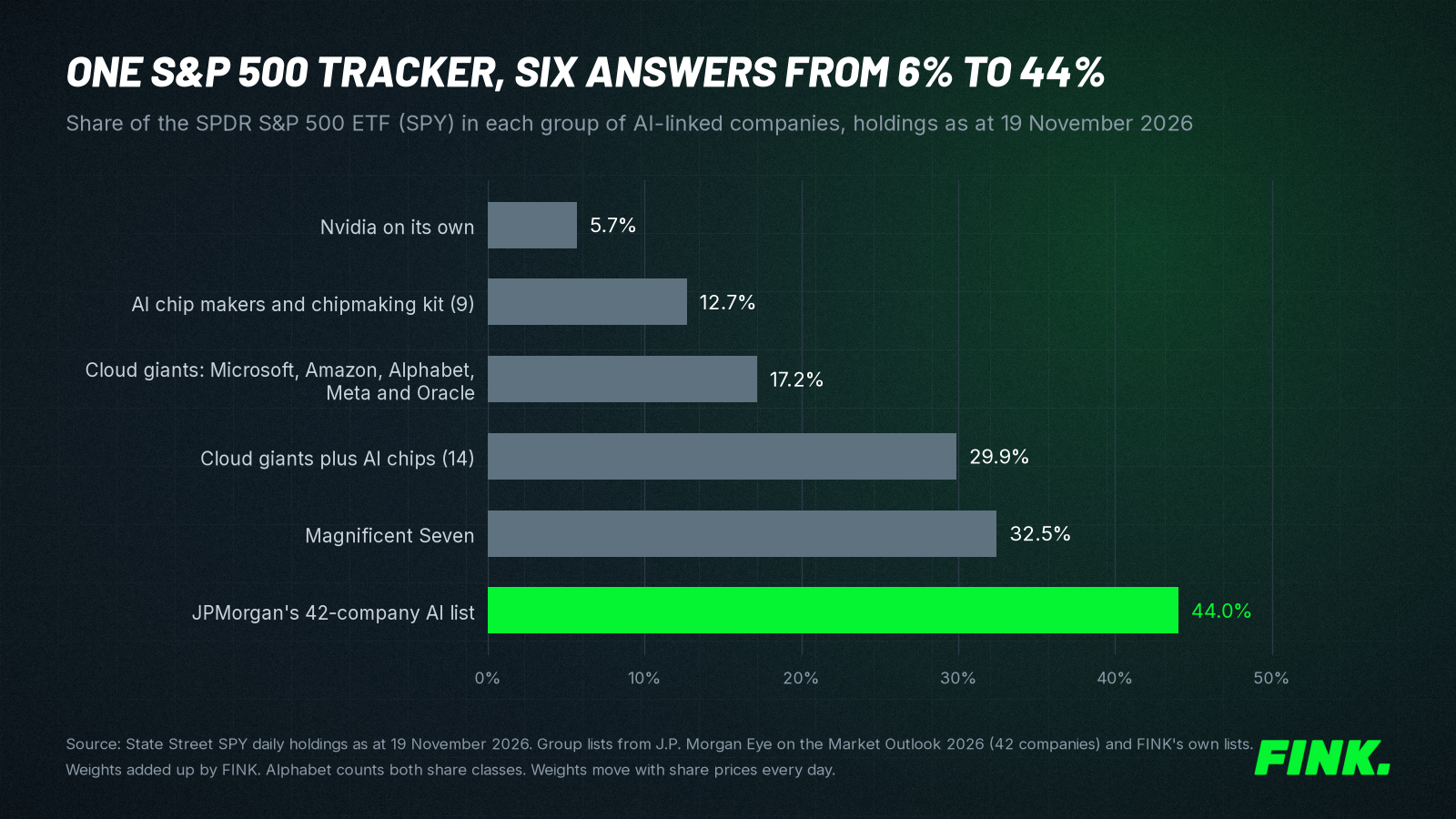
It depends where you draw the line and move the line an inch and the answer moves a mile. I took State Street's daily holdings file for SPY as at 19 November 2026 (SPY holdings) and added up the weights for six common ways of defining an AI stock.
| What you count as AI | Companies | Share of the S&P 500 | In £10,000 of a tracker |
|---|---|---|---|
| Nvidia on its own | 1 | 5.7% | £570 |
| AI chip makers and chipmaking kit | 9 | 12.7% | £1,270 |
| Cloud giants (Microsoft, Amazon, Alphabet, Meta, Oracle) | 5 | 17.2% | £1,718 |
| Cloud giants plus AI chips | 14 | 29.9% | £2,988 |
| Magnificent Seven | 7 | 32.5% | £3,246 |
| JPMorgan's AI list | 42 | 44.0% | £4,404 |
The chip group is Nvidia, Broadcom, AMD, Micron, Intel and Marvell plus the kit makers Applied Materials, Lam Research and KLA. The JPMorgan list is the 42 companies Michael Cembalest published in his Outlook 2026 on 1 January 2026, running from Nvidia and Apple down to power companies such as Vistra and electrical kit makers such as Eaton and GE Vernova.
Think of a pick and mix bag where you took one sweet from all 500 jars, then weighed it at the till and found 42 of them made up nearly half the weight.
Why do the estimates range from a third to a half?
Because nobody agrees on what an AI company is and ask five fund managers for a list and you'll get six lists with a fund attached to each. Capital Economics found around 50% of the S&P 500 by market value is positively exposed to AI in some form (Capital Economics, reported 22 November 2026). KashVector measured how share prices actually moved against AI funds over the year to 2 November 2026 and got 37% (KashVector, 3 November 2026).
Apple is where it gets daft. JPMorgan counts it as a direct AI stock, while KashVector found its share price had no real link to AI moves at all, scoring minus 0.04 and Apple was the biggest holding in SPY on 19 November at 8.22%. A company's index weight isn't its AI revenue either, since Amazon still flogs an awful lot of stuff online and most of Alphabet's money comes from adverts.
How much of the S&P 500 is Nvidia?
Nvidia was 5.70% of SPY on 19 November 2026, about £570 in every £10,000. Seven weeks earlier it was the fund's biggest holding at 8.38% (SPY fact sheet, 30 September 2026). Nobody expects the boring option in their ISA to swing like that inside two months, but weights follow share prices, so every number in this article has a date stuck to it.
How concentrated is the S&P 500's top 10?
Close to the most it's been in decades. On 19 November the ten biggest companies held 38.6% of SPY, against about 19% at the end of 2015 (RBC Wealth Management, The Great Narrowing) and S&P Dow Jones Indices says a top 10 near 40% hadn't been seen since the mid-1960s (S&P DJI, 13 May 2026). In 1990 the top 10 included IBM, Exxon, General Electric and Philip Morris, so your dad's index fund was a computer maker, an oil major, GE and a fag company and nobody called that a bet on one idea.
To be fair, J.P. Morgan Asset Management puts the top ten at just over a third of the index's earnings (J.P. Morgan Asset Management). A global tracker doesn't get you out of it much either, because the US was 72.77% of MSCI World on 30 October 2026 with Apple, Nvidia and Microsoft its top three (MSCI World fact sheet). Hold both and the same names turn up twice, so count them once across the lot.
What should you check before adding an AI fund or AI shares?
Count what you already own, because this is a sizing question dressed up as an AI question. Say you have £10,000 in an S&P 500 tracker. On the 19 November weights £1,270 of that sits in AI chip makers and kit. Stick another £2,000 into a chip-only fund and your chip exposure goes from 12.7% of your money to about 27%, £3,270 out of £12,000. You've more than doubled it and the name on the second fund won't tell you that. Buying more of what you already own in bulk and calling it diversification is how people get shafted, so if you want it, decide it on purpose.
The check needs one spreadsheet and a cup of tea.
- Download your fund's full daily holdings file from the provider's website, not the top 10 on the factsheet.
- Write down your definition of an AI company before you look, so the list doesn't grow to fit the answer you wanted.
- Add up the weights on your list, counting both of Alphabet's share classes.
- Multiply by what you hold in that fund, then add any shares or other funds holding the same companies.
- Write the date on it and redo it when you next rebalance.
Size is one of the five layers we run every idea through at FINK and our guide to how much to put in any one stock covers counting what you hold through funds. If the tracker is your core and the AI holding a satellite, see splitting an ISA into core and satellite.
AI also needs power stations and miles of new cable, covered in who gets paid for the grid behind AI. Our free report The $106 Trillion Trade follows that money down to the grids and kit makers.
Your tracker has already made a big call on AI for you, so know how big before you make another one.
Questions people ask
What percentage of the S&P 500 is the Magnificent Seven?
32.5% on 19 November 2026 from SPY holdings, with Apple 8.22%, Microsoft 5.97%, Nvidia 5.70%, Alphabet 4.66%, Amazon 4.08%, Meta 2.12% and Tesla 1.70%.
What are the top 10 holdings in the S&P 500?
On 19 November 2026 they were Apple, Microsoft, Nvidia, Alphabet, Amazon, Broadcom, Meta, Eli Lilly, Berkshire Hathaway and Tesla, with 38.6% of SPY between them.
Sources
See the sources line in the footer.
This is education, not financial advice. Investments can fall as well as rise, and you may get back less than you put in.


