What's a core and satellite portfolio?
It's a portfolio with two parts: a large, broad and cheap core designed to track the market, plus a smaller set of satellites where you take deliberate, higher-risk positions. The idea is to get market-like results on most of the money while leaving room for your own ideas.
In an ISA, the core is usually one or two index funds or ETFs. A global tracker is the most common choice. Satellites can be individual shares, investment trusts, smaller-company funds or regional and thematic funds.
interactive investor's Kyle Caldwell described the approach in an April 2026 episode on building an ISA from scratch. He suggested "around 80% in core holdings, such as a global fund", with the remaining 20% in satellites such as smaller-company or emerging market funds. In a separate Portfolio Dilemma column, ii noted that a tracker forming the backbone of a portfolio "could even be 70%".
Why is the core usually a tracker?
Because most actively managed funds have trailed their index over long periods. That's the finding of S&P Dow Jones Indices' SPIVA research, which has tracked active funds against their benchmarks for more than 20 years.
The SPIVA Europe Year-End 2025 Scorecard covers funds sold to UK investors in sterling. Over the ten years to 31 December 2025:
| Fund category (GBP) | Share of active funds that underperformed over 10 years |
|---|---|
| Global equity | 97.0% |
| UK equity | 93.0% |
| UK large and mid-cap equity | 94.9% |
| UK small-cap equity | 76.6% |
Source: SPIVA Europe Year-End 2025 Scorecard, S&P Dow Jones Indices. SPIVA counts funds that closed or merged during the period, which removes survivorship bias.
Two things stand out. In the broad global category, where most core funds sit, only about 3 in 100 active funds kept up with their benchmark over ten years. In UK smaller companies, the share that kept up was much higher at about 23%. That's one reason some investors use trackers for the core and consider active management only for narrower satellite areas.
The counter-argument
SPIVA measures the average fund, not the best one. Some active funds do beat their index over long periods. The trouble is picking them in advance. A tracker core accepts the market result in exchange for not having to make that call.
There's also behavioural evidence that private investors who trade most tend to do worst, which our guide to individual shares or funds sets out. A core that's bought and left alone limits how much of the portfolio is exposed to that habit.
Is a tracker core actually diversified?
Less than many people assume. It depends heavily on which index you pick. We checked the published holdings of five iShares trackers widely held in UK ISAs.
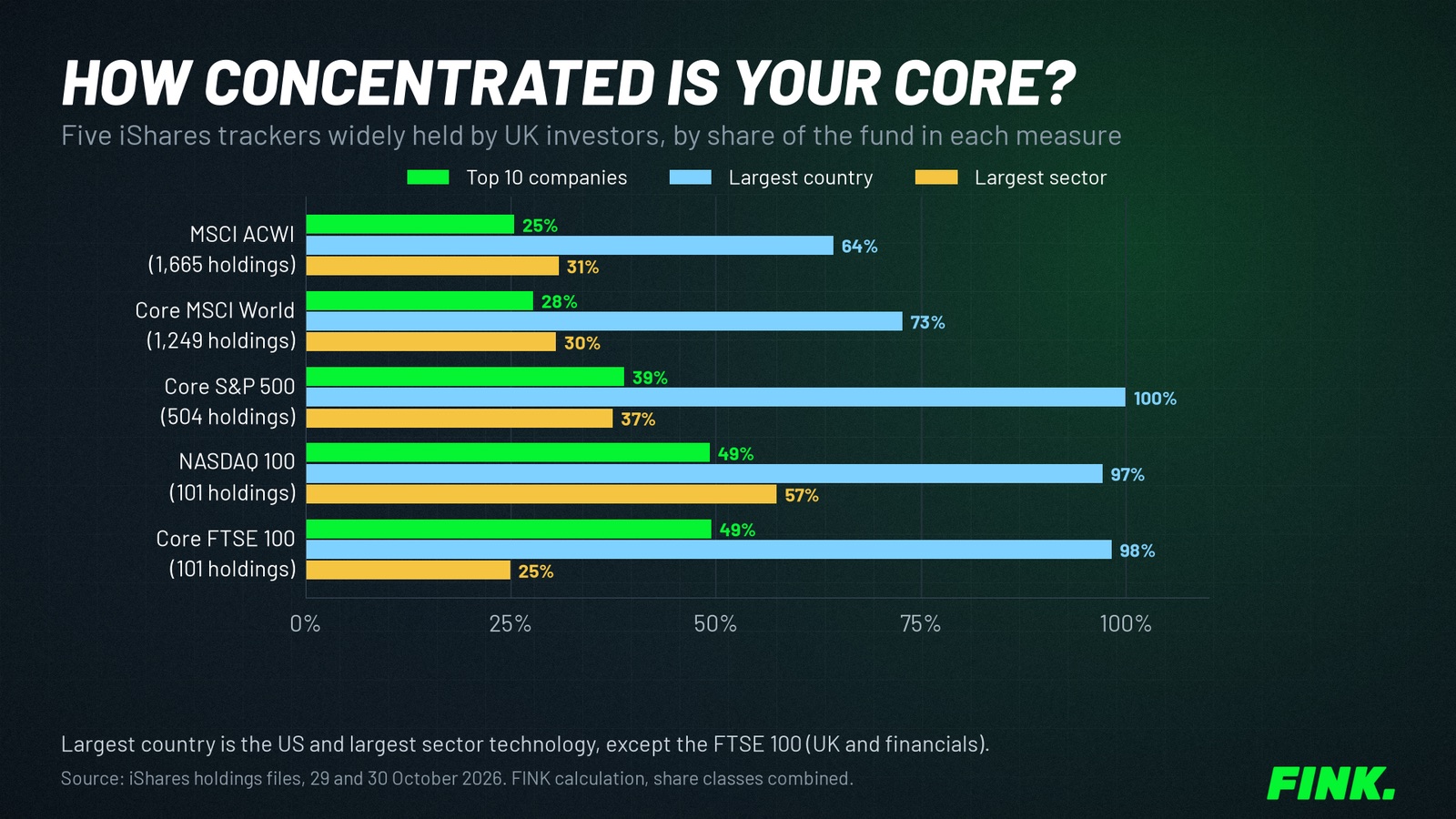
The detail behind the chart:
| Tracker | Holdings | Top 10 companies | US | UK | Technology |
|---|---|---|---|---|---|
| iShares MSCI ACWI | 1,665 | 25.4% | 64.3% | 3.0% | 30.8% |
| iShares Core MSCI World | 1,249 | 27.7% | 72.7% | 3.4% | 30.5% |
| iShares Core S&P 500 | 504 | 38.8% | 99.9% | 0% | 37.4% |
| iShares NASDAQ 100 | 101 | 49.2% | 97.1% | 0.4% | 57.4% |
| iShares Core FTSE 100 | 101 | 49.4% | 0% | 98.2% | 1.0% |
Method: equity lines in each holdings file, with share classes of the same company combined (for example Alphabet A and C). Holdings counts are lines in the file. Weights as of 29 October 2026 for Core MSCI World and 30 October 2026 for the others.
What this means for building a core:
- A global fund is the broadest option on these measures, though it still puts roughly three-quarters in US companies because that's how the index is weighted.
- An S&P 500 tracker is a US fund. Its top 10 companies were 38.8% of the fund. If it's your whole core, you have no direct exposure outside the US.
- A FTSE 100 tracker is concentrated in a different way. Shell, HSBC and AstraZeneca alone made up 26% of it.
- A NASDAQ 100 tracker behaves more like a satellite. It's 57% technology, with nearly half in ten companies.
For comparison, a regulated UCITS fund generally can't hold more than 10% in one company, or 20% for an index tracker, under the FCA's spread rules. None of these trackers is near those limits for a single name. The concentration shows up at the level of countries, sectors and the top ten.
How much should go in the satellites?
Guides commonly use 10% to 30%. A better test is what a bad outcome in the satellites would do to the whole ISA. This is arithmetic, not a forecast.
| Split (core / satellite) | Satellite share of a £20,000 ISA | Hit to the whole ISA if satellites fall 50% | Hit if satellites fall 50% and the core falls 20% |
|---|---|---|---|
| 90 / 10 | £2,000 | 5% | 23% |
| 80 / 20 | £4,000 | 10% | 26% |
| 70 / 30 | £6,000 | 15% | 29% |
Method: satellite share × 50%, plus core share × 20% for the last column. Illustration only.
The last column is the one that matters. In a broad sell-off the core falls too. That usually dominates the result. The satellite share changes how much worse it gets and how much your own decisions matter.
How many satellites?
Once you've chosen the satellite share, the number of holdings inside it sets each position's size. On a £20,000 ISA with £4,000 in satellites:
- Two satellites would be £2,000 each, 10% of the ISA.
- Four would be £1,000 each, 5% of the ISA.
- Eight would be £500 each, 2.5% of the ISA.
interactive investor's Portfolio Dilemma column suggests positions under about 2% "will do very little to move the dial". Our guide to how much to invest in one stock goes deeper on sizing individual positions.
What are satellites for?
A satellite needs a job. Without one, the satellite slice tends to fill up with whatever was in the news. The portfolio then drifts into a collection of unrelated bets.
Common jobs for satellites:
| Satellite type | Typical job | Trade-off |
|---|---|---|
| Individual shares | Back your own research on specific companies | Company-specific risk, research time |
| Smaller-company fund | Add exposure a large-cap core underweights | More volatile, often higher fees |
| Regional fund | Add a region the core underweights, such as the UK | Can duplicate what the core holds |
| Thematic fund | Back a theme such as healthcare or energy | Themes often become crowded and expensive |
| Investment trust | Access specialist managers or assets | Can trade at discounts or premiums to assets |
At FINK we tend to look at it this way: the satellite is where your process gets tested. If you can't write down why a holding is there and what would make you sell it, it probably belongs in the core instead. The individual shares or funds guide looks at that choice in more detail.
Do the satellites overlap with the core?
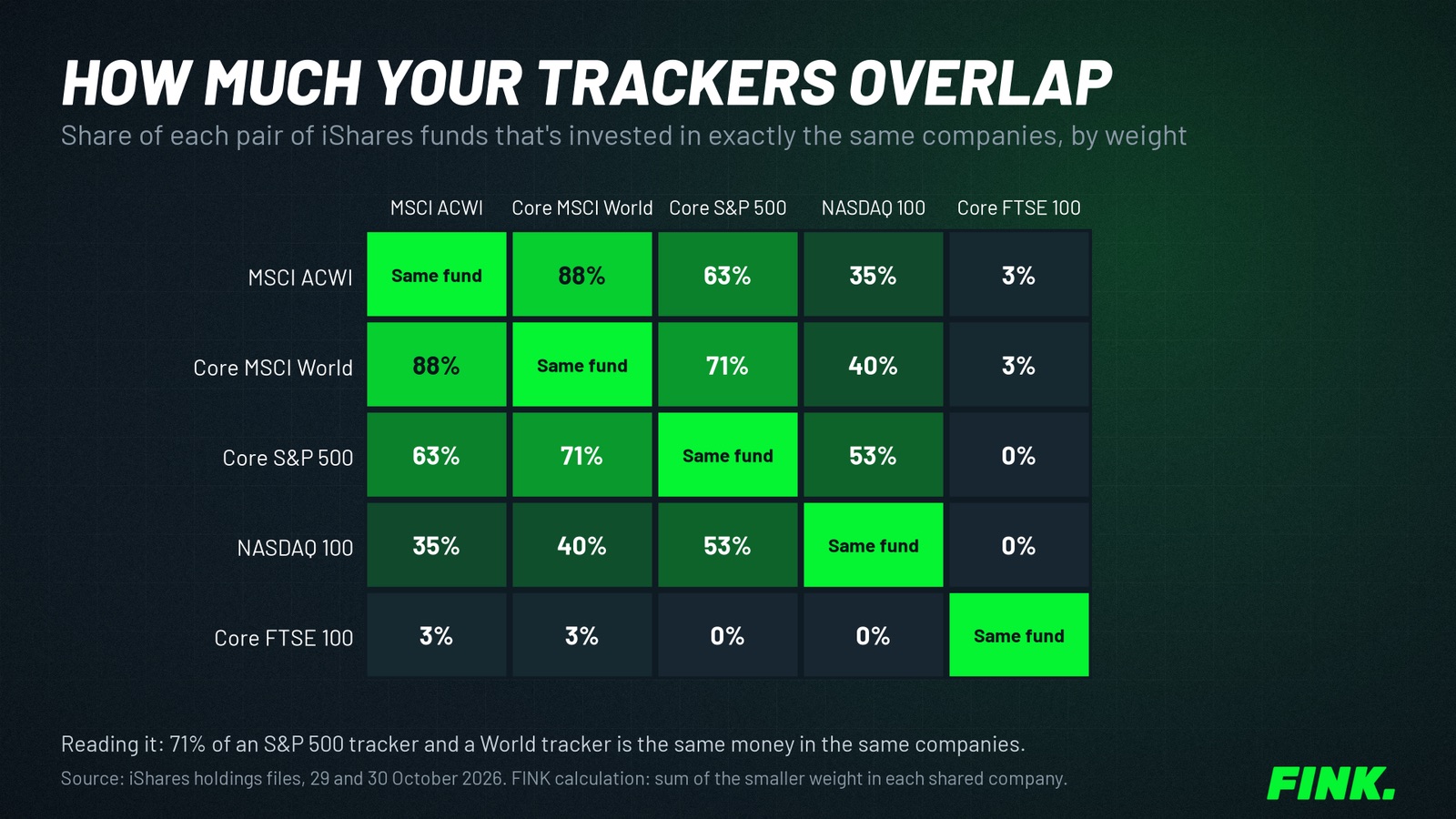
Often, yes. The biggest US companies sit inside almost every global and US tracker, so buying them as satellites adds to exposure you already have.
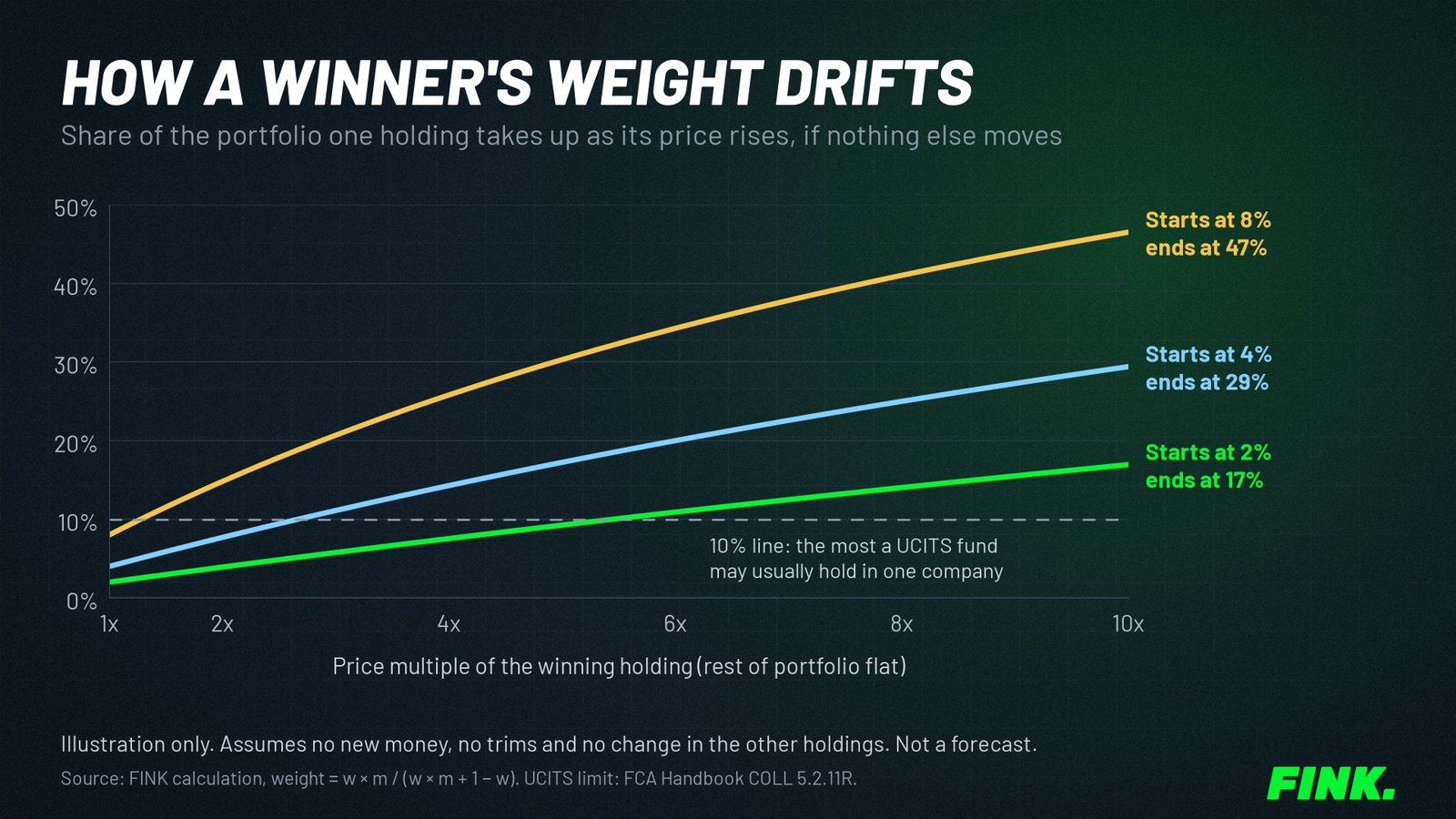
In a £20,000 ISA with £16,000 in a global tracker, a £1,000 satellite in Apple roughly doubles what you already own of it, because Apple was 5.61% of the iShares Core MSCI World on 29 October 2026. Our position sizing guide shows how to add up that look-through exposure before setting a satellite's size. If the satellites are winning, when to take profits covers trimming without guessing.
The same goes for funds. A global tracker and an S&P 500 tracker share most of their largest holdings. Our ISA fund overlap guide measures how much of one fund sits inside another.
How do you rebalance a core and satellite ISA?
Mostly with new money. Because the ISA allowance is £20,000 a year, fresh contributions are the cheapest way to bring the split back to target.
- Check the split once a year, for example at the start of the tax year.
- Direct new money to whichever side is under target.
- Trim only when the gap is large. Inside a stocks and shares ISA there's no capital gains tax on sales, but there are dealing costs and spreads.
- Review each satellite against its job. A satellite that's grown large may need trimming. One whose reason has gone may need selling.
- Write down any change to the target split and why you made it.
Our guide on how to rebalance a stocks and shares ISA covers the mechanics. Our ISA strategy guide shows where this fits in a full annual process.
When does core and satellite not suit someone?
When the satellites aren't really chosen, or when the investor wants no active decisions at all. It's a structure, not a guarantee of better results.
- No time or interest in research. An all-core portfolio of one global fund does the job with fewer decisions.
- Satellites that are just more trackers. You may be adding cost and overlap without adding anything different.
- A very small pot. Satellites can be too small to matter once dealing charges are included.
- Difficulty selling. If you'd find it hard to sell a satellite that's gone wrong, the structure only helps if you decide what would make you sell before buying.