Should you take profits or let winners run?
The research leans towards letting winners run more than most people do, but with limits on how large any one holding can get. Both halves come from evidence.
What the evidence says about selling winners
Terrance Odean's 1998 study of selling behaviour in the Journal of Finance looked at the trading records of 10,000 accounts at a US discount broker. He found investors were much more likely to sell a share that was up than one that was down. This pattern is called the disposition effect.
It cost them. Over the following year, the winners they'd sold did 2.35 percentage points better than the market on average. The losers they'd kept did 1.06 points worse. Our guide on when to sell a stock sets that study next to newer data on professional fund managers, who showed the same weakness when selling.
Two other findings lean the same way. Shares that have done well over the past three to twelve months have tended to keep doing better for a while. That's the momentum effect (Jegadeesh and Titman, 1993). And a tiny share of companies has produced most of the stock market's long-run gains (Bessembinder, 2018), which we cover in the position sizing guide. If the biggest gains come from a few extreme winners, selling them early can mean selling the part of the portfolio that matters most.
The counter-evidence
The same literature also finds limits. Werner De Bondt and Richard Thaler asked whether the stock market overreacts in the Journal of Finance in 1985. They sorted US shares by their returns over the previous three years. The portfolios of past winners went on to earn about 5.0% less than the market over the next 36 months.
Three details in that paper matter for profit-taking:
- The effect was lopsided. Past losers rebounded far more (19.6% ahead of the market) than past winners lagged. Selling a big winner gave up less, on average, than holding a big loser cost.
- It took time to show. Twelve months in, the gap between winners and losers was only 5.4% and not statistically significant. Most of it appeared in years two and three.
- It's about extremes. The study looked at the 35 best and worst performers each time, not at every share that's gone up.
So the reversal evidence is a case for watching very large multi-year winners closely, not for selling every share that's doubled. Our guide to selling a stock at a loss covers the losers' side of the same research.
Fund managers interviewed by interactive investor describe that tension directly. One manager said he'd recycle capital from a share if he thought "if everything goes right, I could make 10%, but if there's a problem, I could lose 30%".
The Scottish Mortgage team gave the other side. Amazon had eight falls of more than 10% while they held it, including losses of more than 50%. It still multiplied their original investment.
How we read it
At FINK we take two things from this. Selling a winner because it's up is a weak reason on its own. Letting a winner grow without any limit is a different risk that the momentum research doesn't cover.
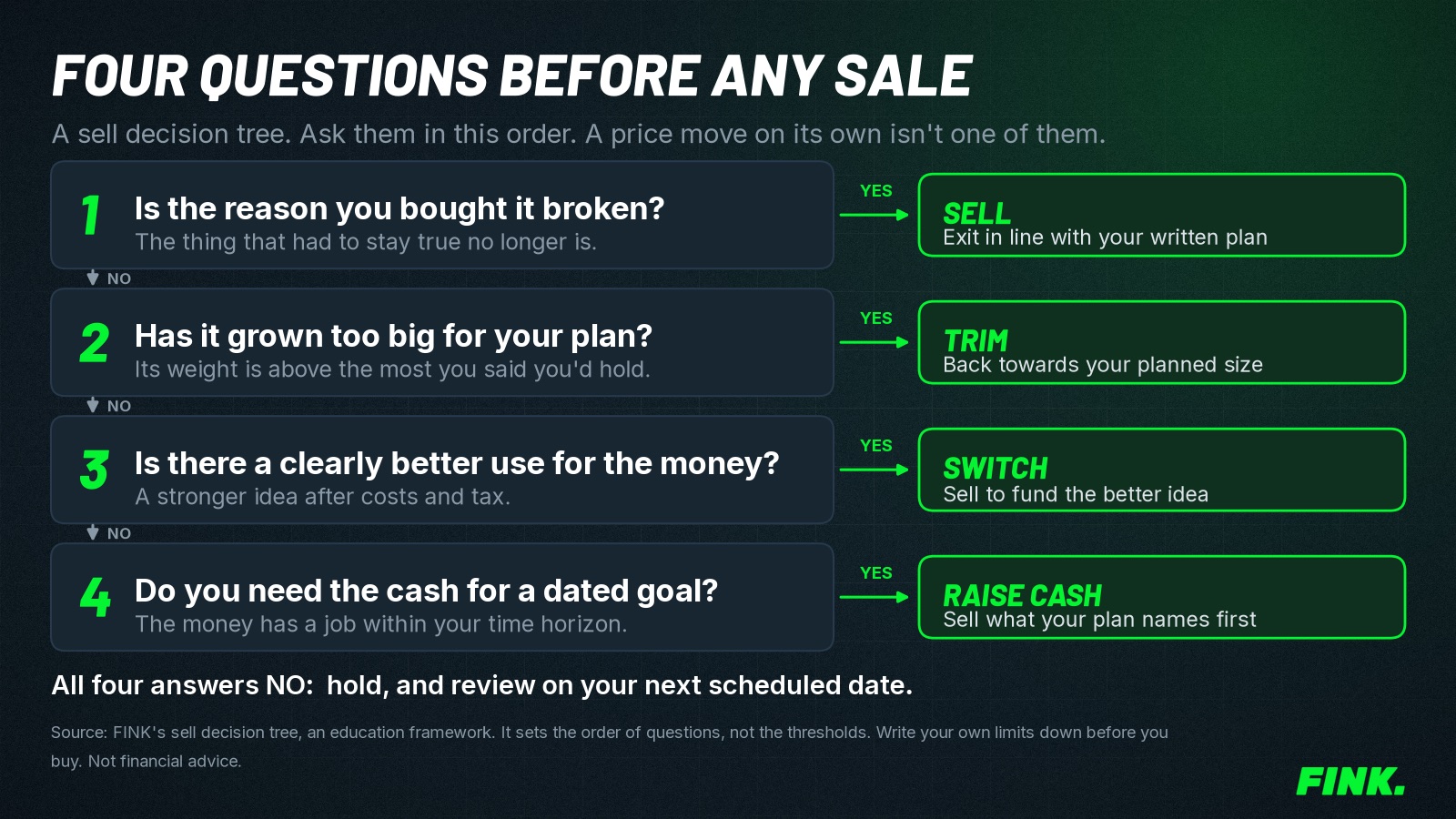
So the useful starting point isn't whether to take profits. It's what's changed since you bought.
What does taking profits actually do to your outcome?
Selling part of a winner gives up some upside in exchange for protection on the downside. The chart shows the arithmetic for one common approach, selling half after a holding has doubled.
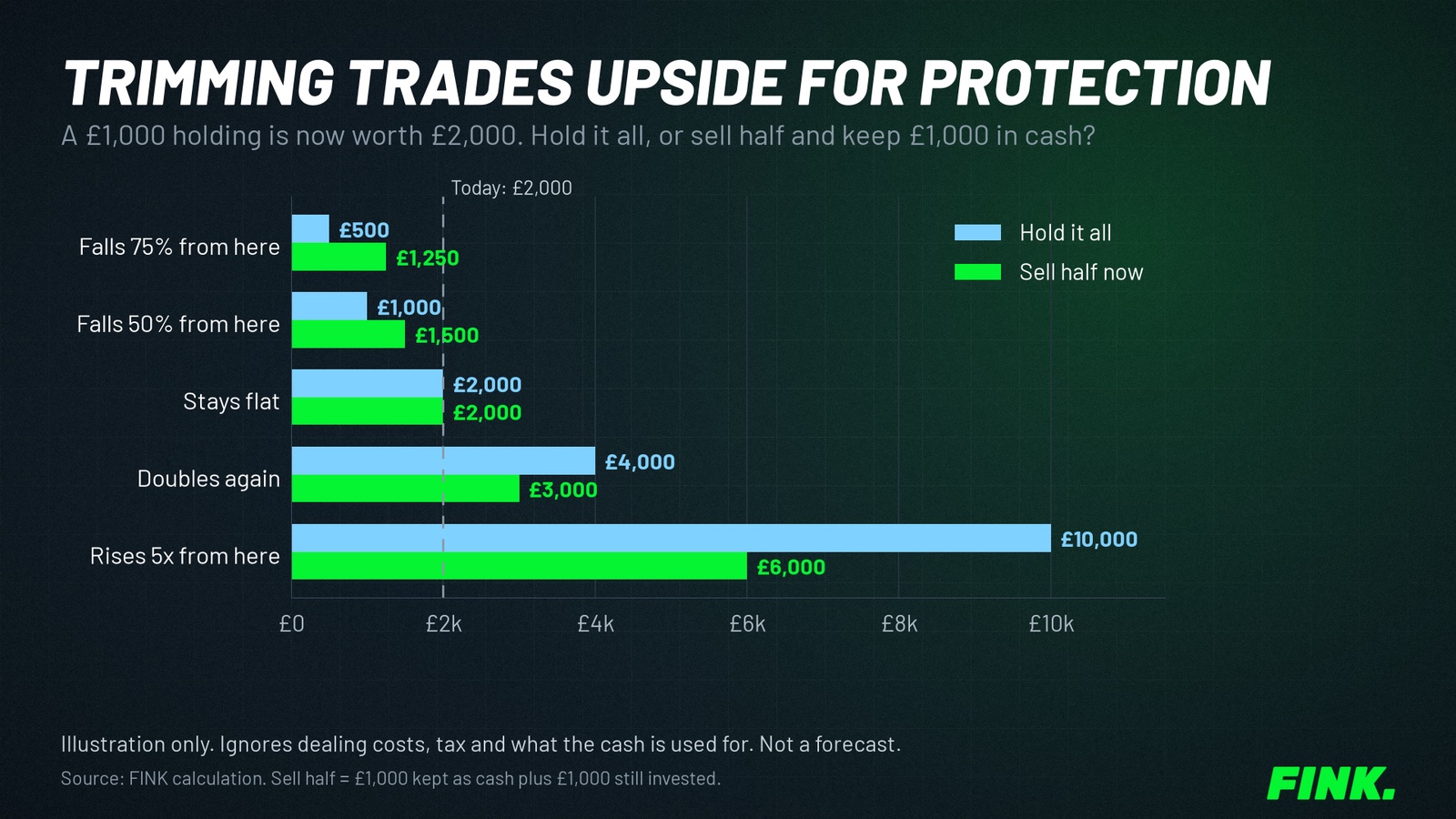
Reading across the outcomes:
| What the share does next | Hold all | Sell half now | Difference |
|---|---|---|---|
| Falls 75% | £500 | £1,250 | +£750 for selling |
| Falls 50% | £1,000 | £1,500 | +£500 for selling |
| Stays flat | £2,000 | £2,000 | £0 |
| Doubles again | £4,000 | £3,000 | −£1,000 for selling |
| Rises fivefold | £10,000 | £6,000 | −£4,000 for selling |
Method: hold all = £2,000 × the move. Sell half = £1,000 cash + £1,000 × the move. No dealing costs, tax or interest on the cash.
The pattern is the point.
Trimming wins when things go wrong and loses when they keep going right. Because the research on skew says the biggest wins are rare but very large, the cost of trimming a true long-term winner can be big. Because most shares disappoint, the protection is often worth having too. That's why it's a judgement about each holding, not a rule for all of them.
When do investors usually take profits?
Most frameworks boil down to five triggers. None is right for everyone. They're worth knowing because they answer different questions.
| Trigger | What it checks | Strength | Weakness |
|---|---|---|---|
| Thesis broken | Whether the reason for buying still holds | Ties selling to the business, not the price | Needs a written thesis to check against |
| Position too big | Whether it's past the most you'll hold in one company | Controls risk without forecasting | Can trim the best ideas early |
| Valuation stretched | Whether the price assumes more than the business can deliver | Uses fundamentals | Valuations can stay high for years |
| Better use of the money | Whether you'd rather own something else | Forces comparison | Easy to rationalise switching |
| Life needs | Whether you need the money within a few years | Matches investments to goals | None, if the need is real |
The trigger missing from that list is "it's gone up a lot". On the evidence above, that alone is the weakest reason.
Thesis broken
This is the cleanest reason to sell, whether the share is up or down. It works only if you wrote down why you bought before you bought. Our investment thesis template sets out a simple format.
Position too big
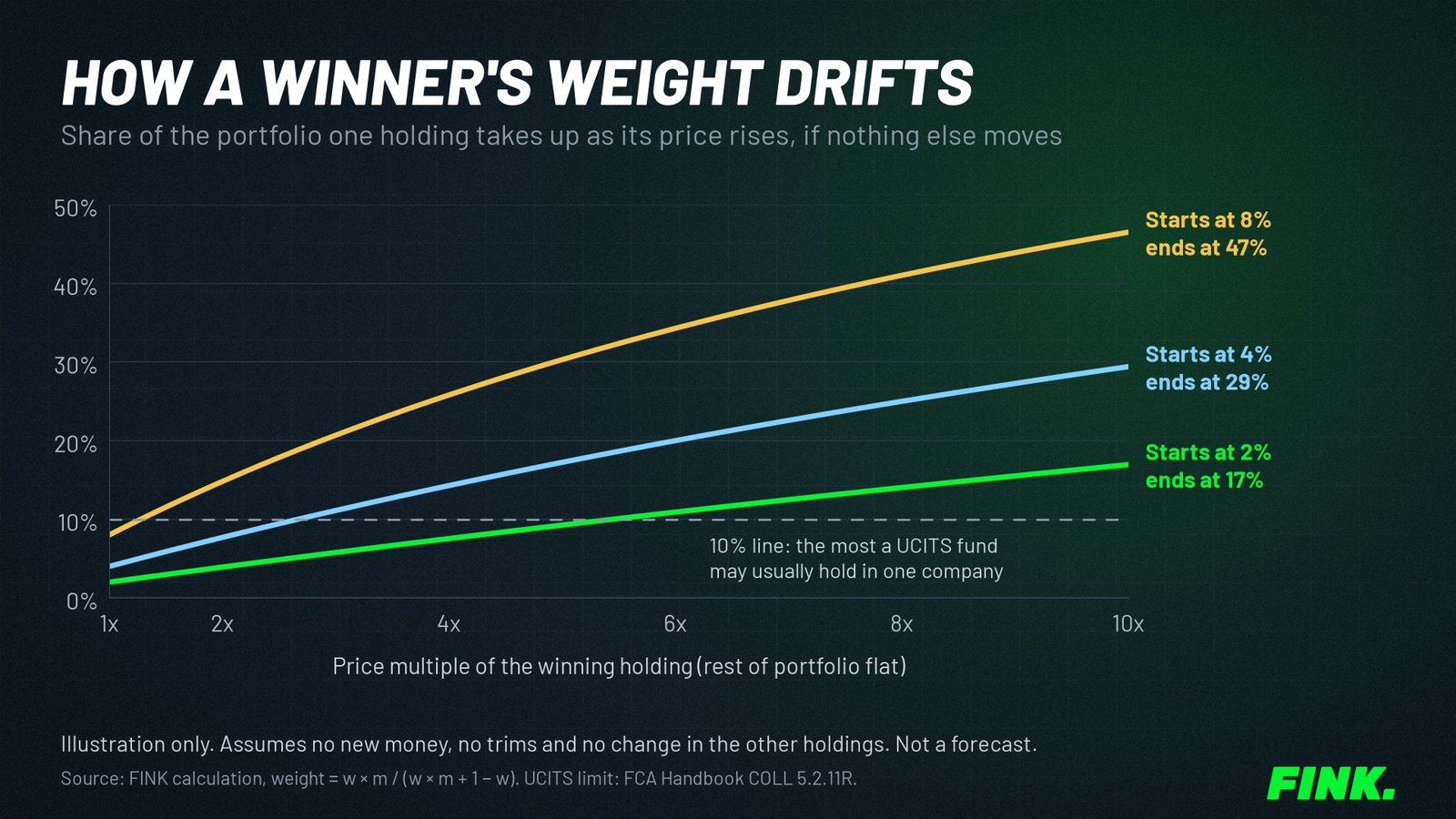
A holding that grows can come to dominate a portfolio without any further buying. Our guide to sizing one stock in a portfolio shows how a 4% holding becomes almost 30% if it rises tenfold while the rest stays flat. Setting a ceiling in advance turns profit-taking into a size question, which is easier to answer calmly than a forecast.
interactive investor's Portfolio Dilemma column in August 2026 put the case plainly. If one share reaches 20% of a portfolio, the stock-specific risk is substantial. It suggested deciding the position size you're comfortable with and rebalancing perhaps every year or after big moves.
Valuation stretched
Some investors trim when the share price has risen much faster than profits. One manager in the ii piece sold after a share rose 40% while its earnings grew 7%. The weakness is timing. A high valuation says little about the next year, as the momentum research shows.
How much should you sell when taking profits?
Common approaches are trimming back to a target size, selling enough to recover the original stake or selling a fixed fraction. Each gives a different balance of upside kept and risk removed.
- Trim back to target. Sell only the amount above your chosen full size. This keeps the holding meaningful and removes only the excess.
- Take out the original stake. Sell enough to get back what you put in. What's left is all gain, which some investors find easier to hold through falls. It's the "sell half after a double" case in the chart.
- Sell a fixed fraction. For example a quarter or a third each time a review is triggered. It spreads the decision over time.
- Sell it all. Usually reserved for a broken thesis or a life need, not for a share that's simply done well.
Peter Lynch's line, quoted by ii, compares selling winners to top up losers to "pruning the roses to feed the weeds". It's a fair warning about option 4 applied to good businesses. The answer is to be clear about which of the four you're doing and why before you trade.
How does tax affect taking profits in the UK?
Inside a stocks and shares ISA, taking profits has no tax cost. Outside it, the size and timing of sales matters. That changes which account you take profits from.
Inside an ISA
Trimming inside an ISA has no capital gains tax and doesn't need reporting. The cash can be reinvested without touching your £20,000 allowance, as long as you don't withdraw it. Our guide to selling shares in a stocks and shares ISA covers settlement and the costs that still apply.
Outside an ISA
In a general investment account, gains above the annual exempt amount are taxable. For 2026 to 2027 the exempt amount is £3,000 and the rates on shares are 18% within the basic rate band and 24% above it, per GOV.UK.
Profit-taking is usually done in slices, which makes timing across tax years worth knowing. Say you want to take £10,000 of gains from a general account holding (an illustration, not a return claim).
| Taking £10,000 of gains | Taxable gain | Tax at 18% | Tax at 24% |
|---|---|---|---|
| All in one tax year | £7,000 | £1,260 | £1,680 |
| £5,000 before 5 April, £5,000 after | £2,000 + £2,000 | £720 | £960 |
| Same trim inside an ISA | £0 | £0 | £0 |
Method: (gain − £3,000 annual exempt amount) × rate, per tax year. Assumes no other gains or losses and the whole gain in one band. Basic-rate taxpayers can pay a mix of both rates.
Two practical points follow.
If you hold the same share in both accounts, trimming in the ISA costs nothing in tax. And in a general account, a trim split either side of 5 April uses two years' exemptions, saving £540 or £720 in this example.
The price can move between the two sales, so the tax saving isn't free. Our sell-decision guide has the wider ISA versus general account comparison. If you're thinking of moving holdings into an ISA to shelter future gains, the bed and ISA guide explains how that works.
A profit-taking checklist
Answer these before you sell. Then write the answers down. It takes a few minutes and makes the decision easier to review later.
- Thesis. Why you bought it and whether that's still true.
- Size. Its share of your whole portfolio now, including what you own through funds.
- Ceiling. Whether that's above the limit you set.
- Price versus business. How the share price has moved compared with profits or revenue.
- Fresh eyes. Whether you'd want it at this price and this size if you didn't already own it.
- Amount. How much you'd sell and which of the four approaches that is.
- Account. Which account you'd sell in and the tax cost.
- Cash. What you'd do with the money.
If the honest answer to point 5 is "yes, but smaller", that points to trimming rather than selling out. If it's a clear no because the business has changed, that points to the full exit covered in when to sell a stock.