Do you pay tax when you sell shares in an ISA?
No. Gov.uk is direct about it: you don't pay tax on income or capital gains from investments in an ISA. If you complete a tax return, you don't need to declare them (gov.uk).
The difference shows up when you sell something that's done well. Here's the same sale in two accounts.
| A sale with a £12,000 gain, 2026/27 | Stocks and shares ISA | General investment account (GIA) |
|---|---|---|
| Capital Gains Tax | £0 | £1,620 at 18% or £2,160 at 24% |
| Goes on your tax return | No | Yes if you owe tax, or if total sale proceeds in the year top £50,000 |
| Losses on other holdings | Can't be used | Can reduce the gain |
| Dividends received before the sale | Tax-free | Taxable above the £500 dividend allowance |
How we worked it out. GIA tax = (£12,000 gain − £3,000 annual exempt amount) × rate. That's £9,000 × 18% = £1,620 or × 24% = £2,160, using gov.uk's 2026/27 rates and allowance (rates, allowance).
It assumes no other gains or losses in the year and the whole gain taxed at one rate. Reporting rule from gov.uk. Illustration only.
The flip side is losses. HMRC's guidance for ISA managers says losses on ISA investments can't be set against gains outside the ISA (gov.uk). We cover that in when to sell a stock at a loss.
Does selling and rebuying use your ISA allowance?
No. Your allowance is a limit on how much you pay into ISAs each tax year: £20,000 for 2026/27 (gov.uk). Selling a holding and buying another with the proceeds is moving money around inside the wrapper. Nothing new has gone in, so nothing's counted.
This comes up often on forums like r/UKPersonalFinance, usually from someone who's sold and is worried they've lost their allowance. They haven't. A simple way to think about it:
| Action | Uses allowance? |
|---|---|
| Paying new cash into the ISA | Yes |
| Selling a share and leaving the cash in the ISA | No |
| Using that cash to buy a different share in the ISA | No |
| Dividends paid into the ISA | No |
| Withdrawing cash, then paying it back in (non-flexible ISA) | Yes, the repayment counts |
| Withdrawing cash, then paying it back in the same tax year (flexible ISA) | No, up to the amount withdrawn |
| Transferring the ISA to a new provider using a transfer form | No |
Can you buy and sell as often as you like in an ISA?
Yes. There's no legal limit on how often you trade inside an ISA. Your provider may charge per trade. Every trade has a spread between the buying and selling price.
The more useful question is whether trading more helps. The best-known study of US brokerage accounts found the busiest traders fell well behind after costs (Barber and Odean, 2000). The tax-free status of an ISA removes one cost of trading. It doesn't remove the others, or the chance of making a bad call each time.
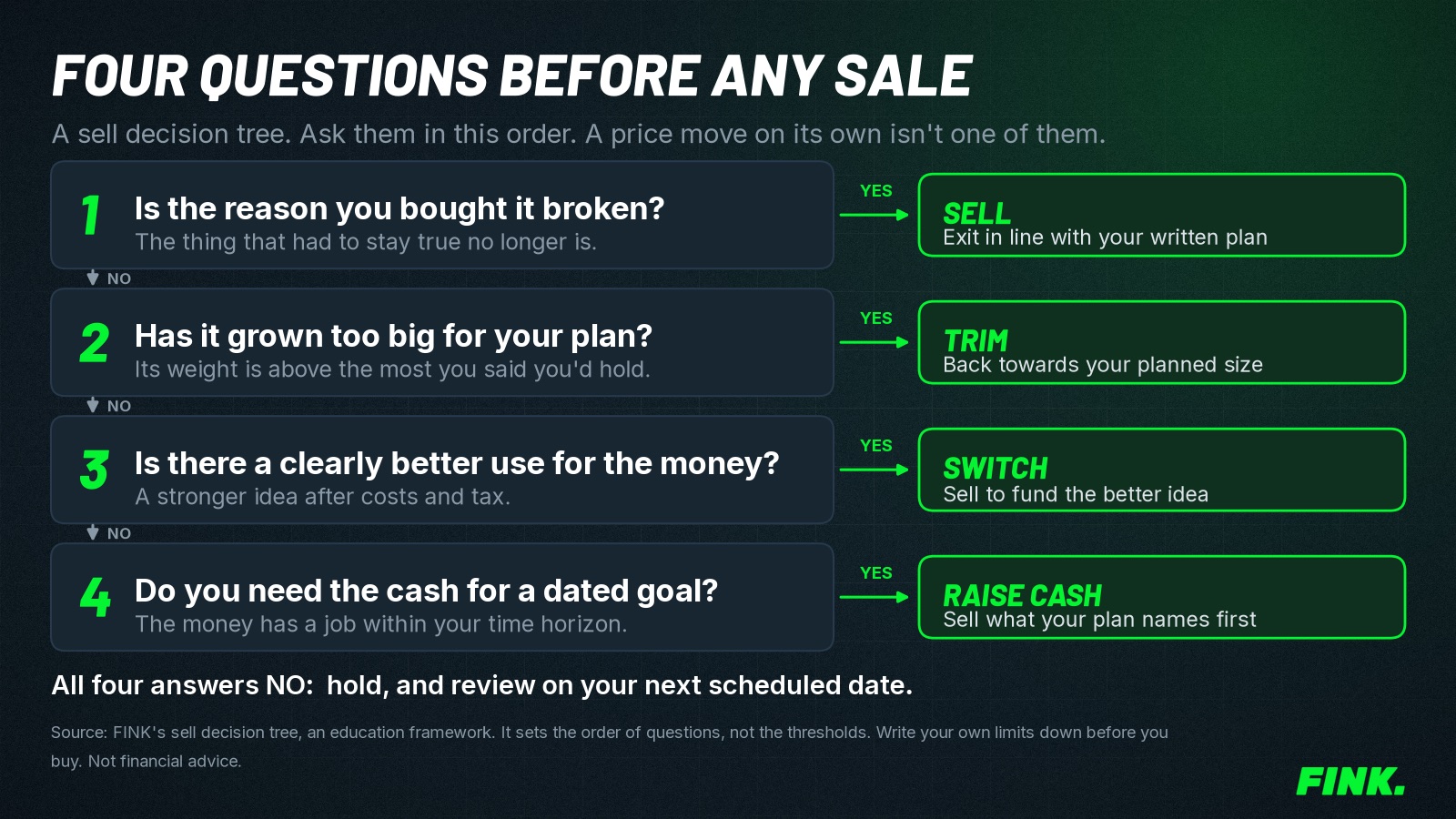
If you're deciding whether to sell a particular holding, our guide to when to sell a stock has a four-question decision tree for it.
How long until the money from a sale is available?
For UK shares, the sale currently settles two business days after the trade date. That's when the cash is formally yours in the ISA. The UK is moving to settlement one business day after trade (T+1) from 11 October 2027 (HM Treasury, Accelerated Settlement, FCA).
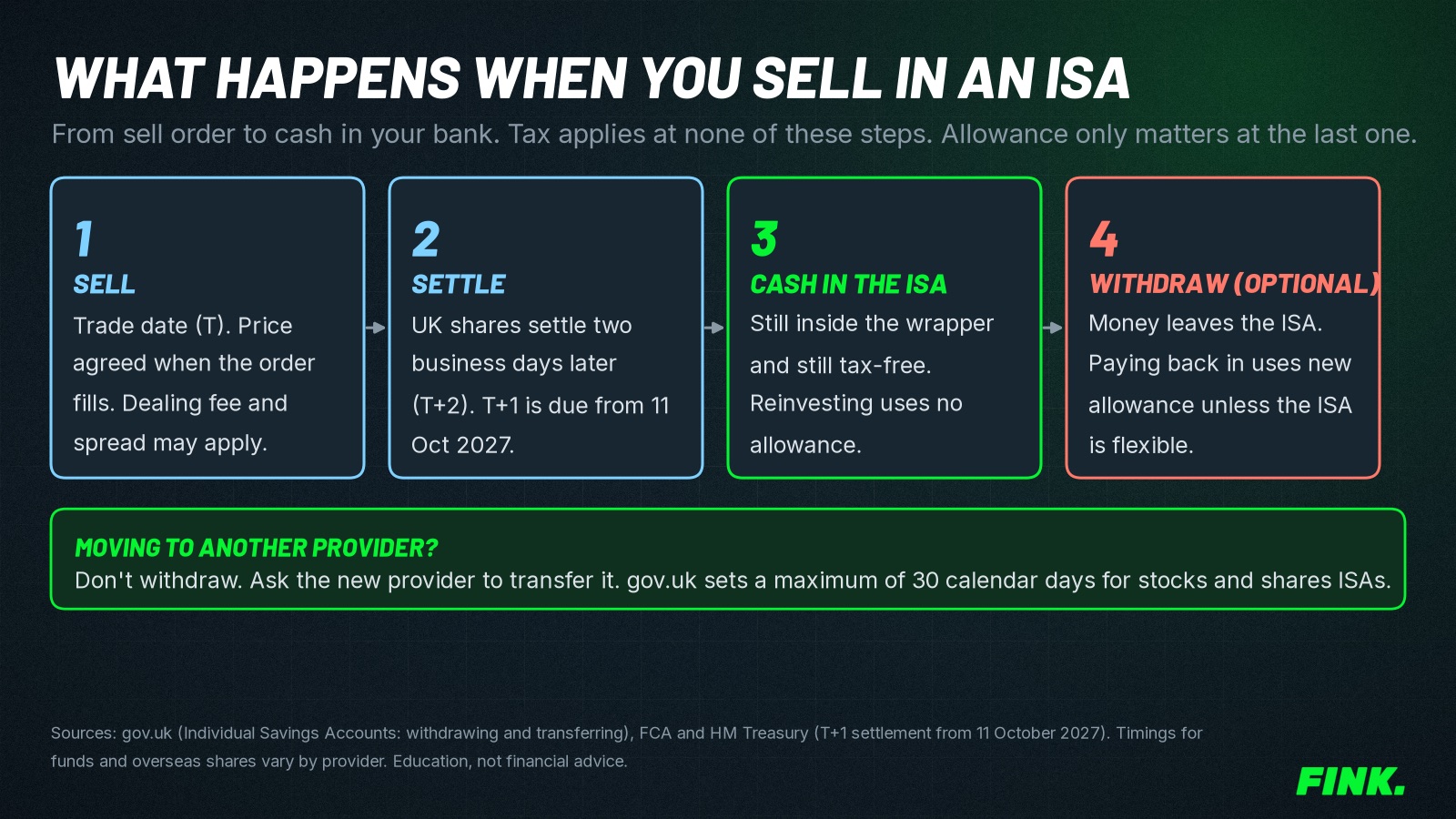 Sources: gov.uk, FCA, HM Treasury. Fund and overseas timings vary by provider.
Funds work differently. Unit trusts and OEICs are usually priced once a day. Settlement times are set by the fund, so check your provider's help pages. Overseas shares follow their home market's settlement rules.
Settled cash stays inside the ISA until you move it. It doesn't need to be withdrawn or reinvested by any deadline. In October 2026, HMRC confirmed the cash ISA limit will stay at £20,000 from 6 April 2027. The anti-circumvention rules announced alongside a planned cut won't take effect either (HMRC newsletter 24).
What happens if you withdraw after selling?
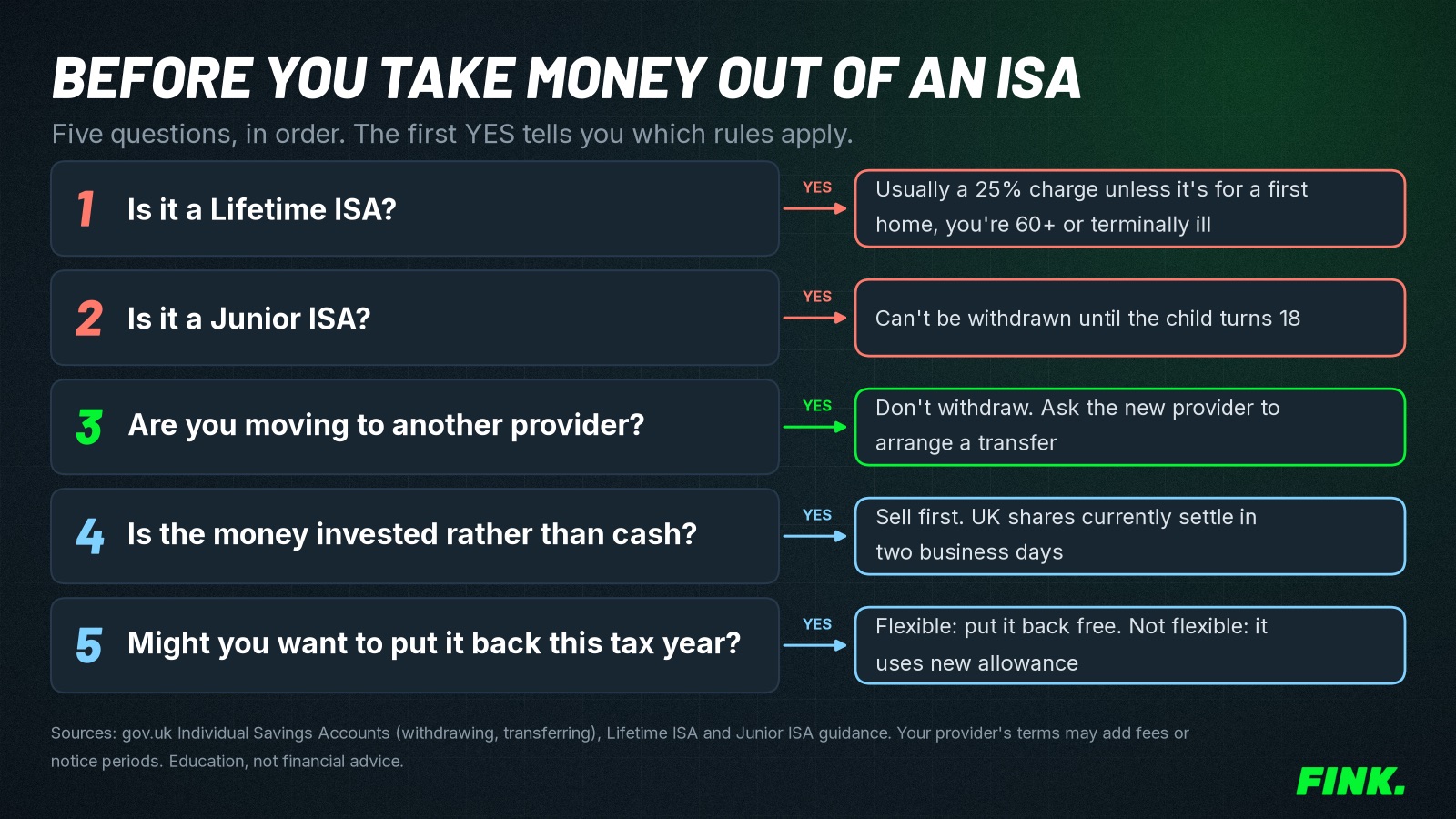
The cash leaves the ISA and loses its tax-free status. You can withdraw from a stocks and shares ISA at any time, though your provider's terms may include charges or notice (gov.uk).
Whether you can put it back depends on whether your ISA is flexible. In a flexible ISA, cash taken out can be replaced in the same tax year without using new allowance. In a non-flexible one, the replacement counts as a fresh subscription. Not every provider offers flexibility, so check before withdrawing.
Our guide to stocks and shares ISA withdrawal rules works through gov.uk's example with the numbers.
Should you sell before moving your ISA to a new provider?
Not as a withdrawal. If you take the money out yourself, it stops being ISA money. To keep the tax-free status, the new provider has to arrange the transfer using a transfer form (gov.uk).
Transfers can be done two ways. Each has a trade-off:
| Transfer type | What happens | The trade-off |
|---|---|---|
| In specie (re-registration) | Your holdings move across unchanged | Not every provider holds every investment. It can take longer |
| Cash transfer | Your old provider sells, then sends the cash | You're out of the market while the money's in transit, which could help or hurt |
You can transfer all or part of the money, whether it was paid in this year or in earlier years. Your provider may charge for it. The time limits and how to combine several ISAs are in how many stocks and shares ISAs you can have.
How does bed and ISA work?
Bed and ISA is the reverse direction: selling shares held outside an ISA and buying them back inside one. You can't move non-ISA shares in directly unless they come from an employee share scheme (gov.uk). The sale outside is taxable and the rebuy uses allowance. Our bed and ISA guide has the tax maths, the costs and a worked example.
What happens if a company you hold is taken over?
Sometimes you don't choose to sell. A takeover, demerger or delisting can make the decision for you. HMRC's guidance for ISA managers sets out what happens (gov.uk).
| What happens to the company | What happens in your ISA |
|---|---|
| Cash takeover | The shares are bought out and the cash lands in your ISA. It stays sheltered and doesn't use allowance |
| Paid in new shares that still qualify | The new shares can stay in the ISA |
| Paid in something that doesn't qualify | Your provider has 30 calendar days to sell it (the cash can stay in the ISA) or move it to you outside the ISA |
| Rights issue or other offer | You can take it up. Whether the new holding can stay depends on whether it qualifies |
What counts as qualifying is set by HMRC. Shares qualify if they're officially listed on a recognised stock exchange or admitted to trading on one in the UK or EEA. Nil paid rights bought in the market, warrants and options don't. So a company that leaves the stock market altogether can end up as a non-qualifying holding that has to come out of the ISA.
Paying for a rights issue with cash already in the ISA is moving money around inside the wrapper. Paying in new money to fund it counts towards your allowance, like any other subscription.
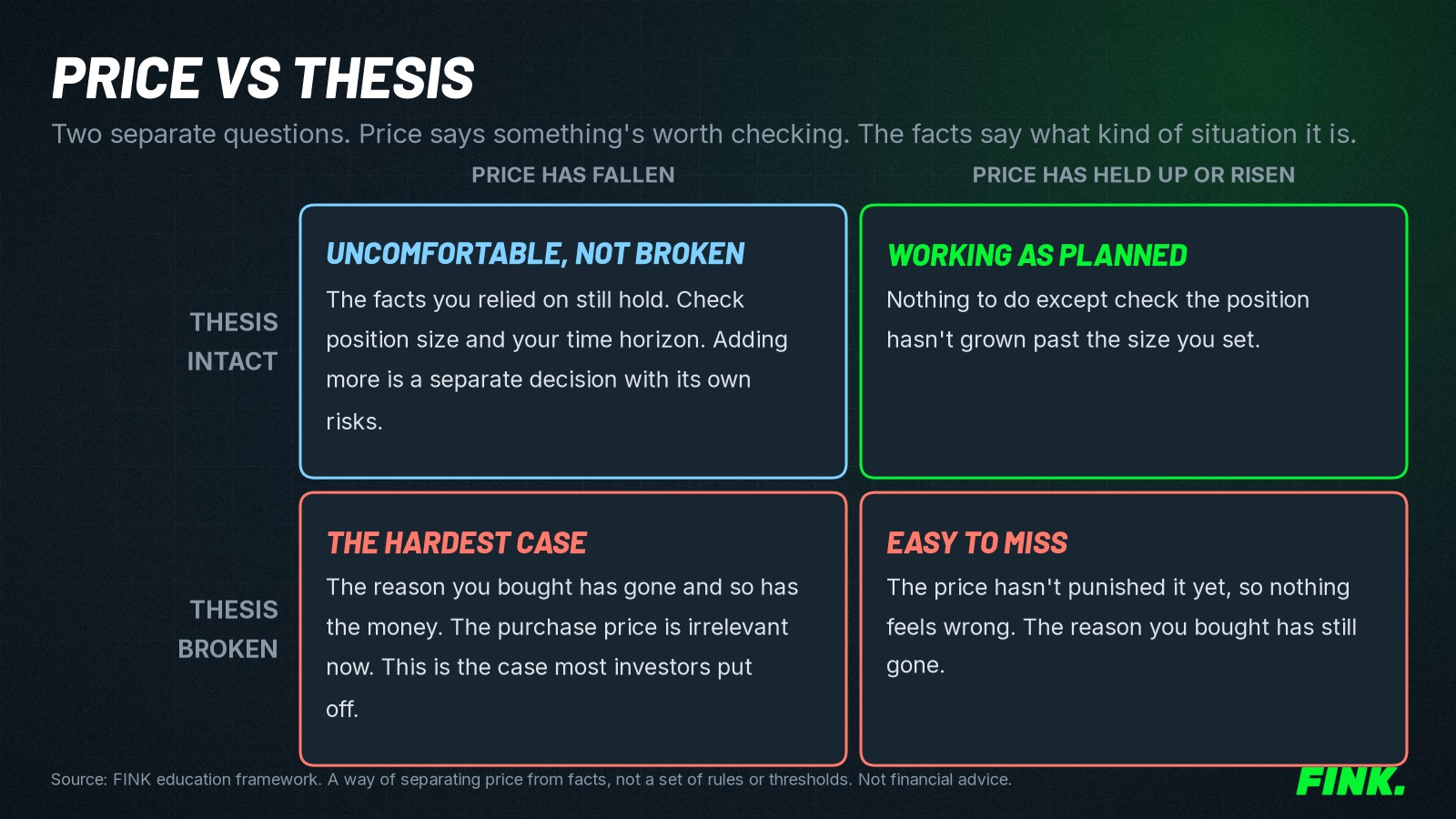
Two practical points follow. Read your provider's corporate action notices, since there's usually a deadline to choose. And a forced sale isn't a decision about the business, so it's worth deciding where the cash goes next using the same reasons you'd use for any other sale.
Which costs still apply when you sell in an ISA?
The tax wrapper removes Capital Gains Tax and dividend tax. It doesn't remove dealing costs.
- Dealing fees. Set by your provider. Some charge per trade, some don't.
- The spread. The gap between the price you can buy at and the price you can sell at. Wider for smaller companies.
- Stamp Duty Reserve Tax on buying. 0.5% when you buy most UK shares electronically, inside an ISA or not. It's charged on purchases, not sales (gov.uk). OEICs and unit trusts bought from the fund manager are exempt.
- Currency charges. If you sell an overseas share, your provider may charge to convert the proceeds to sterling.
None of these is large on a single trade. They add up if you trade often, which is part of what the Barber and Odean study found.
For how selling fits into a broader plan, see our ISA investing strategy guide. If your ISA is down and you're thinking of selling for that reason, start with stocks and shares ISA losing money.