

Can you take money out of a stocks and shares ISA?
Yes. gov.uk puts it in one line: "You can take your money out of an Individual Savings Account (ISA) at any time, without losing any tax benefits" (gov.uk). There's no income tax or capital gains tax on what comes out. You don't report it to HMRC.
The same page adds two qualifiers. Your provider's terms may set rules or charges on withdrawals. And Lifetime ISAs work differently.
What gov.uk doesn't say is that a withdrawal is free of consequences. Once money leaves the wrapper, whether you can put it back without using fresh allowance depends on whether the account is flexible. That's where most of the confusion sits.
What's a flexible ISA?
HMRC's guidance for ISA managers defines it precisely. A flexible ISA is one "whose terms and conditions allow the investor to replace, in whole or in part, cash they have withdrawn, without the replacement counting towards their annual subscription limit" (HMRC).
Four details in that guidance matter to investors:
- It's optional. Providers choose whether to offer it. Your provider can tell you if your ISA is flexible.
- It covers cash only. In a stocks and shares ISA, that means cash held in the account, including cash from selling investments. You can't withdraw shares and put shares back.
- Lifetime ISAs and Junior ISAs can't be flexible. That's a rule, not a provider choice.
- Replacement must happen in the same tax year. Withdraw in March and replace in May and the replacement counts as a new subscription.
For a non-flexible ISA, HMRC's guidance says a later withdrawal doesn't reduce the amount subscribed. In plain terms, money you've taken out still counts against that year's £20,000.
How does a withdrawal affect your allowance?
gov.uk uses a worked example. Your allowance is £20,000. You put in £10,000 during 2026/27, then take out £3,000. What you can still pay in that tax year depends on the account type (gov.uk).
| Scenario (gov.uk example, 2026/27) | Flexible ISA | Not flexible |
|---|---|---|
| Paid in this tax year | £10,000 | £10,000 |
| Withdrawn | £3,000 | £3,000 |
| Allowance still available | £13,000 | £10,000 |
| Can the £3,000 go back in without using allowance? | Yes, in the same tax year | No |
The difference looks small at £3,000. It isn't small for people who already use the whole allowance every year. HMRC's latest statistics show 28.8% of adult ISA subscribers in 2023/24 paid in the maximum (HMRC).
For them, money taken out of a non-flexible ISA can only go back by displacing future contributions. Each pound withdrawn is effectively a pound of tax-free space given up for good.
Does it matter which tax year the money came from?
Yes. This is the detail most guides skip. HMRC sets an order for withdrawals and replacements in a flexible ISA (HMRC):
- Withdrawals come first from this year's subscriptions. Take out more than you've paid in this year and the extra counts as previous-year money.
- Replacements count first as previous-year money. Only once that's restored do they count as this year's subscriptions.
- This-year money can go elsewhere. Withdrawing this year's subscriptions reduces your net subscription, so you can pay that amount into a different ISA later in the same year.
- Previous-year money is tied to the account. It "can only be replaced in the account from where the withdrawal was made and must be replaced in the same tax year."
- Closing the account ends it. If a withdrawal or internal transfer closes the flexible ISA, replacing earlier-year money isn't possible unless the provider reopens it.
An illustration (our example, not an HMRC one): you hold £50,000 built up over past years in a flexible stocks and shares ISA and have paid in £5,000 this year. You withdraw £15,000. HMRC's ordering treats £5,000 as this year's money and £10,000 as previous-year money.
You can replace the £10,000 into that same ISA before 5 April without touching your allowance. Your £20,000 allowance is also fully open again, because your net subscription this year is now zero. If you instead close the account by withdrawing everything, the previous-year portion can't come back.
Not every withdrawal can be replaced either. HMRC lists withdrawals that always count against the limit if repaid. These include money leaving by transfer, money taken to cover the provider's fees and charges, plus money removed by HMRC to cover a tax debt or invalid subscriptions.
Should you withdraw to move to a new provider?
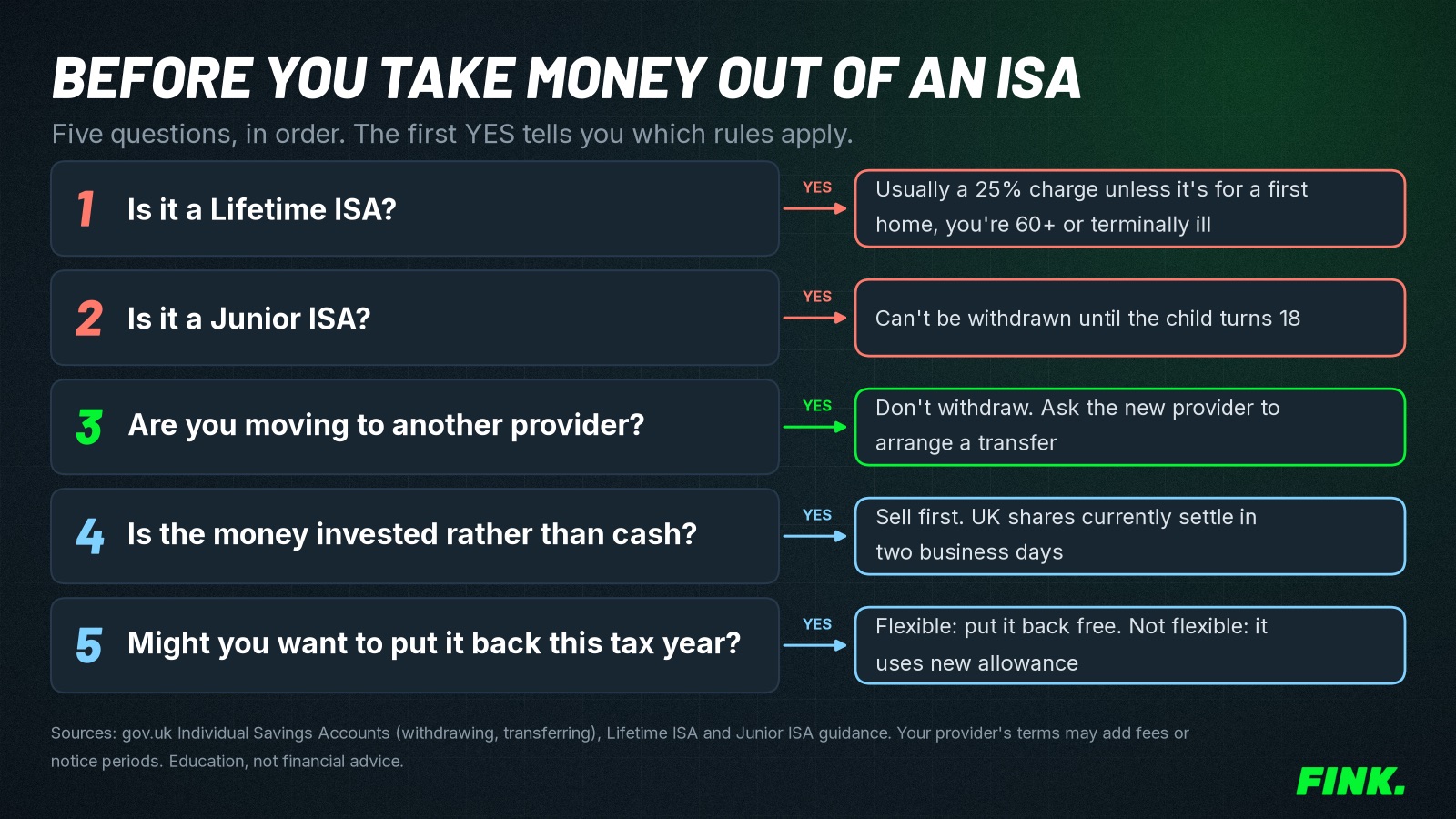
No. This is the one withdrawal rule that can cost you permanently. gov.uk says that to switch providers you contact the new provider and use their transfer form. It warns that if you withdraw the money without doing this, you won't be able to reinvest that part of your tax-free allowance again (gov.uk).
Ask whether your provider transfers investments without selling them or sells them to cash first. If it sells, you're out of the market for the transfer period. The official time limits and how to merge several old ISAs are in how many stocks and shares ISAs you can have.
How long does a withdrawal take?
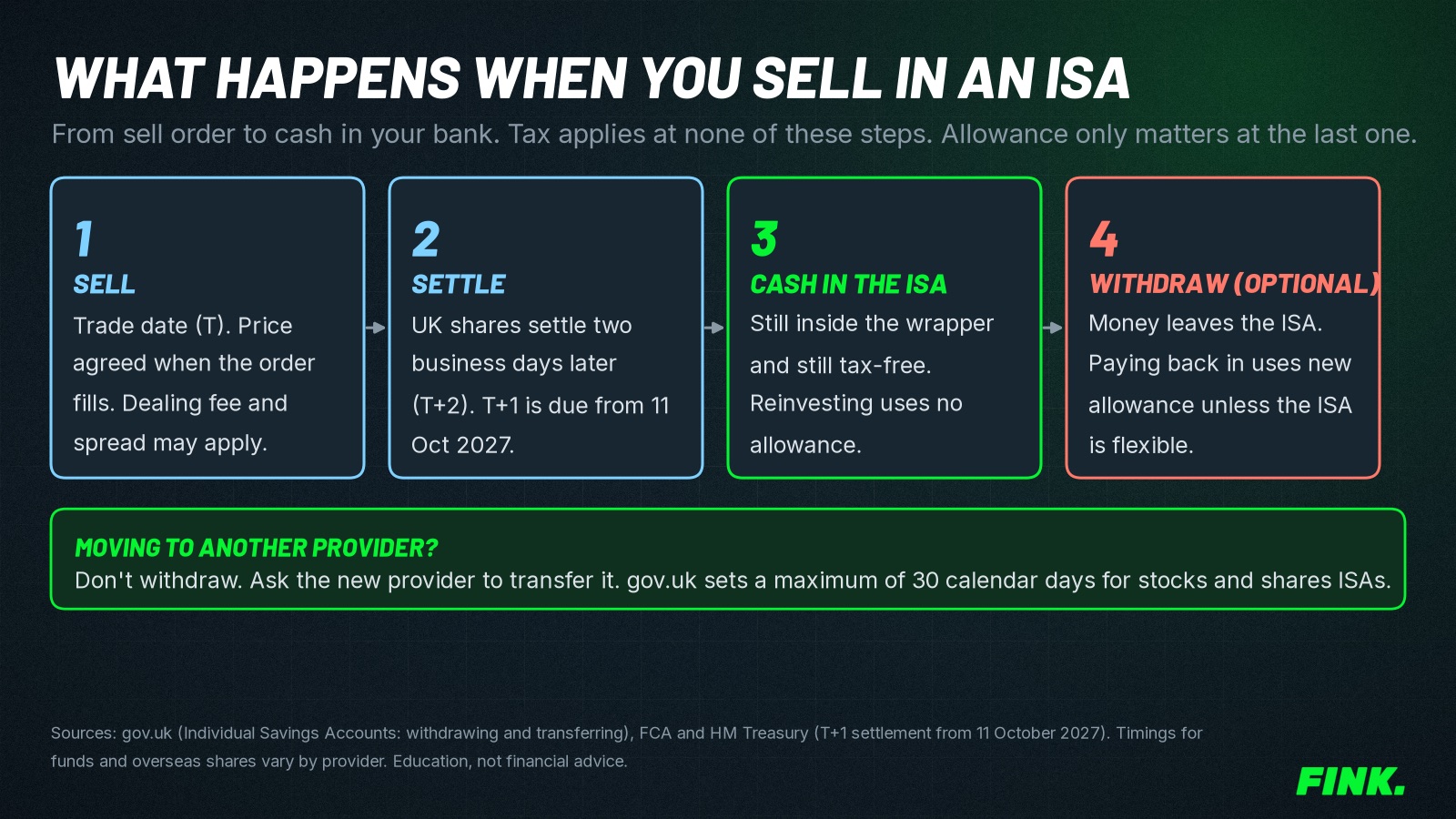
There are two steps and you control only the first.
Selling. If the money is invested, it has to be sold first. UK shares currently settle two business days after the trade. HM Treasury and the FCA have set 11 October 2027 for the move to one-day settlement (HM Treasury).
Funds can take longer, since they deal at a set daily price and the provider then needs the cash from the fund manager.
Paying out. After settlement, the provider pays the cash to your nominated bank account. Timings and any minimum withdrawal amounts sit in your provider's terms.
A few products, especially fixed-rate cash ISAs, charge penalties for early access. Stocks and shares ISAs rarely have withdrawal penalties but can charge dealing or exit fees.
If you need money by a specific date, work back from it. Selling at the last minute also means accepting whatever the price is that day.
Does the timing of a withdrawal matter more than the rules?
For most people, yes. The rules decide what happens to your allowance. The market decides what you get.
We looked at FTSE All-Share prices from 1981 to 2025 (see what 45 years of UK market data says). In 31 of those 45 years there was a fall of 10% or more from a peak at some point in the year. The median intra-year fall was 11.8%. That data is price only, excluding dividends.
Over longer spans the odds have improved but never reached certainty. The Barclays long-run figures on how often UK shares have beaten cash over two and ten years are in our cash ISA vs stocks and shares ISA guide. Badly timed money in and out has its own measurable cost too, which our losing money guide sets out.
Two practical points follow from this:
- Money you'll need within a couple of years is exposed to a fall at the wrong moment. Plenty of people hold it in cash for that reason.
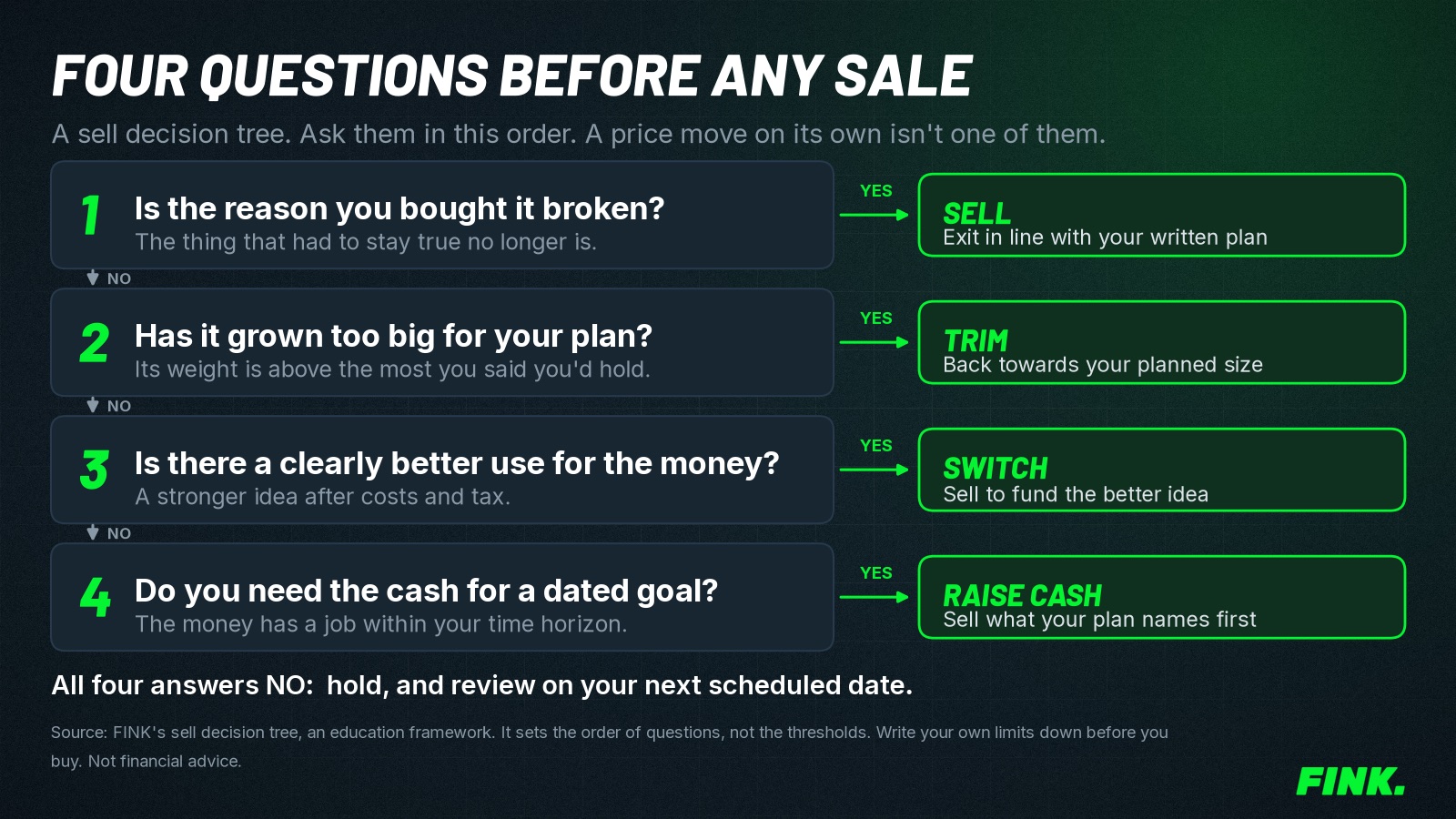
- A withdrawal driven by a market fall is a different decision from one driven by a planned need. The first deserves a check on whether anything has really changed, which is what our guide on when to sell a stock is about. Our guide to selling shares in a stocks and shares ISA covers the sale itself.
At FINK we treat a planned withdrawal as part of the plan, not a reaction. That's why it sits in the Allocate step of our stocks and shares ISA strategy. If you know you'll need money next year, the question of which holding to sell is easier to answer calmly now than during a fall.
What are the rules for Lifetime ISA withdrawals?
A Lifetime ISA can't be flexible. You can withdraw without a charge to buy your first home (subject to the rules), once you're 60, or if you're terminally ill with less than 12 months to live. Otherwise there's a 25% charge on the amount withdrawn (gov.uk). From 29 October 2026 that charge falls to 20% where the money goes towards a first home costing more than £450,000 (HMRC newsletter 24).
Because the 25% charge applies to the whole balance including the 25% bonus, a charged withdrawal leaves you with less than you paid in. HMRC's figures show 154,100 people made unauthorised Lifetime ISA withdrawals in 2025/26, paying £119 million in charges. We break that down in our Lifetime ISA comparison.
Can you take money out of a Junior ISA?
No. gov.uk says you can't take money out of a Junior ISA until the child turns 18 (gov.uk). The money belongs to the child. At 18 they can take it out. A child can become the registered contact for their Junior ISA at 16.
What happens to an ISA if you move abroad or die?
Moving abroad. You can keep your ISA open and it keeps its UK tax benefits, but you can't pay into it while you're not UK resident (Crown employees and their spouses excepted). You must tell your provider.
Withdrawals follow the normal rules (gov.uk). Tax where you now live is a separate question.
Death. There's no income tax or capital gains tax on ISA investments until the account closes. That happens when the executor closes it, when the estate is settled or three years and one day after death. The investments still count for inheritance tax. A surviving spouse or civil partner can claim an extra ISA allowance based on the value of the ISA (gov.uk).
Withdrawal rules at a glance
| Account | Withdraw any time? | Charge on withdrawal | Can it be flexible? |
|---|---|---|---|
| Stocks and shares ISA | Yes | Provider fees only | Yes, if the provider offers it (cash only) |
| Cash ISA | Yes | Possible penalty on fixed terms | Yes, if the provider offers it |
| Lifetime ISA | Yes | 25% unless first home, 60+ or terminal illness (20% for homes over £450,000 from 29 October 2026) | No |
| Junior ISA | No, until 18 | Not applicable | No |
Sources: gov.uk ISA, Lifetime ISA and Junior ISA guidance, HMRC ISA manager guidance, HMRC newsletter 24.