

How many stocks and shares ISAs can you have?
gov.uk sets out the allowance this way: "Every tax year you can save up to £20,000 in one account or split the allowance across multiple accounts" (gov.uk). Its third worked example is £10,000 in one cash ISA, £3,000 in another cash ISA and £7,000 in a stocks and shares ISA, all in one tax year.
There are two separate questions people tend to blur together:
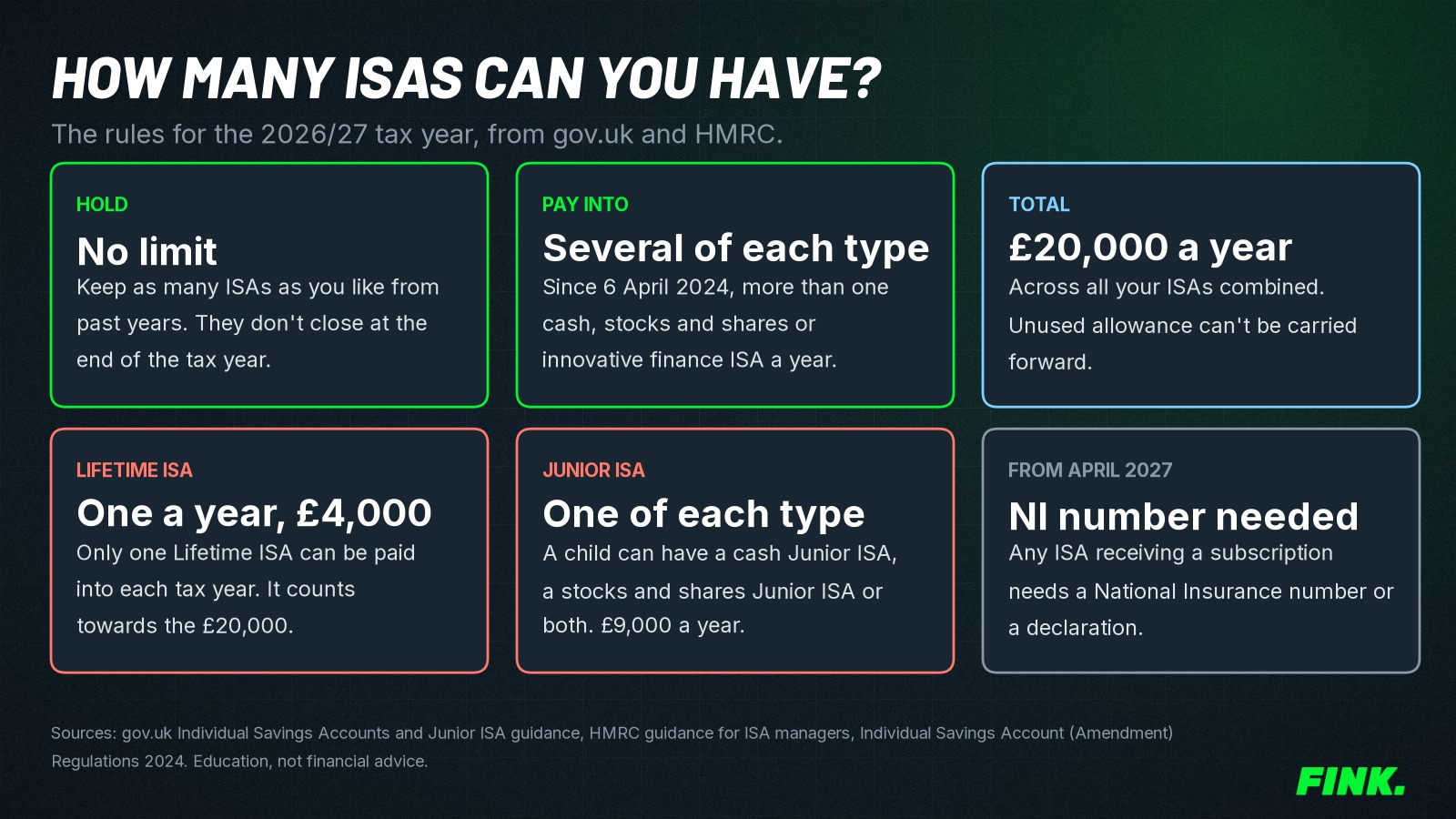
- How many can you hold? No limit. Your ISAs don't close when the tax year ends. You keep the tax-free status for as long as the money stays in them.
- How many can you pay into this tax year? Also no limit for cash, stocks and shares and innovative finance ISAs, as long as the total stays within £20,000. Lifetime ISAs are limited to one a year.
So yes, you can open two stocks and shares ISAs in one tax year, with the same provider or different ones.
What changed in April 2024?
Before 6 April 2024, you could only pay into one ISA of each type per tax year. The explanatory memorandum to the 2024 amendment regulations describes the old rule plainly: when opening an ISA, an investor had to declare that they wouldn't subscribe to another account of the same type in the same year (explanatory memorandum, SI 2024/350).
The regulations, which came into force on 6 April 2024, changed three things that matter to investors:
- Multiple subscriptions. You can pay into more than one ISA of the same type in a tax year.
- Partial transfers. You can transfer part of this year's subscriptions to another provider. Before, current-year money had to move in full.
- No fresh application. An ISA that hasn't been paid into for over a year no longer needs a new application before you can add money.
The same regulations raised the minimum age for opening an adult cash ISA from 16 to 18, with transitional rules for people who were 16 or 17 on 6 April 2024.
A further change is due. HMRC's guidance for ISA managers says that from 6 April 2027 any ISA account receiving a subscription will need a National Insurance number, or a declaration that the investor isn't eligible for one (HMRC).
What are the limits by ISA type?
| ISA type | How many you can hold | How many you can pay into each year | Annual limit |
|---|---|---|---|
| Stocks and shares ISA | No limit | No limit | Part of the £20,000 |
| Cash ISA | No limit | No limit | Part of the £20,000 |
| Innovative finance ISA | No limit | No limit | Part of the £20,000 |
| Lifetime ISA | No stated limit | One | £4,000, counted within the £20,000 |
| Junior ISA (for under 18s) | One cash and one stocks and shares | The child's own accounts only | £9,000 |
Sources: gov.uk ISAs, gov.uk Junior ISAs. The 2026 Budget confirmed the cash ISA limit stays at £20,000. HMRC's October 2026 newsletter says the planned cut won't take effect (HMRC newsletter 24).
How do people actually use their ISAs?
HMRC publishes how adult ISA holders used their accounts in 2023/24, the latest year with a split by person rather than by account (HMRC Table 9.8).
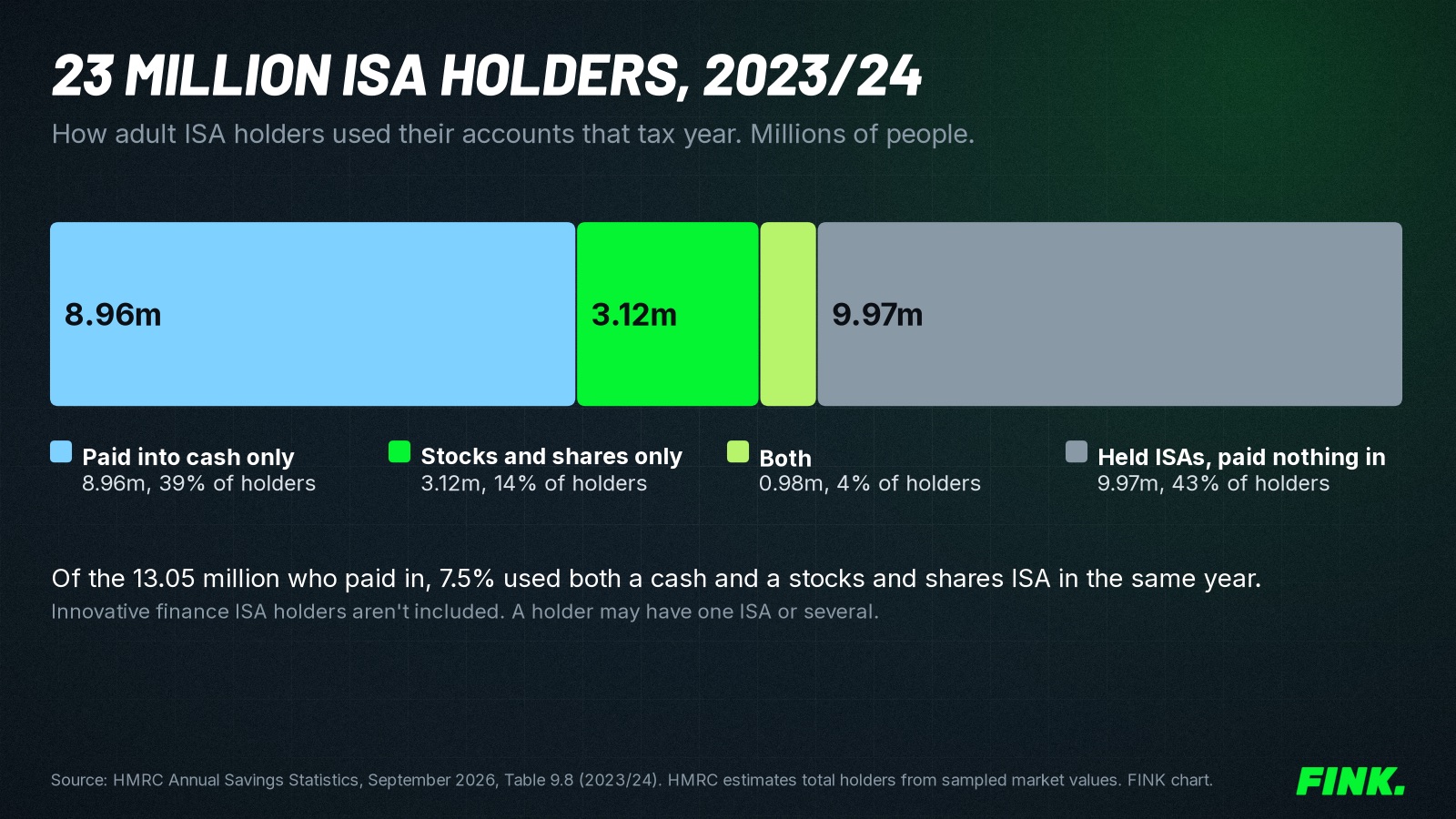 2023/24 adult ISA holders by what they paid into. Source: HMRC Annual Savings Statistics, September 2026, Table 9.8. FINK chart.
| 2023/24, adult ISA holders | People | Share of all holders | Share of those who paid in |
|---|---|---|---|
| Paid into cash ISAs only | 8.96m | 39% | 68.7% |
| Paid into stocks and shares ISAs only | 3.12m | 14% | 23.9% |
| Paid into both | 0.98m | 4% | 7.5% |
| Held ISAs but paid nothing in | 9.97m | 43% | n/a |
| Total | 23.03m | 100% | 13.05m paid in |
How we worked it out. The figures are the totals from Table 9.8. We divided each group by HMRC's estimate of all adult ISA holders (23.03 million) and by the number who paid in that year (13.05 million). HMRC notes that total holders are estimated from a sample of market values. It also notes that innovative finance ISA holders aren't included.
Three things stand out. Most ISA holders use one type of ISA. More than four in ten didn't add money that year at all, which means a large share of ISA wealth sits in accounts from previous years. And 2023/24 was the last year under the one-account-per-type rule, so the data can't yet show how many people now split money across several stocks and shares ISAs.
The account counts hint at the scale. HMRC recorded 15.0 million adult ISA accounts paid into in 2023/24 and 16.8 million in 2024/25, the first year of the new rule (HMRC Table 9.4). Some of that rise reflects people opening more accounts. Some reflects more people saving, with cash ISA accounts alone up from 9.9 million to 10.7 million. The tables don't separate the two.
Why might you want more than one stocks and shares ISA?
There are real reasons. The rules now allow them:
- Different products. One provider may suit funds while another suits individual shares or investment trusts. Our guide to individual shares or funds in your ISA compares what each route costs on the main platforms.
- Fee structure. Some platforms charge a percentage of assets and others a flat fee. The cheaper option can change as your balance grows.
- Provider protection. FSCS investment protection covers up to £85,000 per person per firm if an authorised firm fails and can't return your money (FSCS). It doesn't cover falls in the value of investments. Cash deposits are protected up to £120,000 per person per bank from 1 December 2025 (Bank of England).
- Separate goals. Some people find it easier to stick to a plan when money for different goals sits in different places. That's the Allocate step of our stocks and shares ISA strategy: decide what each pot is for before choosing what goes in it.
That last point has research behind it. In a 14-week field study with 146 households of labourers in rural India, Cheema and Soman found that splitting the same earmarked savings into two envelopes rather than one raised average total savings from 241 to 414 rupees (Cheema and Soman, 2011, Journal of Marketing Research). It's one study, in a very different setting from a UK investment platform. It does suggest that labelled pots can change behaviour.
What are the downsides of several ISAs?
The trade-offs are harder to see. They're just as real:
- Allowance tracking. HMRC's guidance says investors who hold ISAs with different managers are responsible for not exceeding the overall limit. Each provider only sees its own accounts.
- More fees. Several flat-fee accounts can cost more than one. Check each provider's charges page.
- Hidden overlap. Two global funds on two platforms can hold many of the same companies. It's harder to spot when they're on separate statements. Our guide to ISA fund overlap covers how to check.
- Lost track of accounts. The Pensions Policy Institute estimated 3.3 million pension pots worth £31.1 billion were lost in 2024, meaning the provider had no contact with the owner (PPI). That's pensions, not ISAs. The mechanism, people moving house and forgetting old accounts, applies to any long-term account.
At FINK we look at it this way: every account is something you have to review. One or two accounts you check properly beat five you glance at once a year. If you do run several, an annual ISA review that puts them all on one page is worth the effort.
How do you combine ISAs if you have too many?
Use a transfer, never a withdrawal. gov.uk says to contact the provider you want to move to and complete its transfer form. If you withdraw the money yourself, you won't be able to reinvest that part of your allowance again (gov.uk).
Transfers between providers should take no longer than 15 working days for cash ISAs and 30 calendar days for other types. Since April 2024 you can transfer part of this year's subscriptions, not just the whole amount. Check whether the old provider charges an exit fee. Also check whether it sells your holdings to cash for the move, which leaves you out of the market for the transfer period. Don't withdraw the money and pay it in elsewhere yourself. Money from earlier years loses its tax-free status and paying it back in uses this year's allowance, as our withdrawal rules guide explains.
What happens if you pay in more than £20,000?
HMRC's guidance says providers' systems must stop you paying more than the overall limit into the ISAs they run for you. Where a provider's own cross-checks find an oversubscription within 60 days, it removes the excess without involving HMRC (HMRC).
Across different providers, nobody checks in real time. HMRC's repair guidance says that when the limit is exceeded, the excess and any related gains are removed. Tax relief on the excess is lost and the rest of the account stays tax-free (HMRC). For oversubscriptions in earlier years, HMRC contacts the investor. The simplest protection is your own running total. Our guide to the end of the tax year covers the April deadline.