

How many funds do you need in a stocks and shares ISA?
There's no number backed by research. The academic work on diversification counts individual shares, not funds. A single broad fund can hold thousands of shares on its own. What the evidence does show is that overlap and the job each fund does matter more than how many you own.
That's why the answers you'll find vary so much. AJ Bell says you could be well diversified with three or four funds, or "just own a global fund... plus a bond fund". ii suggests a highly diversified portfolio "can be achieved by holding 10 to 15 funds". Both also say the same thing underneath: it's what's inside the funds that counts.
So rather than add another range, this guide tests the claim. We downloaded the full holdings of two popular index funds and measured how much they share.
What do real investors actually hold?
The best public data on this comes from Fidelity, which looked at its own base of more than 550,000 DIY investors. Customers with portfolios of £100,000 to £200,000 held eight funds on average. The number levelled off at 17 from £500,000 upwards (Fidelity).
That tells you what people do, not what works. Fidelity's own writer is careful about it: "Is that too many funds or too few? It's difficult to give a firm answer."
HMRC's statistics give the other end of the scale. In 2023/24, the most common subscription band across all adult ISAs was £1 to £2,000, covering 30.7% of savers (HMRC ISA statistics, Table 9.7). For someone adding £2,000 a year, eight funds would mean £250 each. At that size, a fund barely moves the total.
Why does the number of funds matter less than overlap?
Because diversification comes from the companies and assets you end up owning, not the number of fund names on your statement. Two funds that hold the same large companies give you less spread than their names suggest.
The research on individual shares shows why. The benefit of adding companies flattens out after a few dozen, with a floor of market risk that no amount of diversification removes (Statman, 1987). Our guide to how many shares to hold charts that curve. A broad index fund holding hundreds or thousands of companies is already far along it. Adding a second broad fund that owns mostly the same shares doesn't take you further.
What it can do is change your weights. And that's where overlap gets interesting.
How much do a global fund and an S&P 500 fund overlap?
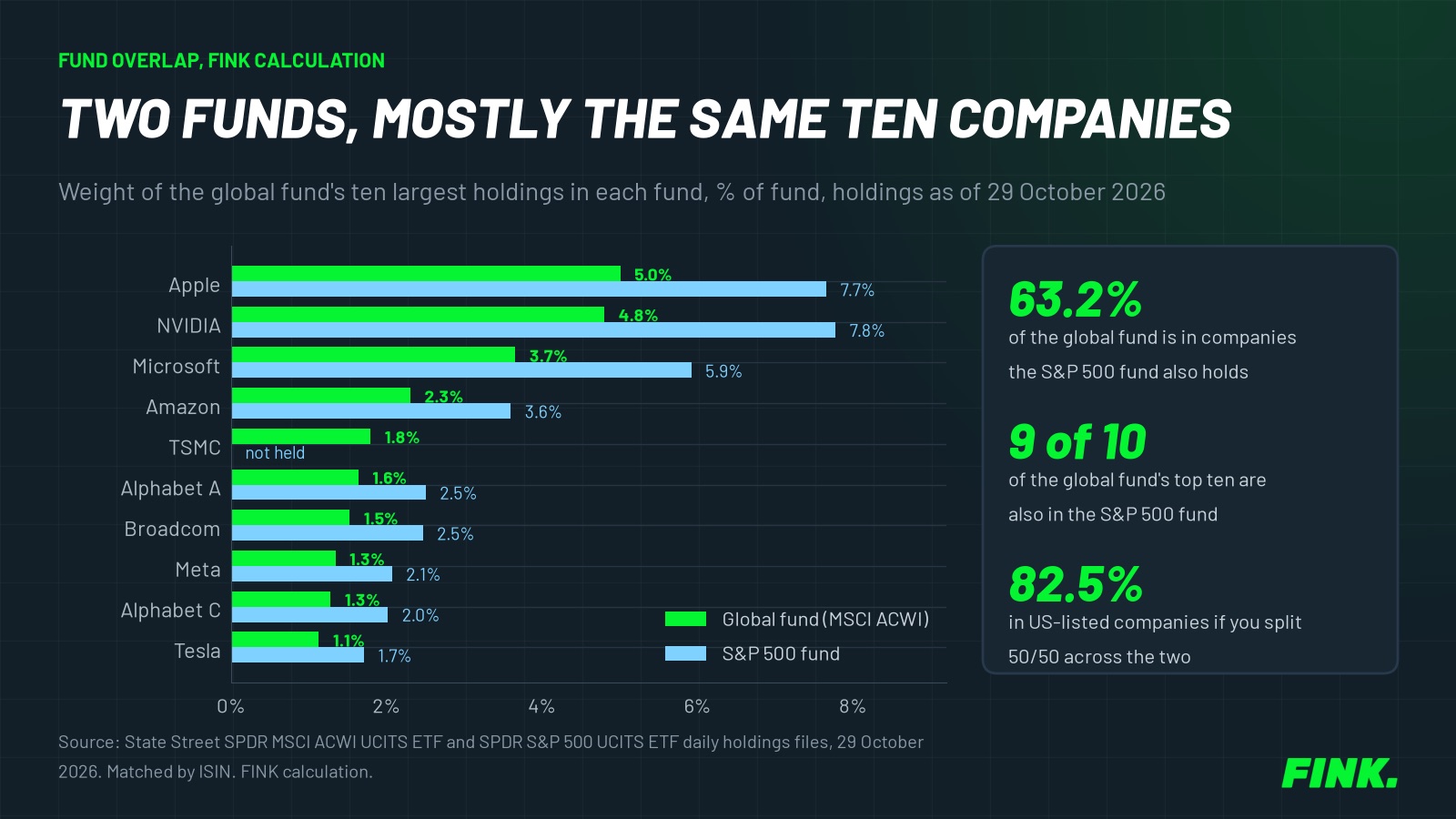
A lot. Using State Street's published holdings for 29 October 2026, 63.2% of its MSCI All Country World fund by value was in companies that its S&P 500 fund also held. Going the other way, 98.8% of the S&P 500 fund was in companies the global fund held too.
How we calculated it
We used two funds from the same provider so the data is formatted the same way:
- Downloaded the daily holdings files for the State Street SPDR MSCI ACWI UCITS ETF (2,250 lines) and the SPDR S&P 500 UCITS ETF (505 lines), both dated 29 October 2026.
- Matched each holding by its ISIN, the international code for a security.
- Added up the weight, in each fund, of the companies that appear in both.
- For blends, multiplied each fund's weights by its share of the blend, combined them by ISIN and recalculated the country and top ten totals.
These are two specific funds on one date. Other global and S&P 500 trackers follow the same or similar indices, so the picture should be close, but weights move every day. We're showing the method so you can repeat it on your own funds.
What happens when you combine them?
Holding both funds shifts your money towards the US and towards the largest companies, because the overlap gets counted twice:
| Split between global fund and S&P 500 fund | Share in US-listed companies | Share in the ten largest companies |
|---|---|---|
| 100% global | 64.9% | 24.5% |
| 75% global, 25% S&P 500 | 73.7% | 27.3% |
| 50% global, 50% S&P 500 | 82.5% | 30.6% |
| 25% global, 75% S&P 500 | 91.2% | 34.0% |
| 100% S&P 500 | 100.0% | 37.4% |
None of these is right or wrong. Someone who wants more in the US might choose the 50/50 split on purpose. The point is to choose it, not to discover it. Two fund names on a statement can look like diversification when much of the money sits in the same handful of companies.
For UK investors, it's also worth knowing that the global fund put 3.1% in UK-listed companies. If you want more UK exposure than that, a global tracker alone won't give it.
What job should each fund do?
Each fund should have one clear role that no other fund in your ISA covers. If two funds have the same role, one of them is probably redundant. If a fund has no role you can name, it's probably there by accident.
Here's the checklist we'd use on every fund before buying it and at every review:
- Can you say its job in one line? "Broad global shares", "UK income", "short-term gilts". If the line is vague, so is the reason.
- Does another fund already do that job? Check the top ten holdings side by side, then the full list if they look similar.
- Is it big enough to matter? ii suggests funds under 2% of a portfolio are worth questioning (ii). A fund that can't move the total can't do much of a job.
- Do you know what it costs? The ongoing charge, any performance fee and your platform's dealing charge for it.
- Do you know what would make you replace it? Rising charges, a manager change, a drift from its stated aim or your plan no longer needing that job.
Common fund jobs in an ISA
| Job | Typical fund type | Overlap to watch for |
|---|---|---|
| Broad global shares | Global or all-world index fund | Any US, developed world or large-cap tech fund |
| Regional tilt | UK, Europe, Japan or emerging markets fund | Already part of a global fund at index weight |
| Bonds or gilts | Gilt, global bond or short-dated bond fund | Multi-asset funds that already hold bonds |
| Everything in one | Multi-asset or target-risk fund | Holding other funds alongside it can undo its balance |
| A theme you believe in | Sector or thematic fund | Often concentrated in the same large companies as broad funds |
When does adding funds start to hurt?
When the extra funds add cost, complexity or hidden concentration without adding a new role. There isn't a specific count where this kicks in. ii suggests reviewing any portfolio of more than 20 funds for overlap. It also warns about "diworsification".
The costs are usually small one at a time. Fund ongoing charges are percentages, so they don't rise with the number of funds. But dealing fees do. On the platforms we checked for our shares or funds guide, one-off online fund deals cost £1.50 at AJ Bell and £1.95 at Hargreaves Lansdown, while Fidelity charged nothing for fund deals. Exchange-traded funds and investment trusts are charged like shares on most platforms.
The bigger cost is time. Every fund is something to check at each review and something that can drift. Our rebalancing guide shows how quickly a split can move away from its target.
Does a bigger ISA need more funds?
Not automatically. A larger ISA can afford a separate fund for a specific job (a gilt fund for money needed sooner, say) because that fund will be large enough to matter. But a £200,000 ISA in one global tracker is no less diversified than a £2,000 one in the same fund.
The counter-argument is concentration in a single provider or fund structure. Some investors spread large sums across two providers' versions of the same index for that reason, even though it adds no market diversification. That's a judgement about operational risk, not about returns.
Where do individual shares fit in?
If you hold individual shares alongside funds, count what those funds already own. Buying Apple shares on top of a global tracker increases your exposure to a company that was already 5% of that fund. Our guide to how many shares to hold covers that side. The ISA strategy guide shows how fund and share decisions fit into one process.
At FINK we look at it this way: the number of funds is an output of the plan, not an input. Decide the jobs first. The count follows.