

Can you hold individual shares and funds in the same ISA?
Yes. A stocks and shares ISA can hold "shares in companies" and "unit trusts and investment funds" side by side, along with corporate and government bonds, according to gov.uk. So the question isn't which one you're allowed. It's how much of each suits you.
That question gets argued hard on forums, mostly on opinion. This guide takes the other route. It sets out what the research says about how individual investors do with shares, what professional funds achieve and what the main platforms charge for each route. Then there's a matrix to weigh it all against your own situation.
What does the research say about individual investors picking shares?
The large studies of real brokerage accounts point in one direction: most individual investors hold too few shares and trade too often. Both habits cost them. The research doesn't say no one can pick shares well. It says the average experience is worse than the market.
Trading too often
Barber and Odean (2000) studied 66,465 US households at a discount broker between 1991 and 1996. The average household earned 16.4% a year after costs, against 17.9% for the market. The fifth of households that traded most earned 11.4% a year. The gap was mostly trading costs, not poor share choices before costs. The paper's title sums it up: "Trading is hazardous to your wealth".
Those were high-return years and dealing costs were far higher than today. The lesson that carries over is about turnover. Every trade has a cost and a reason. Fewer trades mean fewer of both.
Holding too few shares
Using data from the same broker, Goetzmann and Kumar (2008) found the average investor held four shares and the median investor three. Under-diversification was more common among younger and less experienced investors and was linked to overconfidence and trend-following. The diversification research in our how many shares guide suggests that's far too few to remove most company-specific risk.
The counter-evidence
Two points cut the other way. First, Goetzmann and Kumar found a small group of concentrated investors who did well, which they linked to better information. Second, the comparison isn't individual shares versus a perfect index. It's individual shares versus whatever fund you'd actually buy. Many funds have their own problems.
Do funds do better?
Index funds track a market by design, so they deliver the market's return minus costs. Actively managed funds try to beat it and the evidence suggests most don't over long periods.
S&P Dow Jones Indices' SPIVA Europe scorecards find most active UK and global equity funds sold to UK investors fall behind their benchmarks over ten years. Our core and satellite guide has the latest figures by category. That's a finding about professional fund managers with research teams, which is worth keeping in mind before assuming a part-time investor will do better.
The trade-off is that an index fund is built to deliver the market's return minus costs, so beating the market isn't on offer. You get the market, concentration and all. A global tracker we checked had 24.5% in its ten largest companies on 29 October 2026, as our how many funds guide shows.
What does each route cost on the main platforms?
It depends on how you invest. Fund dealing is cheap or free on most platforms and regular investing is free on all four we checked. Individual share deals cost £3.99 to £7.50 each for one-off online trades and UK share purchases pay 0.5% stamp duty. Funds carry an ongoing charge that shares don't.
| Platform (checked on the 1st of November 2026) | One-off online share deal | One-off fund deal | Regular investing | Annual charge, shares | Annual charge, funds |
|---|---|---|---|---|---|
| Hargreaves Lansdown | £6.95 (£3.95 after 20+ deals in a month) | £1.95 | Free | 0.35%, capped at £12.50 a month | 0.35% |
| AJ Bell | £5.00 (£3.50 after 10+ deals in a month) | £1.50 | Free | 0.25%, max £3.50 a month | 0.25% on the first £250,000 |
| interactive investor (Core plan) | £3.99 for UK and US shares | £3.99 | Free | £5.99 a month plan fee | £5.99 a month plan fee |
| Fidelity | £7.50 | No charge | Free for funds, £1.50 for shares | 0.35%, or £7.50 a month under £25,000 without a regular savings plan, capped at £7.50 a month for exchange-traded holdings in an ISA | 0.35% |
HL's fund dealing charge is from its ISA charges page. UK stamp duty is listed on HL's dealing charges page.
An illustration of annual platform costs
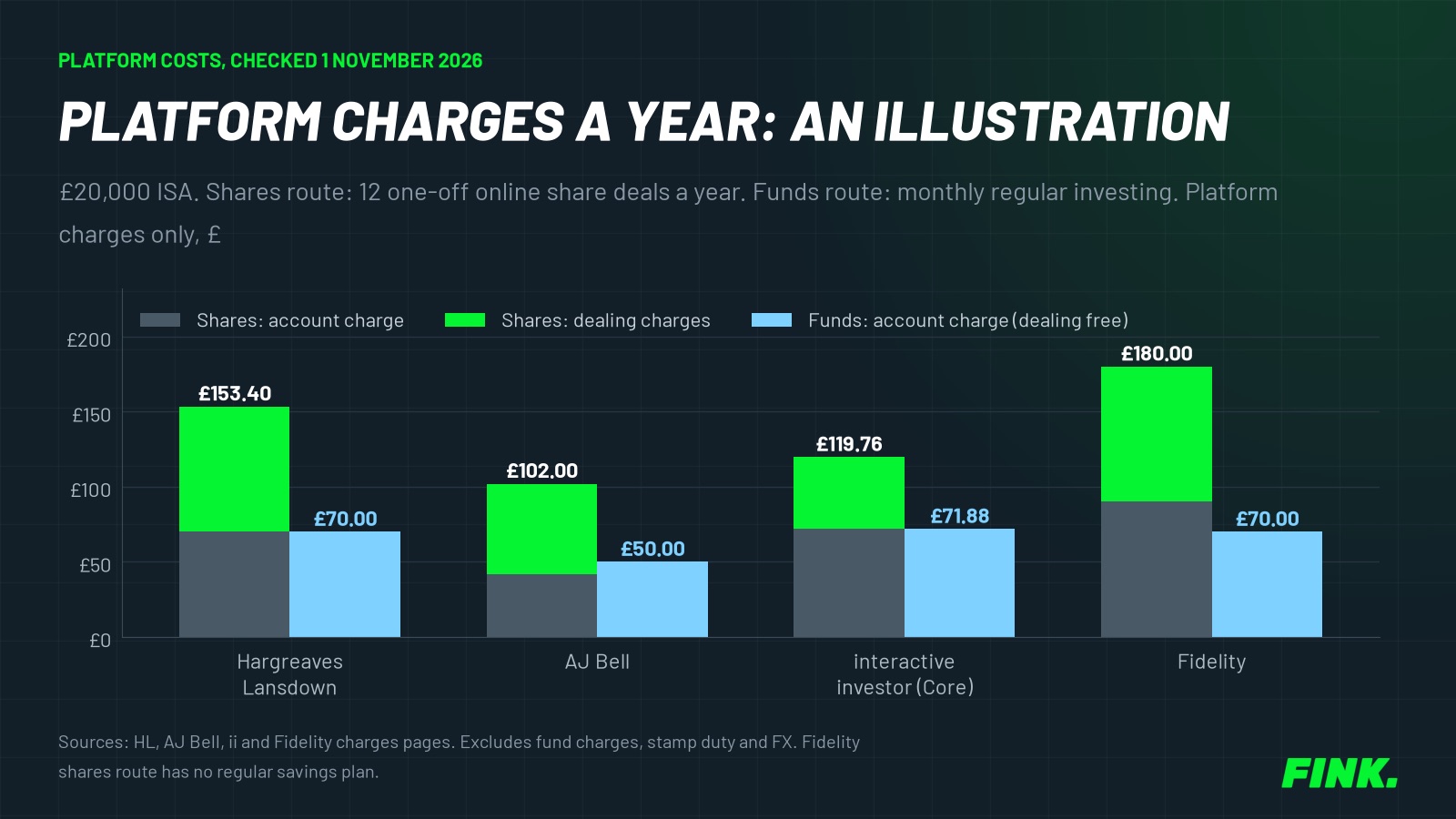
To make that comparable, we costed two simple routes for a £20,000 ISA. The shares route places 12 one-off online share deals a year. The funds route invests monthly through regular investing, which is free on all four platforms. Both include the platform's annual charge. Neither includes fund ongoing charges, stamp duty or currency costs.
How we worked it out:
- Dealing: 12 times the one-off online share deal charge. HL £6.95 x 12 = £83.40. AJ Bell £5 x 12 = £60. ii £3.99 x 12 = £47.88. Fidelity £7.50 x 12 = £90.
- Shares account charge: HL 0.35% of £20,000 = £70, under its £150 annual cap. AJ Bell 0.25% = £50, capped at £42 (£3.50 a month). ii £5.99 x 12 = £71.88. Fidelity £7.50 x 12 = £90 under £25,000 without a regular savings plan.
- Funds route: HL 0.35% = £70. AJ Bell 0.25% = £50. ii £71.88. Fidelity 0.35% = £70 with a regular savings plan.
Two things change the picture. Fund ongoing charges come on top of the funds route, so a 0.2% fund charge would add £40 a year on £20,000. And buying £20,000 of UK shares adds £100 of stamp duty at 0.5%. Prices change, so check the platform's own page before relying on any of this.
How do you decide between shares and funds?
Four things matter most: time, interest, temperament and cost. The matrix below adds ISA size and diversification and sets out what each factor points to. Most people end up somewhere in the middle, which is why a mix is common.
| Factor | Points towards funds | Points towards some individual shares |
|---|---|---|
| Time | You'll give the ISA a few hours a year | You'll read results announcements for every company you own |
| Interest | You care about the outcome, not the companies | You enjoy reading about businesses and would do it anyway |
| Temperament | Price falls in a single company would worry you | You can hold through a 40% fall in one share if your reason still holds and sell if it doesn't |
| Cost | You invest monthly in small amounts | You trade rarely and in larger amounts, so dealing costs are a small share of each deal |
| Size of the ISA | Small, so 20+ shares would mean tiny positions | Large enough that each share can be meaningful without dominating |
| Diversification | You want thousands of companies from day one | You'll build to enough holdings to spread company risk |
A short test: if you can't name the reason you'd sell each share before you buy it, the time and temperament rows probably point to funds.
What's a core and satellite ISA?
It's the middle route: most of the money in one or a few broad funds, a smaller part in individual shares. It answers the research above quite directly, because the core supplies the diversification and the satellite caps how much a bad pick can cost. How big the satellite should be, what the tracker core really holds and how to keep the split in line are covered in our core and satellite guide.
One point to add here: time still counts. Five satellite shares still produce at least ten results announcements a year, so the satellite is where your time goes. If you're weighing which shares or funds to look at first, what to invest in a stocks and shares ISA sets out a process for both.
At FINK we look at it this way: the shares-or-funds choice is mostly a decision about where your time goes. Funds buy you time back. Shares spend it. Neither is wrong, as long as the split matches the time you'll really give.
How do you get started with either route?
The steps are similar whichever way you lean:
- Decide the split between a fund core and any individual shares. Write it down.
- Choose a platform whose charges suit how you'll invest (regular or one-off, funds or shares).
- For funds, check what each one holds and that no two do the same job.
- For shares, set a limit on how much any one can be and write down why you're buying it.
- Book a review date and check the split against your target.
The ISA strategy guide sets those steps out in full, from allocation through to selling.