

What does rebalancing a stocks and shares ISA mean?
Rebalancing means bringing your ISA back to the mix you chose after market moves have pushed it away. If you decided on 60% shares and 40% bonds and a strong year for shares has made it 66% and 34%, rebalancing moves it back towards 60/40.
It matters because drift changes your risk without you deciding to change it. A portfolio that started cautious can end up adventurous simply because the riskier part grew faster. Rebalancing is how you keep the risk you signed up for.
Below is what the research says about how often to do it, a worked example with real arithmetic and the ways to rebalance inside an ISA without selling anything.
Why does an ISA drift away from its target mix?
Because different investments grow at different rates. Over long periods, shares have usually grown faster than bonds, so a mixed portfolio left alone tends to become more share-heavy over time.
Vanguard's paper on best practices for portfolio rebalancing (Zilbering, Jaconetti and Kinniry, 2015) shows how far that can go. It compared a portfolio of 50% global shares and 50% global bonds rebalanced each year with the same portfolio never rebalanced, from 1926 to 2014:
| 1926 to 2014, 50% shares and 50% bonds | Rebalanced each year | Never rebalanced |
|---|---|---|
| Highest share weighting | 60% | 97% |
| Lowest share weighting | 35% | 27% |
| Average share weighting | 51% | 81% |
| Final share weighting | 49% | 97% |
| Average annual return | 8.1% | 8.9% |
| Annual volatility | 9.9% | 13.2% |
Source: Vanguard (2015), Figure 3. US dollar returns, no costs or contributions.
Note the return line. The portfolio that was never rebalanced earned more on average, because it ended up mostly in shares. That's the honest trade-off: rebalancing isn't a way to raise returns. It's a way to keep the portfolio you chose. By the end, the "50/50" investor who never rebalanced was holding 97% shares, a portfolio with very different risks from the one they started with.
How does drift look in a real ISA? A worked example
Here's the arithmetic with round numbers. It's an illustration of the method, not a forecast of what any investment will do.
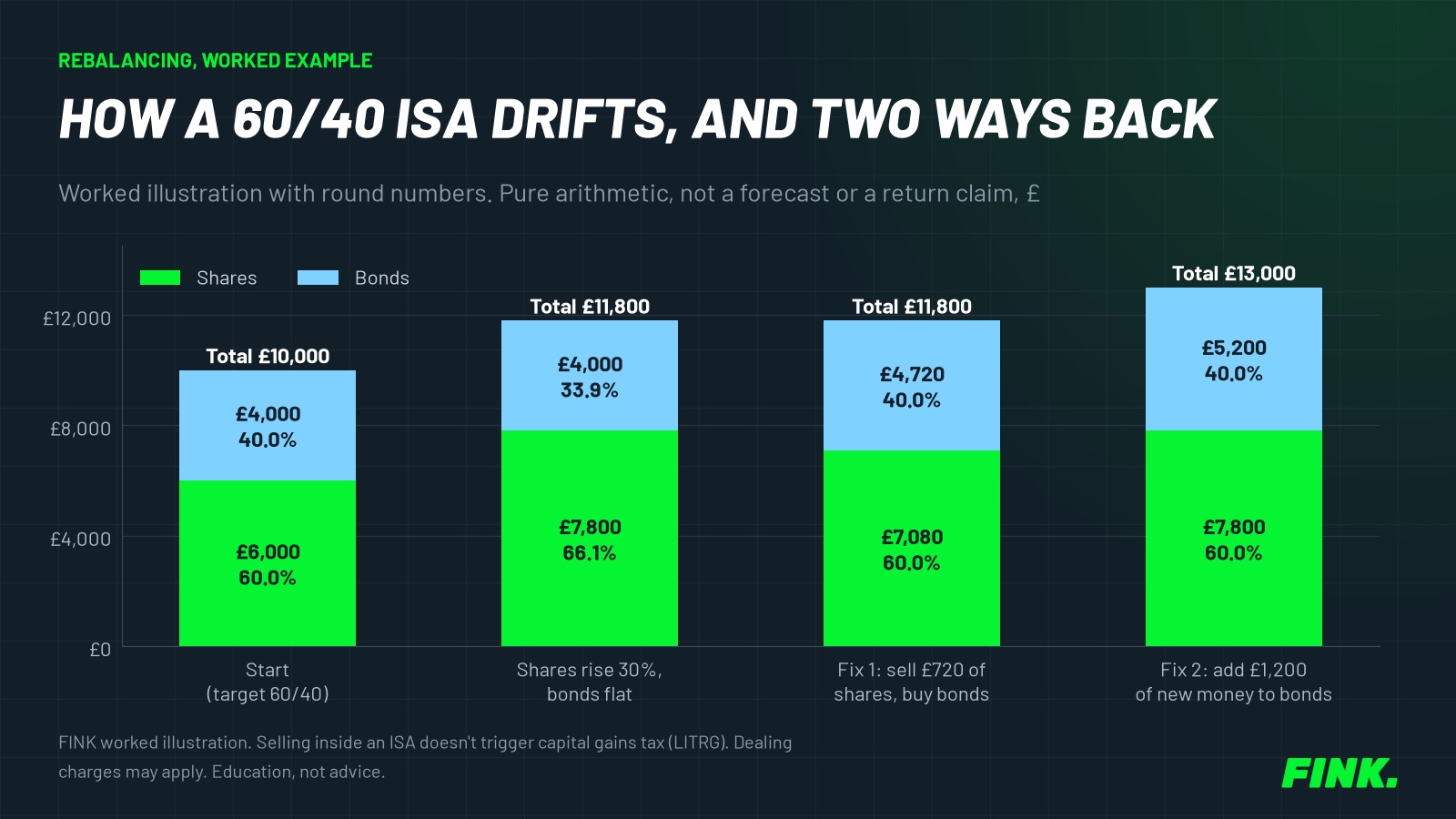
- Start: £10,000 ISA with a 60/40 target, so £6,000 in a shares fund and £4,000 in a bonds fund.
- Drift: shares rise 30% and bonds don't move. Shares are now £6,000 x 1.3 = £7,800. The total is £7,800 + £4,000 = £11,800. Shares are £7,800 / £11,800 = 66.1% and bonds 33.9%.
- Fix 1, sell and buy: the target for shares is 60% of £11,800 = £7,080. Sell £7,800 − £7,080 = £720 of the shares fund and buy £720 of the bonds fund. You end with £7,080 and £4,720, back at 60/40.
- Fix 2, new money: leave the shares alone and add enough to bonds to bring them back to 40%. Shares at £7,800 need to be 60% of the new total, so the total has to be £7,800 / 0.6 = £13,000. That means adding £13,000 − £11,800 = £1,200 to bonds.
The general formulas, if you want to apply them to your own numbers:
- Amount to move by selling = current value of the overweight holding − (target % x total ISA value).
- New money needed instead = (current value of the overweight holding / its target %) − total ISA value.
In this example, the 66.1% share weighting is 6.1 points away from target, beyond the 5% threshold Vanguard suggested as a reasonable trigger.
How often should you rebalance an ISA?
Less often than you'd think. Vanguard found "no optimal frequency or threshold" because results were similar across schedules. What differed was how many trades each approach needed, which is a proxy for cost.
Calendar vs threshold: what the evidence shows
Vanguard tested three types of rule on the same 50/50 portfolio from 1926 to 2014. Here's a selection from its Figures 5 and 6:
| Rule | Average share weighting | Annual volatility | Number of rebalancing trades |
|---|---|---|---|
| Monthly, any drift | 50.1% | 10.1% | 1,068 |
| Quarterly, any drift | 50.2% | 10.1% | 355 |
| Annually, any drift | 50.6% | 9.9% | 88 |
| Monthly check, 1% threshold | 50.1% | 10.1% | 423 |
| Quarterly check, 5% threshold | 50.9% | 10.2% | 50 |
| Annual check, 5% threshold | 51.2% | 9.8% | 36 |
| Annual check, 10% threshold | 52.4% | 10.0% | 19 |
| Never | 80.6% | 13.2% | 0 |
Source: Vanguard (2015), Figures 5 and 6.
The risk barely changes across any of the rebalanced rows. Volatility stays between 9.8% and 10.2%. The number of trades ranges from 19 to 1,068. Vanguard's conclusion was that "annual or semiannual monitoring, with rebalancing at 5% thresholds, is likely to produce a reasonable balance between risk control and cost minimization for most investors."
The three types of rule
- Calendar only: rebalance on a fixed date whatever has happened. Simple, but you may trade when there's barely any drift.
- Threshold only: rebalance whenever the mix moves past a set limit. Vanguard notes this needs constant monitoring, which most people won't do.
- Calendar and threshold: check on a fixed date and only act if the drift is past your limit. This is what Vanguard suggested for most investors.
At FINK we'd add one practical point. Put the review date in your diary. Pick one that isn't tied to market news. A rule you only remember after a big move tends to become a reaction to that move.
How do you rebalance without selling?
Use the money that's already coming in. Vanguard's paper suggests rebalancing with portfolio cash flows: dividends, interest and new contributions. In an ISA there are three ways to do that:
- Direct new contributions to whatever's underweight until the mix is back on target. In the worked example, £1,200 of new money into bonds did the whole job.
- Take dividends and interest as cash rather than reinvesting them automatically, then invest that cash in the underweight part.
- Change a regular investment split for a few months. If you invest £500 a month 60/40, switching it to 0/100 for a while moves the mix back without a single sale.
This approach works best when contributions are large compared with the drift. In a £200,000 ISA that's drifted 6 points, it could take years of contributions to fix. Selling may be more practical.
Does rebalancing an ISA cost anything?
There's no tax, but there can be dealing charges. LITRG confirms there's no capital gains tax on gains inside an ISA. There's no minimum holding period. So the costs are:
| Cost | Inside an ISA | In a general investment account |
|---|---|---|
| Capital gains tax on sales | None | Due on gains above the £3,000 annual exempt amount (gov.uk) |
| Dealing charges | Yes, depending on platform and investment | Yes |
| Stamp duty on UK share purchases | 0.5% | 0.5% |
| Fund ongoing charges | Unchanged by rebalancing | Unchanged |
The tax difference is why it often makes sense to do any selling inside an ISA or pension rather than a taxable account, if you look at all your investments as one mix. Our Bed and ISA guide covers moving taxable holdings into an ISA in the first place.
Platform dealing charges vary a lot. One-off fund deals cost nothing to £3.99 and share or ETF deals £3.99 to £7.50 on the four platforms we checked for our shares or funds guide. A rebalance that sells one fund and buys another is two deals.
What about rebalancing individual shares?
The same logic applies to single holdings. If one share has grown to a much bigger part of the ISA than you intended, trimming it back is a form of rebalancing. The ISA makes that tax-free.
The difference is that a single company can move much further than a broad fund. Our guide to how many shares to hold explains why. The ISA strategy guide shows where reviewing and trimming sit in a full process. The principles of position size are covered in how much to invest in one stock.
A simple ISA rebalancing routine
- Write your target mix down, with the threshold that will trigger action.
- Set one or two review dates a year in your diary.
- On each date, compare the current mix with the target.
- If the drift is inside your threshold, do nothing.
- If it's outside, use new money and income first. Sell only what's left to fix.
- Note what you did and why, so the next review starts from a record rather than memory.