

Is it better to invest a lump sum or drip feed into an ISA?
If the money is already in your hands, the historical record favours investing it in one go. In roughly two out of three periods studied, a lump sum ended ahead of the same money phased in over several months. The other third is the part that matters for your decision, because it tends to include the worst markets.
This question has two versions that often get mixed up:
- You've got a lump sum now (savings, a bonus, an inheritance) and you're deciding whether to invest it all at once or spread it out.
- You're investing from income each month because that's when the money arrives.
The research covers the first. The second isn't really a choice, as we'll come to.
What does the research say?
Vanguard has studied this twice with UK data, in 2012 and 2023. Both found the lump sum won in about two thirds of historical periods, whether the money was phased in over three months or twelve.
The 2023 study
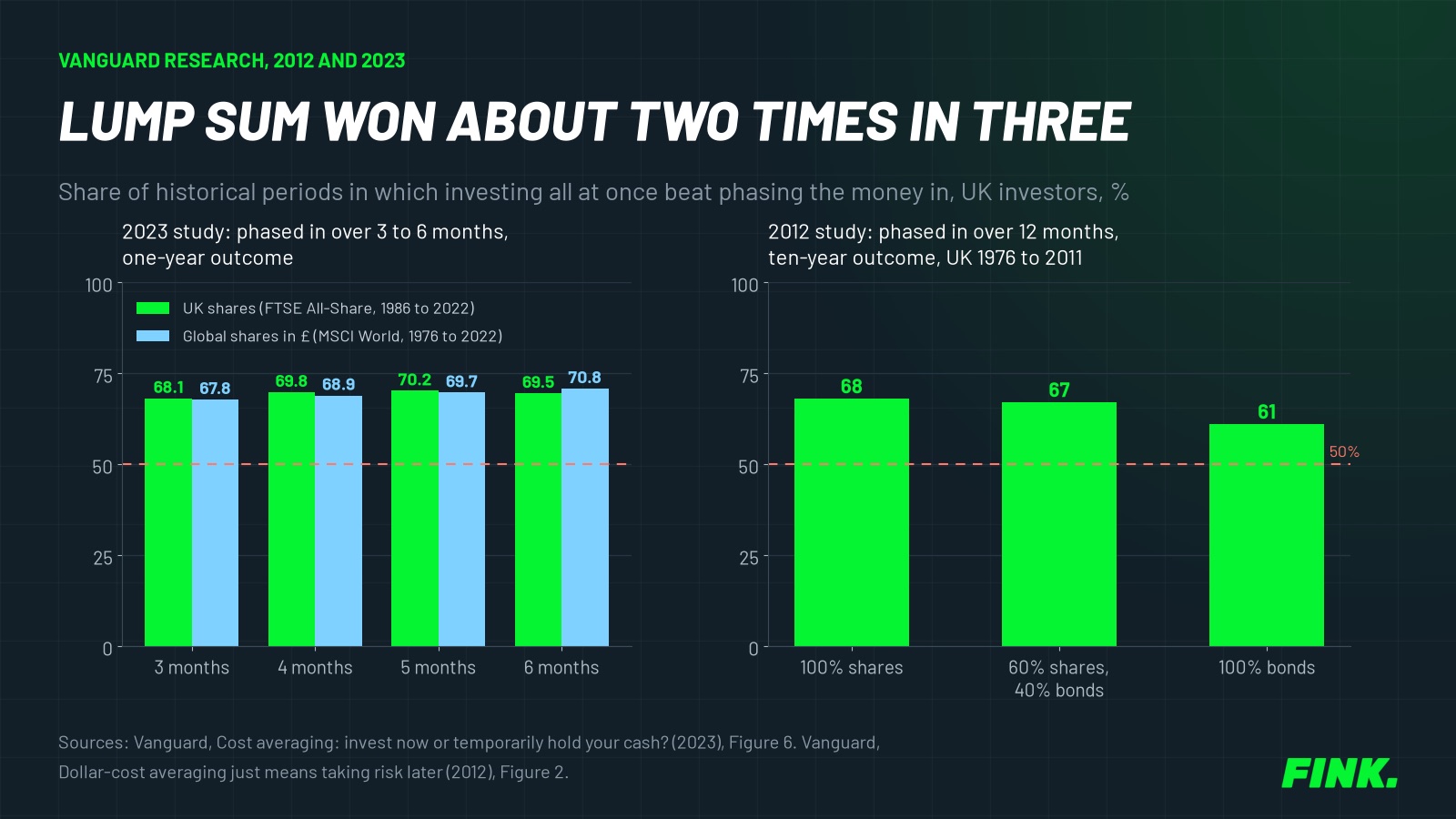
Vanguard's 2023 paper compared investing everything at once with splitting it into equal parts invested a month apart, then measured the result after one year. For UK shares, using the FTSE All-Share from 1986 to 2022, the lump sum won:
| Phasing period | UK shares (FTSE All-Share) | Global shares in pounds (MSCI World) |
|---|---|---|
| 3 months | 68.1% | 67.8% |
| 4 months | 69.8% | 68.9% |
| 5 months | 70.2% | 69.7% |
| 6 months | 69.5% | 70.8% |
Across all the markets it tested, the range was 61.6% to 73.7%. Using global shares, the median one-year result for an all-equity portfolio was 2.2% higher with a lump sum than with three months of phasing (Vanguard UK summary).
The 2012 study
The earlier paper, "Dollar-cost averaging just means taking risk later", phased money in over 12 months and measured the result after ten years. For the UK from 1976 to 2011, the lump sum won in 68% of periods for an all-share portfolio, 67% for 60% shares and 40% bonds and 61% for all bonds. On average, a UK investor in the 60/40 portfolio ended with 2.2% more.
Why the lump sum usually wins
It's simple arithmetic about time in the market. Shares and bonds have usually returned more than cash over long periods. Vanguard notes that from 1976 to 2022, US shares beat cash 76% of the time and bonds 68% of the time. Money waiting in cash to be phased in misses that, so on average the phased approach trails.
When does drip feeding do better?
In falling markets. Those are the periods people remember. The lump sum has the wider range of outcomes: better in the good cases, worse in the bad ones. Phasing in narrows the range at the cost of the average.
The 2012 study shows the size of that spread. For a UK investor starting with £1,000,000 in a 60/40 portfolio, the lump sum's lead after ten years was:
| Outcome (percentile) | Lump sum minus 12-month phasing |
|---|---|
| 5th (among the worst) | -£302,385 |
| 25th | -£36,977 |
| 50th (median) | £64,904 |
| 75th | £174,865 |
| 95th (among the best) | £441,492 |
Those are Vanguard's historical figures for a large hypothetical sum, so treat the pounds as scale, not a forecast. The point is the shape. In the worst one in 20 periods, phasing in left the investor far better off. The 2023 study found the same at one year: at the 5th percentile, cost averaging came out ahead by 3.6% for an all-equity portfolio.
Does a higher cash rate change it?
It narrows the gap but, in Vanguard's tests, didn't close it. When the 2023 study added interest on the cash waiting to be invested, the lump sum still beat three-month phasing 65% of the time for an all-equity portfolio. Vanguard notes that "as cash interest increases, LS's advantage diminishes, all other things being equal". With cash paying more than it did through much of the 2010s, that's worth factoring in, but it doesn't reverse the finding.
Why might someone choose to drip feed anyway?
Because the decision isn't only about the average outcome. It's also about what you'll do next. Vanguard's 2023 paper modelled investors with different levels of risk and loss aversion and found that investors with high loss aversion could prefer cost averaging, even though it usually returns less.
Its advice for that group was to keep the phasing period short: "the opportunity cost should be minimised by investing the capital over a short period, such as three months."
The 2012 paper put the trade-off more bluntly. Phasing in "just means taking risk later". If you hold the money in cash for a year and then invest it all anyway, you've paid the average cost to avoid the risk of feeling bad early.
At FINK we look at it this way: the best plan is the one you'll still be following a year later. If investing a lump sum and watching it fall 15% in the first month would make you sell, phasing in over a fixed, short period is a reasonable price for staying invested. If it wouldn't, the evidence says the wait costs more than it saves on average.
How does drip feeding from salary fit in?
It's not the same decision at all. If you invest £300 a month because that's what's left after bills, there's no lump sum to compare it with. Vanguard's 2012 paper made the same distinction. It described regular investing from income as "a prudent way to invest" and "really the only sound alternative to accumulating that money in cash and then actively trying to time the market at some later point."
Two practical points for monthly ISA investors:
- Regular investing is often free. Hargreaves Lansdown, AJ Bell, interactive investor and Fidelity all charge nothing for regular investing on their charges pages. One-off deals can carry a charge. Our shares or funds guide has the detail.
- The dates take care of themselves. Regular investing spreads your money across the tax year automatically, so the 5 April deadline isn't a scramble.
Choosing the monthly figure itself is a budgeting question rather than a timing one. Our guide to how much to put in a stocks and shares ISA each month works through it.
Lump sum or drip feed: a decision flow
The four questions below take you through it in order. They're a framework for thinking, not a recommendation.
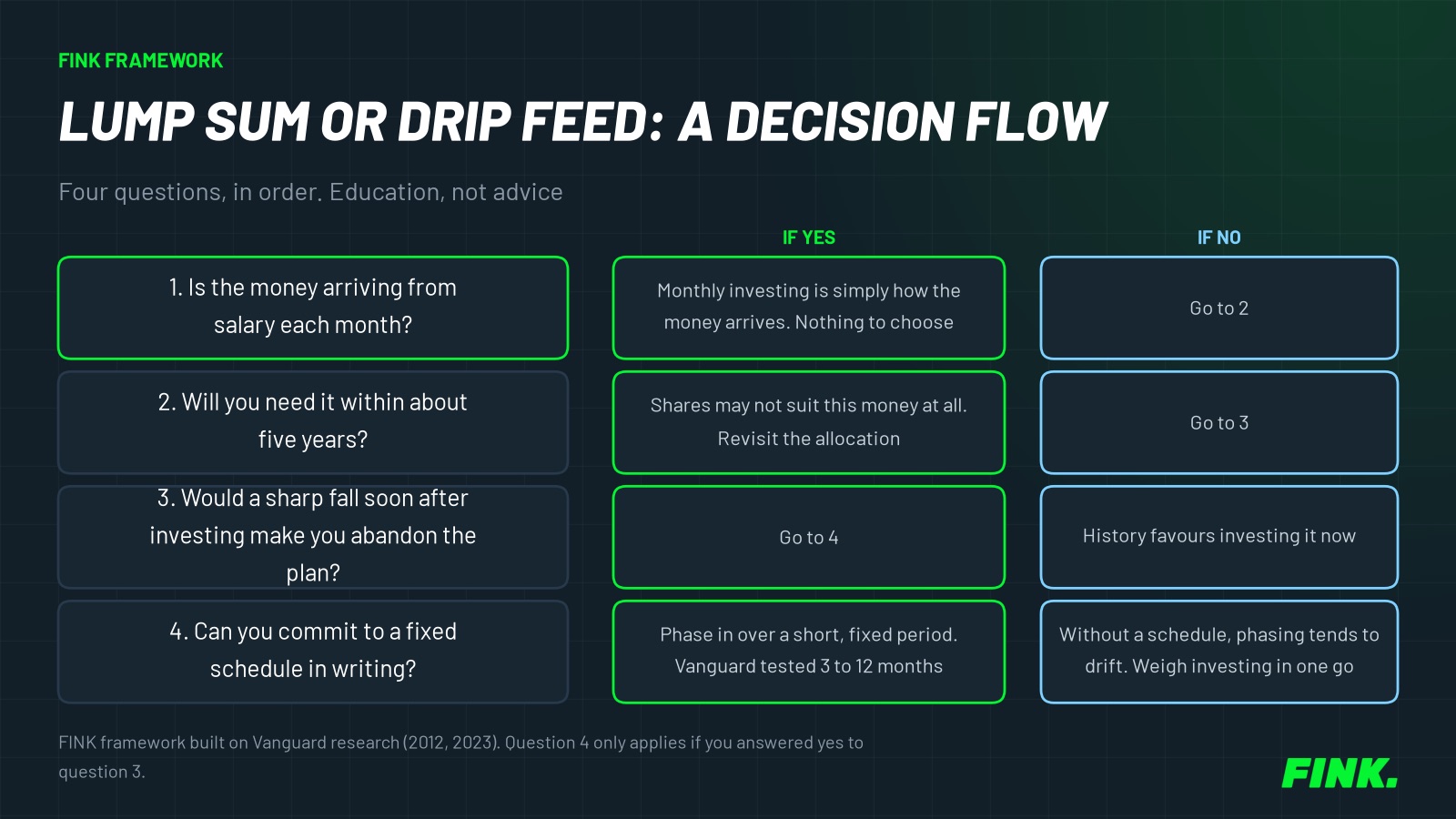
- Is the money arriving from salary each month? If so, monthly investing is simply how it arrives.
- Will you need it within about five years? If so, the bigger question is whether it belongs in shares at all.
- Would a sharp fall soon after investing make you abandon the plan? Be honest. If not, the historical data has favoured investing in one go.
- If it would, can you commit to a fixed schedule in writing? Phasing in only works if it ends. A schedule that pauses every time the news looks bad becomes market timing.
What about the ISA allowance and the tax year?
The ISA rules add three wrinkles:
- The allowance caps the lump sum. You can pay in up to £20,000 in the 2026/27 tax year (gov.uk). A larger sum has to be split across tax years, which forces some phasing whatever you'd prefer.
- Paying in and investing are separate steps. You can pay cash into a stocks and shares ISA before 5 April 2027 to use the allowance, then invest it over the following weeks.
- Cash inside a stocks and shares ISA won't face the 22% charge that was planned from April 2027. HMRC confirmed on 29 October 2026 that the anti-circumvention rules won't take effect (HMRC newsletter 24). Check what interest your platform pays on cash, as it's often low.
Our tax year end guide covers the dates and the ISA strategy guide shows where this decision sits in a full process.