How often does a new ISA dip below what you put in?
Most of the time, at some point in the first year. We tested every monthly start date for the UK market since 1981 to see what a first year has tended to look like.
| First 12 months after each start date (538 starts, January 1981 to October 2025) | Result |
|---|---|
| Index fell below its starting level at some point | 90.5% |
| Median lowest point, compared with the start | 5.9% below |
| Index fell 10% or more below the start at some point | 30.7% |
| Index fell 20% or more below the start at some point | 12.6% |
| Index ended the 12 months below its starting level | 26.6% |
Source: FTSE All-Share price index (^FTAS) daily closes via Yahoo Finance. FINK calculation.
Methodology: we took the first trading day of each month from January 1981 to October 2025 as a start date, then tracked the index for the following 12 months. The figures are price only, so they leave out dividends, charges and any monthly top-ups. They describe a broad UK index, not any fund or share.
Two things come out of it. A dip below what you put in is the normal first-year experience, not a sign something's gone wrong. It isn't always brief either. Of the 165 start dates that saw a fall of 10% or more, 53 still ended the year above their starting level, which means most didn't.
Our guide to a stocks and shares ISA losing money has the longer record of falls and recoveries. A single share can do far worse than the index.
If you're starting small, you're in good company. About three in ten ISA savers paid in £2,000 or less in 2023/24 (how much people pay in each month has HMRC's breakdown). Most UK adults with savings still hold them in cash, as our Starter ISA guide shows from the FCA's survey.
What should you sort out before opening a stocks and shares ISA?
An emergency fund and a plan for any expensive debt. Investments can fall in value at exactly the moment you need cash, so the cushion comes first.
MoneyHelper's guidance on emergency savings suggests three to six months of essential outgoings in instant access savings and clearing costly debt first. Our monthly amount guide turns that into a budget-first worksheet. The table above is the reason it matters: a fall of 10% or more in year one has happened in almost a third of start dates.
Before you open anything, write down three things:
- What the money is for. Retirement, a house deposit or simply long-term wealth.
- When you might need it. Money you could need within a few years is exposed if shares fall just before you need it.
- How you'd feel about a fall. Imagine the account showing a loss of a fifth after a few months. Would you sell?
Those answers shape every later choice and give you something to read when markets get noisy.
How do you open a stocks and shares ISA?
Choose a platform, open the account online and set up a payment. The account takes minutes. The choices around it matter more.
You need to be 18 or over and a UK resident to open a stocks and shares ISA. You can pay into more than one in a tax year, but the total across all your ISAs can't exceed £20,000. HMRC's tax-free savings newsletter 19 confirms the overall allowance stays at £20,000 until April 2031.
When comparing platforms, look at how charges are structured rather than headline offers:
| What to compare | Why it matters for a beginner |
|---|---|
| Platform fee | A flat fee hits small accounts hardest. A percentage fee grows as the pot grows |
| Fund charges | Paid on top of the platform fee, every year |
| Dealing charges | Matter if you buy individual shares or trade often |
| Regular investing option | Some platforms buy funds for free or cheaply on a monthly schedule |
| Cash interest | What uninvested cash earns while it waits |
| Protection | FSCS covers up to £85,000 per person per firm if an investment firm fails |
That last row is about firm failure, not market falls. The FSCS is clear that its investment protection doesn't cover normal losses from investments going down.
What should a beginner invest in first?
Most guides suggest starting with something broad and simple, then adding complexity only if you have a reason. We don't recommend specific funds or shares. What we can do is set out the trade-offs.
A single broad fund, such as a global tracker or a multi-asset fund, spreads money across hundreds or thousands of companies in one purchase. Individual shares put more of the outcome on a few businesses. Our guide to individual shares or funds in an ISA sets out the evidence on both.
The research on individual shares is sobering for beginners: most US stocks over 90 years returned less than Treasury bills, while a small minority drove the market's gains (Bessembinder, 2018). Picking those in advance is hard, which is one reason beginners often start broad. If you do want to look at shares, what to invest in a stocks and shares ISA walks through reading one company's results.
Lump sum or monthly payments?
Both are reasonable. For most beginners the deciding factor is cash flow, not timing. If you're investing from salary, a monthly direct debit happens naturally. If you have a lump sum, the evidence is more mixed.
Our guide to lump sum or drip feeding into an ISA covers the research in detail. For a first year, the regret side deserves extra weight. A dip below the starting value has come in nine start dates out of ten. Someone who'd sell after a bad first month may be better served by a slower start they can stick with.
For deciding how much to pay in each month, our guide to how much to put in a stocks and shares ISA monthly works through a budget-first method.
What does the first year look like, month by month?
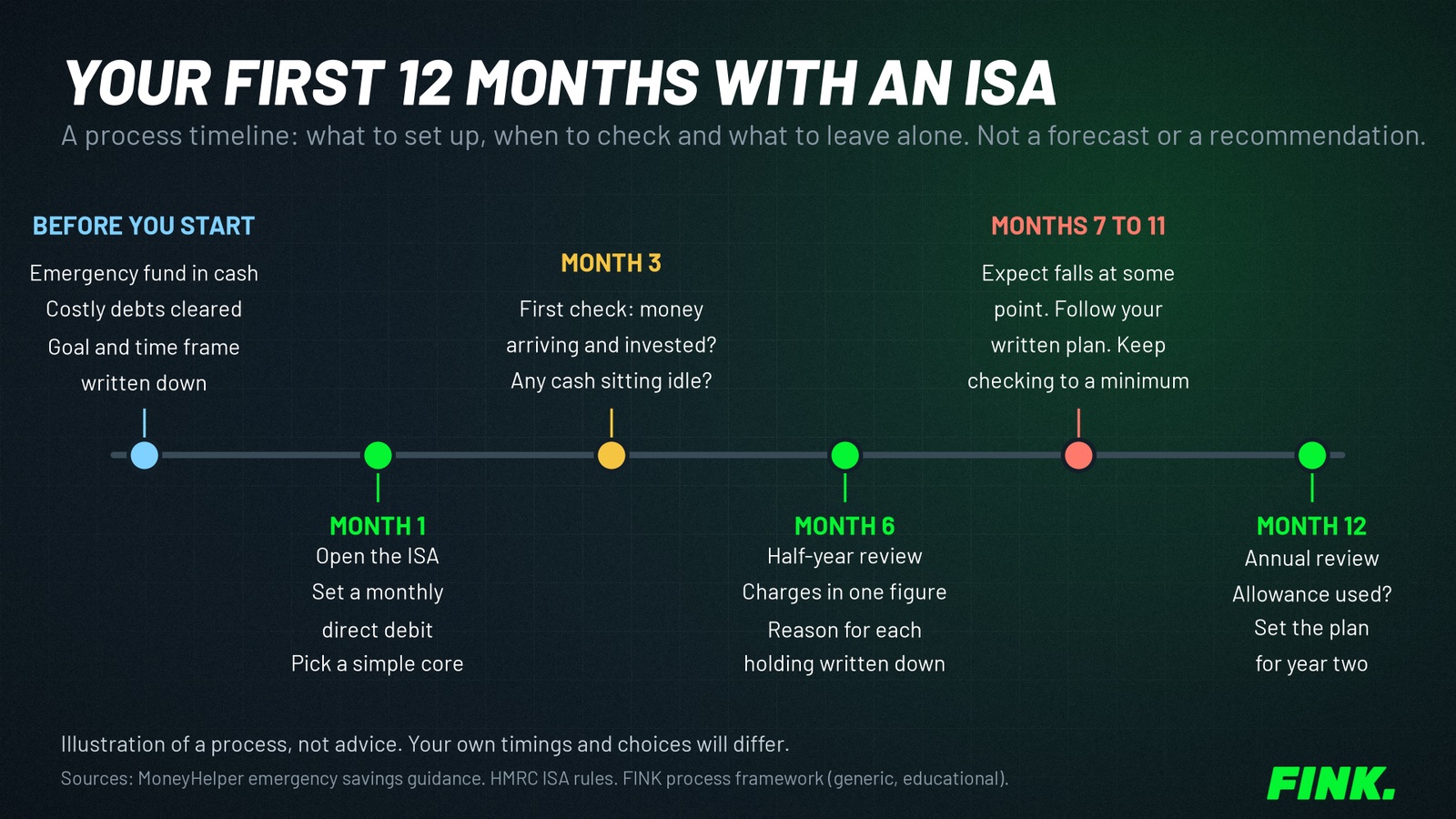
Most of the work happens in month one. After that it's mostly scheduled check-ins. The timeline below is a generic process, not a recommendation for any particular investment.
Here's what each stage involves:
- Before you start. Emergency fund in cash, expensive debts cleared and your goal and time frame written down.
- Month 1. Open the account, set a monthly direct debit and choose a simple core holding. Write one line on why you chose it.
- Month 3. Check the money is arriving and being invested. Look for cash sitting idle by mistake.
- Month 6. Add up all your charges as one yearly figure. If you've added anything beyond the core, check you can still explain why in one sentence.
- Months 7 to 11. Expect a fall at some point. Read your written plan before making any change. Keep checking to a minimum.
- Month 12. Do a full annual review using a checklist such as our annual ISA review checklist. Decide how much to pay in for year two.
The ISA tax year runs from 6 April to 5 April. If you start partway through, the month 12 review might fall in a different tax year from the one you opened in, which is fine.
What mistakes do new investors make most often?
The research points to behaviour rather than fund choice. Three findings come up again and again.
Trading too much
The households that traded most in Barber and Odean's study of US brokerage accounts lagged the market by several percentage points a year, mostly through costs (Journal of Finance, 2000). Our guide to individual shares or funds in an ISA puts that study next to research on how few shares most private investors hold.
Buying and selling at the wrong times
Morningstar's Mind the Gap 2025 study found US fund investors earned less than the funds they held because of when they bought and sold. It's US data. Our losing money guide explains how it's measured. For a new investor, the first-year table above shows where the temptation comes from: a dip is likely and a deep one is common enough to plan for.
Checking too often
Shlomo Benartzi and Richard Thaler described myopic loss aversion in 1995. People feel losses more than equal gains. The more often they look, the more losses they see. Our first-year numbers show why that bites early. The index dipped below its starting value in nine start dates out of ten, so someone checking daily would almost certainly have seen red at some point.
A 1997 experiment by Thaler and colleagues tested this directly. Their paper is The Effect of Myopia and Loss Aversion on Risk Taking. Participants who got frequent feedback took less risk and ended up with less money than those who saw results less often.
The counter-view
Not every study finds frequent attention harmful. Checking a new account regularly also catches real problems, such as a payment that hasn't gone through or cash left uninvested for months. The month three check-in is there for exactly that. The research above is about reacting to price moves, not about making sure your money arrived.
How do you handle your first fall?
Decide what you'll do before it happens. A written rule is easier to follow than a decision made while watching the account drop.
At FINK we look at it this way: a fall in a diversified fund is a normal part of investing. A fall in a single share is a prompt to check whether the reason you bought it still holds. Those are different questions and they deserve different answers.
A simple pre-commitment might read: "If the account falls, I won't sell the core fund unless my goal or time frame has changed. I'll keep the monthly payment going unless I need the cash." The point isn't the exact words. It's that you wrote them when you were calm.
If you hold individual shares, the question is different and our stocks and shares ISA strategy guide covers how a full process handles reviews and selling.