

When should you review your ISA?
Once a year at a fixed point works for most long-term investors. Common choices are the start of the tax year on 6 April or a few weeks before it ends on 5 April.
A fixed date has two advantages. It means the review happens even when markets are calm. It also means you're not reviewing only when something has gone wrong, which is when people tend to make rushed decisions.
There's a timing pattern in the data too. interactive investor reported that 28% of the year's subscriptions from its investors came in between 6 and 30 April 2025. Many people already think about their ISA around the tax-year change, so it's a natural point to review it properly.
Why does an annual review matter?
Because many ISAs aren't actively managed at all. HMRC's Annual Savings Statistics, published in September 2026, show how varied ISA behaviour is.
| Measure (2023 to 2024) | Figure |
|---|---|
| ISA holders | About 23 million |
| Average value per holder | £37,831 |
| Subscribers who paid in the full £20,000 | 28.8% |
| Subscribers who paid in £2,000 or less | 30.7% |
| Holders aged 66 and over who didn't subscribe that year | 52.3% |
Source: HMRC Annual Savings Statistics, September 2026.
None of this is a problem on its own. Plenty of people stop paying in later in life and simply hold. But an ISA nobody looks at can drift into a shape its owner never chose, without anyone deciding it.
The 12-point annual ISA review checklist
Work through these in order. The first four are about money in, the next five about what you hold and the last three about the account itself.
Money in
1. How much allowance is left this tax year?
The ISA allowance is £20,000 for 2026 to 2027 and will stay at that level until April 2031, according to HMRC's tax-free savings newsletter. Unused allowance is lost on 5 April. Our guide to the stocks and shares ISA end of tax year covers the deadline in more detail.
2. Has anything changed in the rules?
The Budget on 28 October 2026 scrapped the planned £12,000 cash ISA limit, so the full £20,000 can still go into cash from April 2027. HMRC's October 2026 newsletter confirmed this and said the government would explore a new incentive for first-time stocks and shares ISA investors.
3. Are regular contributions still the right size?
Check the monthly amount against what you can afford now. Our guide on how much to put in a stocks and shares ISA each month runs through the arithmetic.
4. Is there money outside the ISA that could move in?
Shares in a general investment account can be moved in through a bed and ISA, using this year's allowance. Outside an ISA, dividends above £500 and gains above £3,000 are taxable, per GOV.UK and GOV.UK.
What you hold
5. Does the mix still match your plan?
Write down your current split, for example between a core fund and individual shares. Then compare it with your target. Our guide to rebalancing a stocks and shares ISA covers when and how.
6. Has any one holding grown too large?
A winner can grow into a large share of the portfolio without any further buying. Our guide to sizing a single share position shows the arithmetic and some ways to set a ceiling.
7. Do your funds overlap?
Our analysis of iShares holdings files found heavy overlap between global and US trackers. On 29 and 30 October 2026, 98.7% of the Core S&P 500 by weight sat in companies the Core MSCI World also holds. The ISA fund overlap guide explains how to check yours.
8. Does each holding still have a reason to be there?
For each fund or share, write one line on why you own it. If you can't, that's worth looking into. The investment thesis template gives a simple format.
9. Are dividends being reinvested or paid out as you intended?
Check whether income is set to reinvest, accumulate in cash or be paid out. Dividends inside an ISA aren't taxed, so this is about what you want the money to do. Our ISA dividends guide covers the options.
The account itself
10. What does the account cost?
Add up the platform fee, each fund's ongoing charge and any dealing charges from the past year. Then compare that total with the account value.
11. How much uninvested cash is there and what does it earn?
Cash waiting to be invested piles up quietly. interactive investor said cash made up 8.4% of all ISA holdings on its platform in February 2026. Check the interest rate your platform pays on it.
12. Is the account still the right one?
If charges, service or investment choice no longer suit you, you can transfer an ISA without losing its tax status. Our guide to how many stocks and shares ISAs you can have covers the time limits and merging old accounts. Use the official transfer process rather than withdrawing, because withdrawn money from a stocks and shares ISA counts towards your allowance if you put it back, according to LITRG.
How much do ISA charges cost over time?
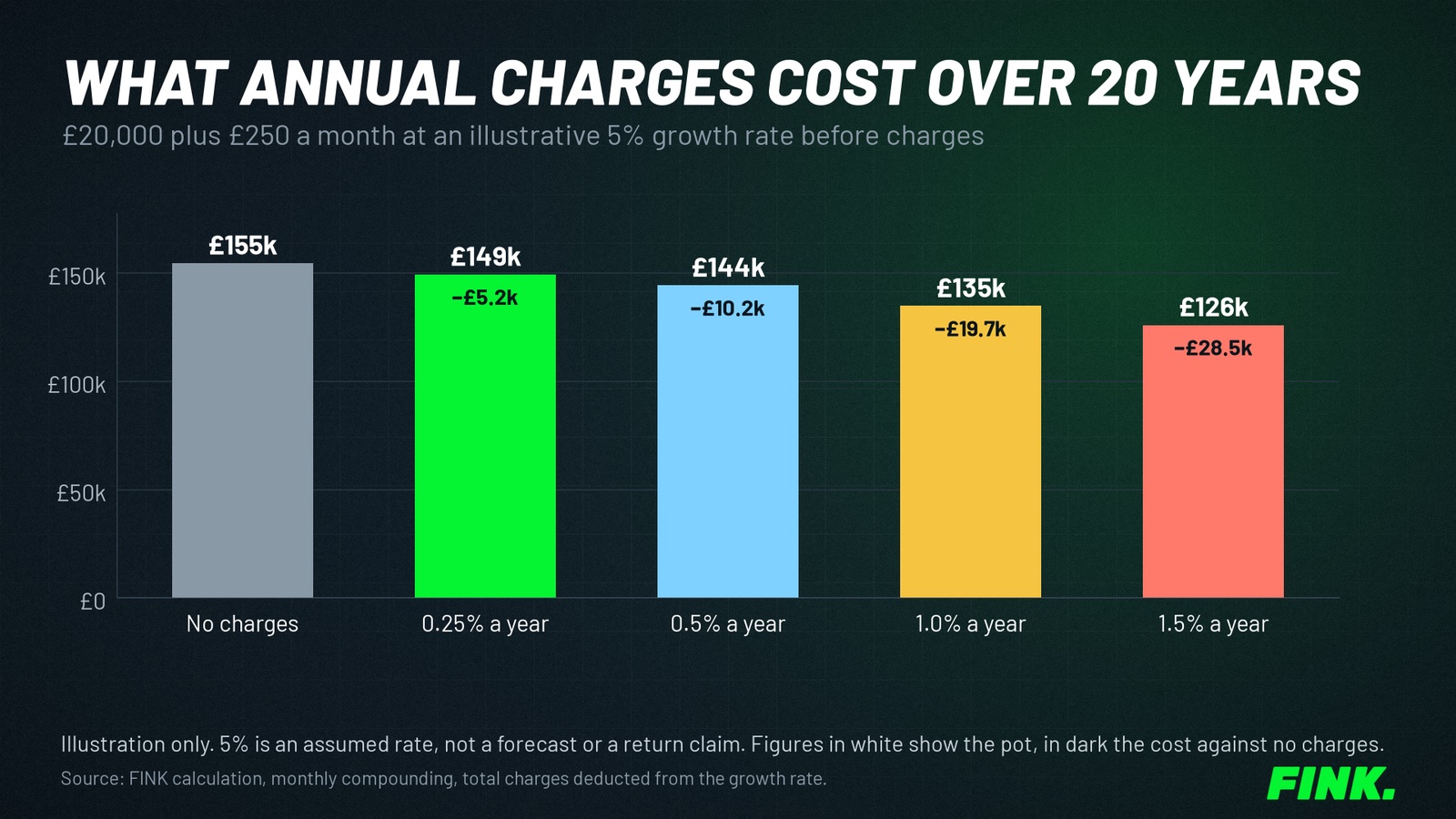
More than the yearly percentage suggests, because charges come off the growth every year. The chart shows an illustration: £20,000 invested at the start plus £250 a month for 20 years, with growth before charges set at 5%.
| Total yearly charges | Pot after 20 years | Cost against no charges |
|---|---|---|
| 0% | £154,500 | £0 |
| 0.25% | £149,300 | £5,200 |
| 0.5% | £144,300 | £10,200 |
| 1.0% | £134,800 | £19,700 |
| 1.5% | £126,000 | £28,500 |
Method: £20,000 at the start plus £250 at the end of each month, growing at the monthly equivalent of 5% minus the charge, rounded to the nearest £100. Total paid in is £80,000. The 5% figure is an illustration, not a forecast.
Charges aren't the only thing that matters. A higher-cost fund may be worth it to someone for a specific reason. But charges are one of the few parts of investing you know in advance. That alone makes them worth checking every year.
What did the FCA find about cash interest on platforms?
That most platforms it surveyed kept part of the interest earned on investors' cash. In December 2023 the FCA wrote to firms after reviewing 42 platforms and SIPP operators.
Its findings:
- 71% retained some of the interest earned on investors' cash balances.
- Some of those also charged a fee on the same cash, which the FCA called "double dipping" and told firms to stop.
- It said firms had to show this represented fair value under the Consumer Duty.
Practices have changed since then. Many platforms now publish the interest they pay and keep. The review point is simple: know how much cash you hold, what it earns and whether it's there on purpose.
What should you write down after the review?
A one-page record is enough. The point is to be able to compare this year with last year without relying on memory.
| Item | What to record |
|---|---|
| Date and account value | The value on the review date and the total paid in so far |
| Allowance | How much of this year's £20,000 you've used and what's planned |
| Mix | Current split against target, for example core fund versus individual shares |
| Largest holdings | The top five by real exposure, including what you own through funds |
| Charges | Platform fee, fund charges and dealing costs as one yearly percentage |
| Cash | Uninvested cash, the rate it earns and why it's there |
| Changes | Anything you bought, sold or changed, with the reason in one line |
| Next review | The date of the next one |
Keeping the same table every year turns the review into a record of decisions. Over time it shows which changes helped and which were reactions to the news.
What should you not change at an annual review?
Anything that's only changed because of recent price moves. A review is a check against a plan, not a prompt to trade.
The evidence on private investors, which we cover in individual shares or funds in your ISA, is that more trading has tended to mean worse results after costs. A review that ends in "no change" is a perfectly good outcome.
A few habits that keep a review useful:
- Write the result down, even if the answer is "no change".
- Change one thing at a time where you can, so you know what made a difference.
- Use new money before selling to fix the mix.
- Keep a record of reasons for anything you buy or sell.
At FINK we look at it this way: the review is where a process either holds or slowly falls apart. Our guide to building a stocks and shares ISA strategy shows how the yearly review fits with everything else.


