Are dividends in a stocks and shares ISA tax-free?
Yes. Dividends from shares and funds held in an ISA are free of UK tax. You don't need to report them either. GOV.UK says it plainly: "You do not pay tax on dividends from shares in an ISA."
Outside an ISA the position is different. Everyone gets a £500 dividend allowance each year. Anything above it gets taxed at your income tax band. Rates for 6 April 2026 to 5 April 2027, from the same GOV.UK page, are:
| Tax band | Dividend tax rate outside an ISA (2026 to 2027) | Inside an ISA |
|---|---|---|
| Basic rate | 10.75% | 0% |
| Higher rate | 35.75% | 0% |
| Additional rate | 39.35% | 0% |
Both the basic and higher rates rose by 2 percentage points from April 2026, from 8.75% and 33.75%, according to the government's policy paper on property, savings and dividend income. The additional rate stayed at 39.35%.
The allowance has shrunk too. It was £1,000 in 2023 to 2024, as ii notes. It's been £500 since. ISA dividends don't use up that allowance, which leaves the full £500 for anything you hold outside the wrapper.
How much tax does an ISA save on dividends?
For small portfolios the saving is modest. It grows quickly once yearly dividends are well above £500, especially for higher rate taxpayers. To show the scale we used a 3.3% yield, which is AJ Bell's consensus forecast for the FTSE 100's dividend yield in 2026, published on 8 October 2026.
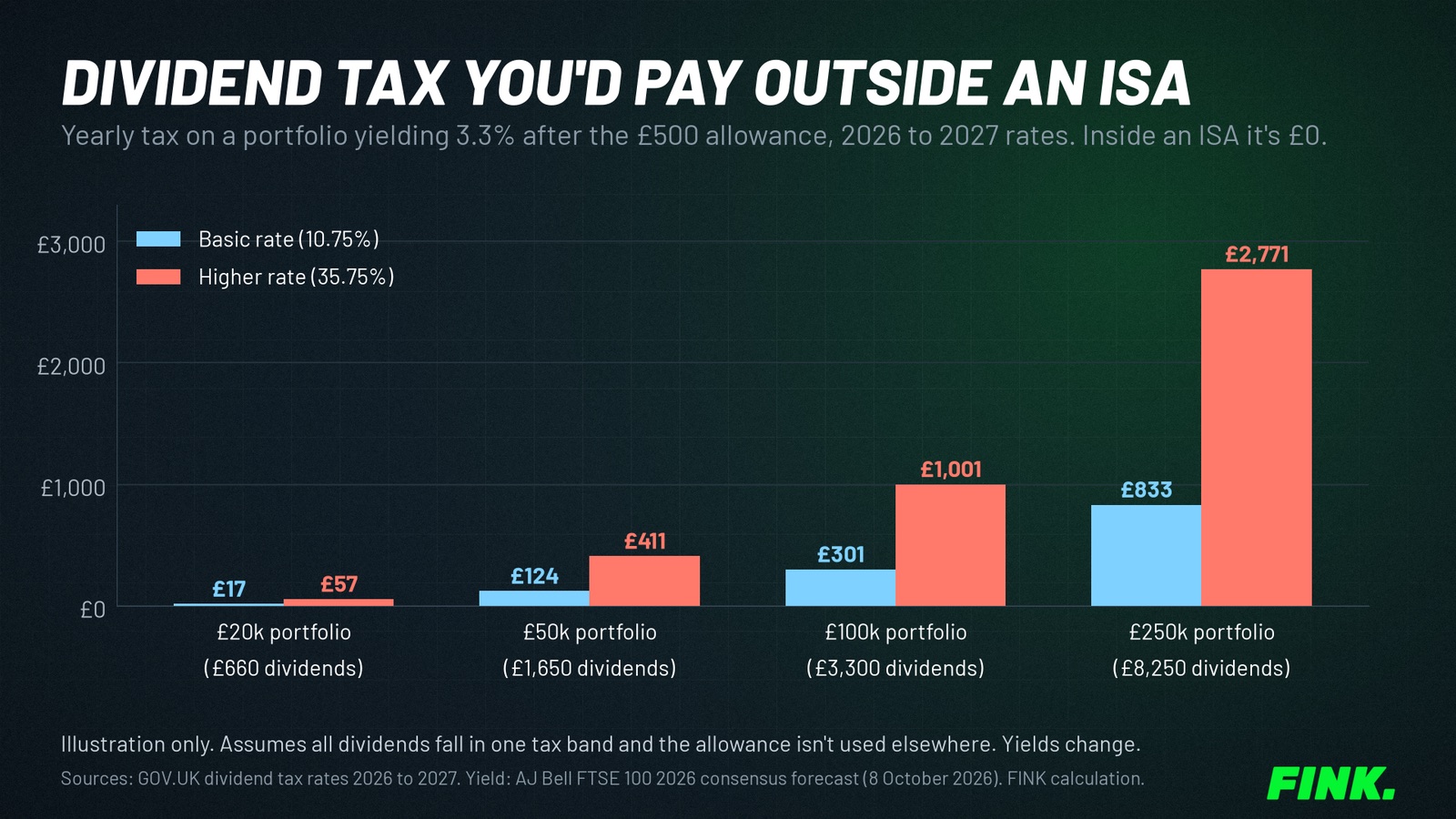
The method is simple. We multiplied each portfolio by 3.3% to get yearly dividends, took off the £500 allowance and applied each tax rate to the rest:
| Portfolio | Yearly dividends at 3.3% | Basic rate tax | Higher rate tax | Additional rate tax |
|---|---|---|---|---|
| £20,000 | £660 | £17 | £57 | £63 |
| £50,000 | £1,650 | £124 | £411 | £453 |
| £100,000 | £3,300 | £301 | £1,001 | £1,102 |
| £250,000 | £8,250 | £833 | £2,771 | £3,050 |
This is an illustration with simplifying assumptions. It treats all dividends as falling in one tax band and assumes the £500 allowance isn't used by other holdings. Real yields vary by holding and change every year. A portfolio of growth companies might yield far less than 3.3%, while some income funds yield more.
The table also shows why the tax shelter matters more over time. A pot that starts at £20,000 might grow into the higher rows. Meanwhile the allowance has fallen from £1,000 to £500 in the space of two tax years.
Holding dividend payers inside the ISA first and anything else outside is a common approach for people with both types of account. Moving existing holdings across means a bed and ISA, which has its own tax maths. And if what you're after is how big a pot would need to be to live off its dividends, how much you need to be financially free runs that sum.
Do reinvested dividends count towards your ISA allowance?
No. Only new money you pay in counts towards the £20,000 allowance. ii's help page puts it directly: "Reinvested dividends do not count as ISA contributions." Income, interest and growth earned inside the account are all outside the allowance.
That means a £20,000 ISA that pays £660 of dividends can reinvest the full £660 and you can still pay in a fresh £20,000 that tax year.
One point catches people out with US shares. The ISA wrapper removes UK tax but not tax deducted by other countries before the dividend reaches you. For US shares, a completed W-8BEN form normally cuts US withholding from 30% to 15%, as ii's guide to US shares in an ISA explains. That 15% is usually lost even inside an ISA.
Other countries have their own rates.
Should you choose accumulation or income units?
They hold the same investments. The difference is what happens to the income. Most funds offer both types and the label is usually "Acc" or "Inc" in the fund name.
| Accumulation (Acc) units | Income (Inc) units | |
|---|---|---|
| What happens to dividends | Kept in the fund and reflected in a higher unit price | Paid out as cash to your account |
| Effort | None, reinvestment is automatic | You decide what to do with the cash |
| Dealing costs on reinvestment | None, as it happens inside the fund | Possible, if your platform charges to reinvest |
| Useful for | Building the pot when you don't need income | Taking income or redirecting cash to other holdings |
| Tax inside an ISA | None | None |
Outside an ISA there's a common misunderstanding. Accumulation units are still taxed on the income they reinvest, even though no cash is paid out. AJ Bell's comparison of Acc and Inc funds explains how these "notional distributions" work. Inside an ISA the point doesn't matter because neither type is taxed.
For individual shares there's no accumulation option. Dividends arrive as cash. Many platforms offer an automatic reinvestment service that buys more of the same share. Some charge for it, so it's worth checking the terms on your own platform.
What does the research say about reinvesting dividends?
The theory says a dividend doesn't make you richer on its own. The evidence says many investors behave as though it does. Both points matter for deciding what to do with the cash.
The theory: a dividend comes out of the share price
In 1961 Merton Miller and Franco Modigliani set out what's known as dividend irrelevance. In a simplified market with no taxes or costs, a company paying a dividend doesn't make its shareholders richer. The cash leaves the company and the share price falls by about the same amount on the ex-dividend date. What you own after the payment is the same value split between shares and cash.
Real markets have taxes and costs, which is why the ISA wrapper matters. But the core idea holds up well. A 3.3% yield isn't a 3.3% gain on top of the share price. It's part of the total return, not an extra.
The evidence: investors treat dividends as separate income
Samuel Hartzmark and David Solomon studied how investors respond to dividends in a 2019 paper in the Journal of Finance, The Dividend Disconnect. Their abstract states that many investors "trade as if dividends and capital gains are disconnected attributes, not fully appreciating that dividends result in price decreases". It also finds that "investors rarely reinvest dividends".
Methodology: the authors used US trading data from individual investors, mutual funds and institutions. They looked at what they did with holdings around dividend payments. They tested whether decisions to sell tracked price changes or total returns including dividends.
The practical point for an ISA investor is that cash from dividends tends to sit uninvested or get spent without a decision being made. In an ISA, cash sitting idle doesn't compound at the rate the investments might.
The counter-evidence: dividends can be cut
Dividends aren't guaranteed. In 2020 UK companies paid £61.9 billion in dividends, down 44% on 2019 and the lowest total since 2011, according to the Link Group UK Dividend Monitor reported by Trustnet. Anyone relying on dividend income that year saw it fall sharply.
So a yield isn't a fixed number to plan around. It also explains why some investors prefer to focus on total return. When they need cash they sell small amounts of holdings rather than depend only on what companies choose to pay.
How much difference does reinvesting make?
Over long periods, a lot. The illustration below assumes the share price never changes so the effect of reinvestment shows on its own. It's arithmetic, not a forecast. Yields change and prices rarely stay flat.
| £10,000 at a 3.3% yield, flat prices | Take the income | Reinvest the income |
|---|---|---|
| Value after 10 years | £10,000 plus £3,300 of income received | £13,836 |
| Value after 20 years | £10,000 plus £6,600 of income received | £19,143 |
When the income is taken, the pot stays at £10,000 and pays £330 a year. When it's reinvested, each year's dividend buys more shares, which pay their own dividends the following year. After 20 years the reinvested pot is worth about £2,500 more than the original £10,000 plus every pound of income taken.
Taking the income isn't a mistake if you're spending it on something you need. The difference only becomes a loss when the cash sits idle in the account.
How do dividends fit with rebalancing and position sizing?
Dividend cash is fresh cash you can direct wherever it's needed, without selling anything. That makes it a useful tool for keeping a portfolio close to the shape you planned.
Automatic reinvestment puts each dividend back into the holding that paid it. Over time that adds most to the largest holdings and the highest yielders, which can push a portfolio away from its target mix. Taking dividends as cash and directing them to the holdings that are below target is a gentle way to rebalance. Our guide to rebalancing a stocks and shares ISA covers the wider process.
The same logic applies to individual shares. A high-yielding holding whose dividends get reinvested every time can grow into a bigger slice of the portfolio than you meant it to be. Our guide to capping how much goes in one share looks at the principles of sizing.
At FINK we look at it this way: decide the rule once and write it down, so dividends get used on purpose.
A decision flow for your ISA dividends
Four questions settle it for most people. Work through them in order:
- Do you need the income to live on now? If yes, income units or taking dividends as cash fit that, with a plan for the possibility of cuts. If no, move on.
- Is your portfolio close to its target mix? If yes, accumulation units or automatic reinvestment keep things simple. If no, taking dividends as cash and sending them to the holdings below target does some of the rebalancing for you.
- Does your platform charge to reinvest dividends from shares? If the charge is large compared with your dividends, collecting cash and investing it in one go may cost less.
- Do you hold US or other overseas shares? If so, check your W-8BEN is in place and accept that some foreign tax is usually lost.
Then write down the answer in one line. For example: "Reinvest automatically in the core fund, take share dividends as cash and invest them each quarter in whatever is furthest below target". Review it once a year alongside the rest of the ISA. Our whole-ISA strategy guide shows where this fits in a full process.