

What happens to a stocks and shares ISA on 5 April?
Nothing happens to the investments. They don't move, they keep their value and they stay tax-free. What ends on 5 April 2027 is the 2026/27 allowance, the £20,000 you can pay in during that tax year. From 6 April 2027 you get a fresh allowance.
Gov.uk puts the key point plainly: "Your ISAs will not close when the tax year finishes. You'll keep your savings on a tax-free basis for as long as you keep the money in your ISA accounts."
So the end of the tax year is about one thing: whether you've paid in what you meant to. Everything else in this guide is about getting that right without a last-minute scramble.
Does unused ISA allowance roll over?
No. Each tax year's allowance applies to that year only. Gov.uk describes it as up to £20,000 "every tax year" and there's no mechanism to carry unused allowance forward. If you pay in £8,000 in 2026/27, the other £12,000 is gone on 6 April 2027.
That's different from pensions, where unused annual allowance can sometimes be carried forward from earlier years (gov.uk). ISAs have no equivalent.
How much do people actually pay in?
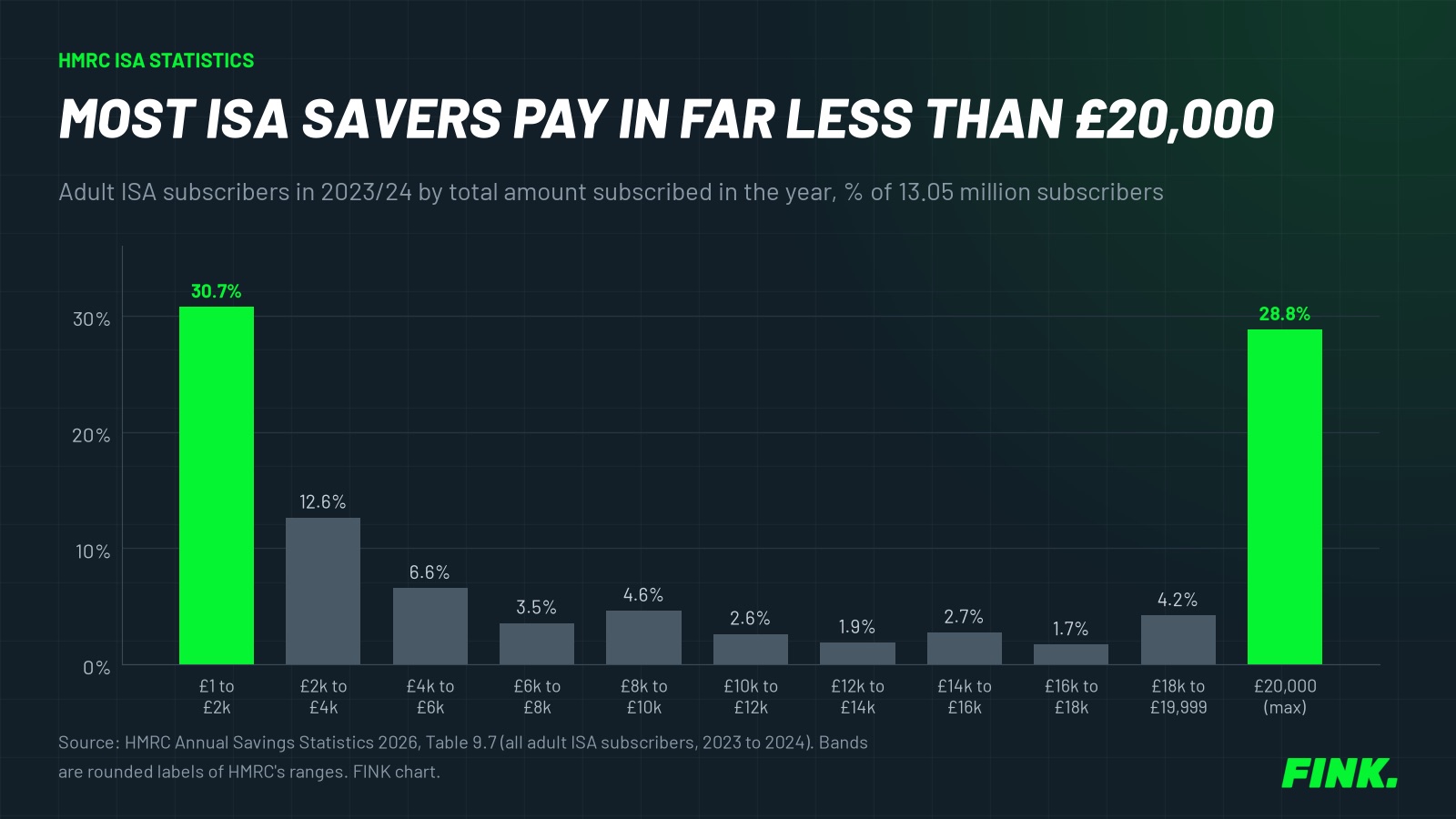
Far less than the maximum, for most. HMRC's ISA statistics show how 2023/24 subscriptions were spread across 13.05 million adult ISA savers.
| Amount paid in during 2023/24 | Subscribers | Share |
|---|---|---|
| £1 to £2,000 | 4,013,326 | 30.7% |
| £2,001 to £10,000 | 3,568,296 | 27.3% |
| £10,001 to £19,999 | 1,712,506 | 13.1% |
| £20,000 (the maximum) | 3,760,433 | 28.8% |
| All subscribers | 13,054,561 | 100% |
Source: HMRC Table 9.7. We added the middle bands together from HMRC's £2,000 ranges. The table header says "thousands" but the values are individual counts.
HMRC's commentary describes the lowest band as £1 to £2,499, while the table's own band is £1 to £2,000. We've used the table.
Two more figures from the same table put that in context. HMRC estimates 23.0 million adults held an ISA, but 9.97 million of them made no new subscription in 2023/24. For stocks and shares ISAs on their own, the pattern is similar, as our monthly contributions guide shows.
The practical point: for most savers, the tax year end isn't a race to find £20,000. It's a check that the plan for the year happened.
What are the key dates for 2026/27?
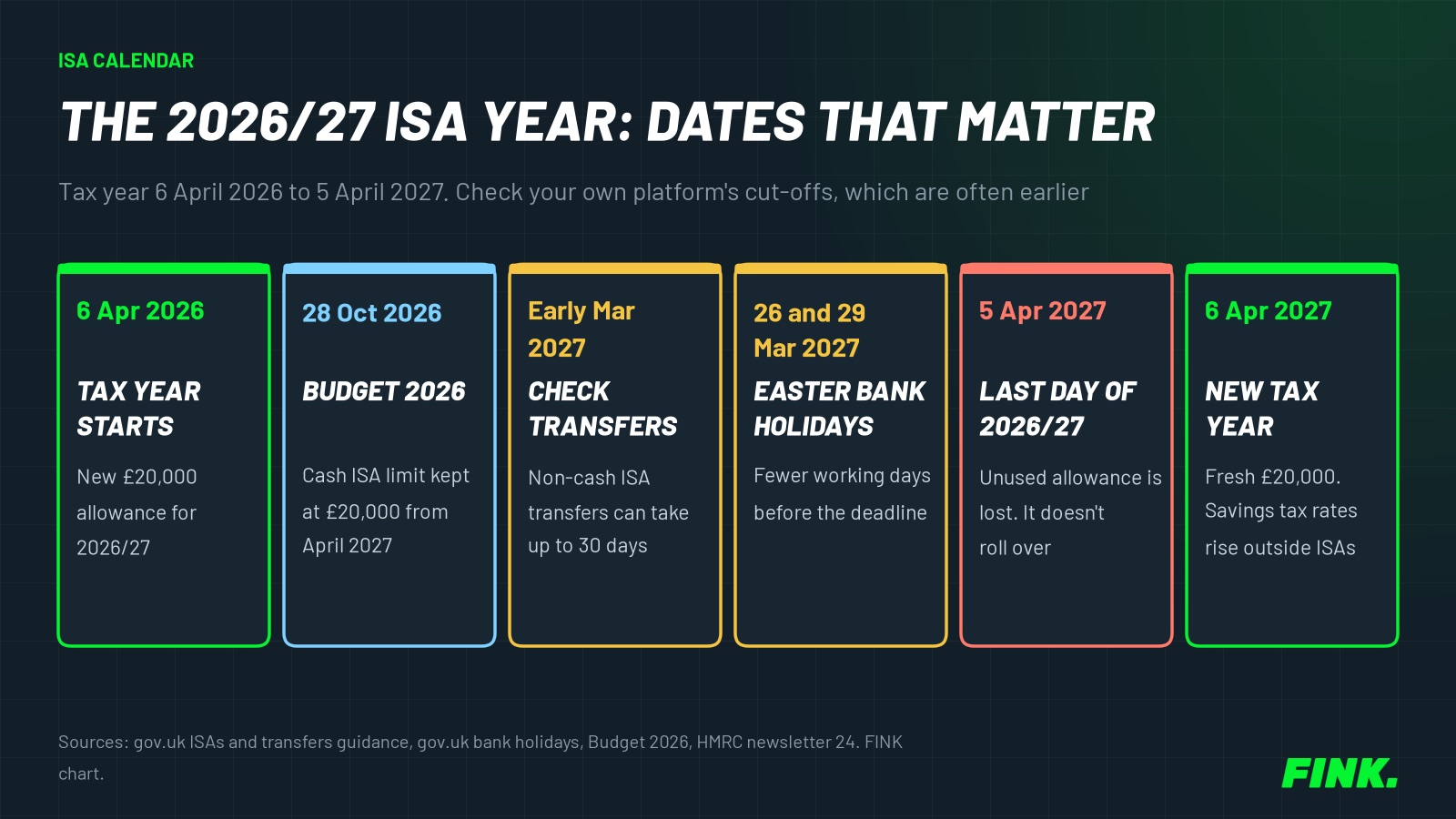
The tax year runs from 6 April 2026 to 5 April 2027. Inside that window, the dates that need planning are the transfer times and the bank holidays near the end.
| Date | What happens |
|---|---|
| 6 April 2026 | 2026/27 tax year starts with a £20,000 allowance |
| 28 October 2026 | Budget 2026 keeps the cash ISA limit at £20,000 from April 2027 |
| Early March 2027 | Sensible point to start any ISA transfer, as non-cash transfers can take up to 30 calendar days |
| 26 and 29 March 2027 | Easter bank holidays in England and Wales (gov.uk) |
| 5 April 2027 | Last day of the 2026/27 tax year |
| 6 April 2027 | New £20,000 allowance. Savings income tax rates rise outside ISAs |
Why the transfer timing matters
Gov.uk says ISA transfers "should take no longer than" 15 working days between cash ISAs and 30 calendar days for other transfers (gov.uk). A transfer doesn't use allowance, so a slow transfer doesn't cost you this year's allowance in itself. The risk is when you're relying on money arriving from a transfer to make a new subscription, or when you want to subscribe to the new provider this tax year.
Why platform cut-offs matter
Many platforms stop accepting some payment types, or opening new accounts, a few working days before 5 April so payments clear in time. With the Easter bank holidays on 26 and 29 March 2027, there are fewer working days in the last fortnight than usual. Your platform's own year-end page is the source to check.
Does the money need investing before the deadline?
No. Using the allowance means paying money in, not investing it. You can pay cash into a stocks and shares ISA before 5 April 2027 and invest it in the weeks after. That separates the tax deadline from the investment decision, which is useful if you'd rather not invest a large sum in a hurry.
Holding that cash won't face a special charge. The 22% charge on interest paid on cash in stocks and shares ISAs, planned for April 2027, won't take effect, as HMRC confirmed in its October 2026 newsletter. Our guide to ISA changes 2027 has the details. The lump sum or drip feed guide covers how to invest it once it's in.
How do flexible ISAs change the year end?
A flexible ISA lets you withdraw and replace money in the same tax year without it counting twice. That matters near the deadline if you've taken money out earlier in the year.
The deadline is what matters here: the replacement has to happen in the same tax year. Our withdrawal rules guide works through gov.uk's example of how much allowance is left after a withdrawal. Money withdrawn in 2026/27 and put back after 6 April 2027 uses the new year's allowance. Not every stocks and shares ISA is flexible. Gov.uk says your provider can tell you.
What should you check before 5 April 2027?
A short list, in order:
- How much have you paid in this tax year? Add up every ISA, not just one. The £20,000 is shared across cash, stocks and shares, innovative finance and Lifetime ISAs.
- Do you want to pay in more? If so, check your platform's cut-off and payment method.
- Is any transfer pending? Start it by early March if the timing matters to you.
- Is your ISA flexible? If you've withdrawn money this year, find out whether you can put it back without using allowance.
- Do you hold investments outside an ISA? A Bed and ISA moves them in, using this year's allowance and possibly this year's capital gains allowance too.
- Does your split still match your plan? The year end is a natural review date. Our rebalancing guide explains how.
What changes from 6 April 2027?
The ISA rules themselves don't change much. The overall allowance stays at £20,000, frozen until April 2031. The cash ISA limit stays at £20,000 after Budget 2026 reversed the planned cut (Budget 2026).
What does change is tax outside ISAs. From 6 April 2027 savings income tax rises to 24%, 44% and 49% for basic, higher and additional rate taxpayers (HMRC newsletter 24). That raises the value of the ISA shelter for anyone with savings interest above their Personal Savings Allowance.
At FINK we look at it this way: the tax year end is a deadline for paying in, not for deciding. The decisions (what the money's for, how it's split, when you'll review it) are better made calmly earlier in the year. Our ISA strategy guide sets those out.