How much do people actually pay into a stocks and shares ISA?
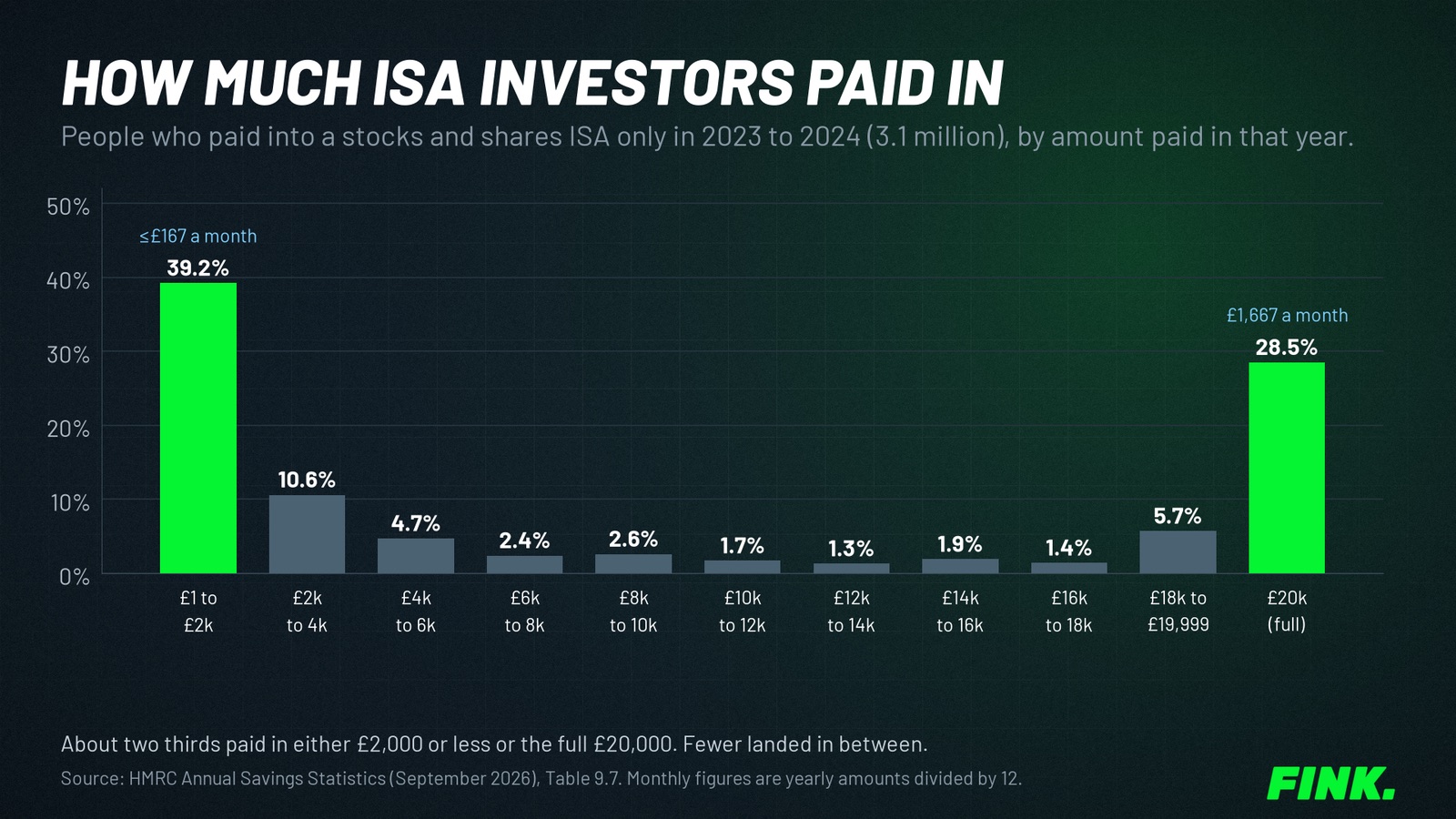
Far less than the full allowance, in most cases. HMRC's Annual Savings Statistics, published in September 2026, break down subscriptions by amount. Table 9.7 covers 3.1 million people who paid into a stocks and shares ISA only, with no cash ISA, in 2023 to 2024.
| Amount paid in during 2023 to 2024 | Monthly equivalent | Share of people |
|---|---|---|
| £1 to £2,000 | Up to about £167 | 39.2% |
| £2,001 to £4,000 | About £167 to £333 | 10.6% |
| £4,001 to £10,000 | About £333 to £833 | 9.7% |
| £10,001 to £19,999 | About £833 to £1,667 | 12.0% |
| £20,000 | About £1,667 | 28.5% |
Source: HMRC Table 9.7, stocks and shares ISA subscribers only. We grouped the middle bands and divided by 12 for the monthly column.
Methodology: HMRC builds these figures from annual returns that ISA managers must send it, matched to a sample of individuals. The table counts people rather than accounts. It includes only those who paid in something during the year. A further 1.3 million people held a stocks and shares ISA but paid nothing in that year.
The shape is striking. Most people either pay in a small amount or the maximum, with relatively few in between. HMRC's commentary notes that the share paying the maximum rises with income, from 28.8% of all ISA subscribers to 62.5% of those with income above £150,000.
Small amounts are the most common choice. If you're starting with £50 or £100 a month, you're in good company.
What's the most you can put in each month?
£20,000 a year across all your ISAs, which is £1,666.67 a month over a full tax year. HMRC's tax-free savings newsletter 19 confirms the allowance stays at £20,000 until April 2031.
The tax year runs from 6 April to 5 April. If you start partway through, the monthly figure to use the full allowance is higher:
| Start month | Monthly payments left in the tax year | Monthly amount to reach £20,000 |
|---|---|---|
| April | 12 | £1,666.67 |
| July | 9 | £2,222.22 |
| October | 6 | £3,333.33 |
| January | 3 | £6,666.67 |
The allowance is shared. Money paid into a cash ISA or Lifetime ISA in the same year comes out of the same £20,000. A Lifetime ISA has its own £4,000 limit within it. Unused allowance doesn't roll over to the next year. How the monthly amount fits with what you buy and hold is covered in our stocks and shares ISA strategy guide.
What should come before a monthly ISA payment?
Essential spending, an emergency fund, costly debt and any employer pension contribution. Everything else in this guide assumes those are covered.
An emergency fund
MoneyHelper's emergency savings guidance suggests "three to six months' essential outgoings available in an instant access savings account". The same page says credit card debt, unauthorised overdrafts and payday loans are usually cheaper to clear first.
That doesn't mean waiting years to invest. Some people split their spare money between the emergency fund and a small ISA payment until the cash target is reached.
An employer pension contribution
Some employers add money when you pay into a workplace pension. Some match more if you pay more. That's worth checking before choosing an ISA amount, because an employer contribution is money you only get by paying in. Our stocks and shares ISA vs SIPP guide sets out the auto-enrolment minimums and what £100 becomes in each wrapper.
A budget-first worksheet for choosing your monthly amount
Start from your take-home pay and work down, not from a target and work back. An amount you can keep paying matters more than an ambitious one you stop after three months.
| Step | What to do | Example figures |
|---|---|---|
| 1. Take-home pay | Monthly pay after tax, National Insurance and pension | £2,500 |
| 2. Essentials | Rent or mortgage, bills, food, transport, debt repayments | £1,600 |
| 3. Irregular costs | Yearly or one-off costs divided by 12, such as car servicing or gifts | £150 |
| 4. Day-to-day spending | Everything else you want to keep doing | £350 |
| 5. Left over | Step 1 minus steps 2 to 4 | £400 |
| 6. Emergency fund top-up | Until you hold three to six months of essentials | £150 |
| 7. Monthly ISA amount | What remains, rounded down | £250 |
The example figures are made up to show the method. They aren't a recommendation or a typical household.
Then run two checks:
- The bad month test. If your largest irregular bill landed in the same month, could you still make the ISA payment without dipping into the emergency fund?
- The six-month test. Could you keep this amount going for six months without changing how you live? If not, lower it.
For context, the ONS household saving ratio was 8.8% in April to June 2026. That figure includes pension saving and covers all UK households, so it's a national average rather than a target for anyone.
What if your income changes from month to month?
Set the regular payment from your lowest typical month, then top up when there's more. This suits the self-employed, people on commission and anyone with irregular overtime.
- Look back over the last 12 months of take-home pay and find the lowest normal month, ignoring one-off events.
- Run the worksheet above using that figure. The result is your fixed monthly payment.
- In better months, move part of the extra into the ISA as a one-off payment, after topping up the emergency fund.
A larger emergency fund is often sensible with irregular income, because the gap between good and bad months has to come from somewhere.
Is £100 a month worth investing?
Yes, as a habit and as a starting point. But be clear about what it adds up to. Without counting any growth, £100 a month is £1,200 a year and £12,000 over ten years.
| Monthly amount | Paid in after 1 year | After 10 years | After 20 years |
|---|---|---|---|
| £50 | £600 | £6,000 | £12,000 |
| £100 | £1,200 | £12,000 | £24,000 |
| £250 | £3,000 | £30,000 | £60,000 |
| £500 | £6,000 | £60,000 | £120,000 |
| £1,667 | £20,000 | £200,000 | £400,000 |
These are contributions only, with no investment returns included. Investments can rise or fall, so the final value could be more or less than the amount paid in. Even the top row, the full allowance every year, is only £400,000 of contributions after 20 years. It's one reason the 7,730 ISA millionaires HMRC counted at 5 April 2024 are mostly in their seventies, according to platform data.
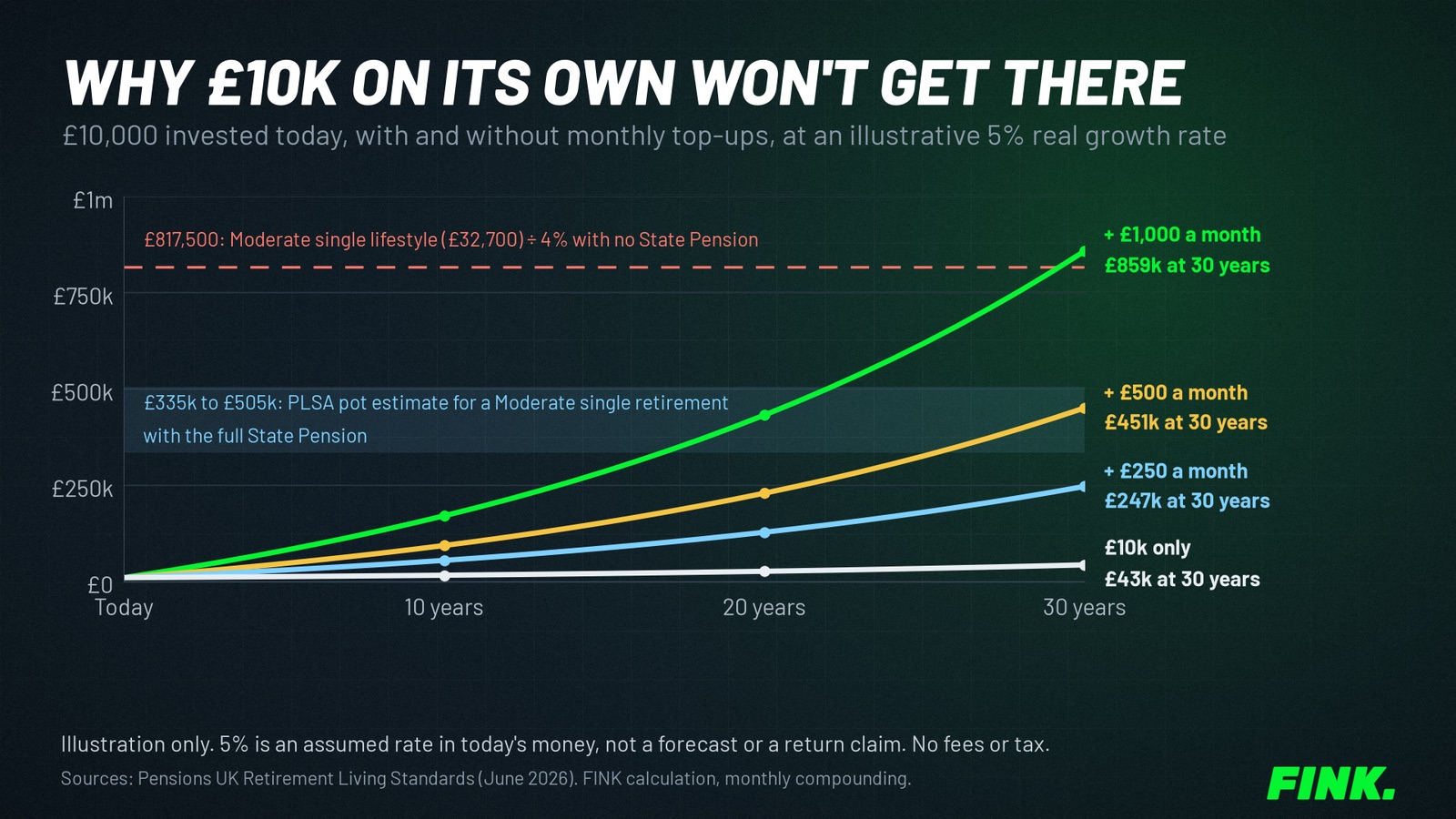
Our guide to how much you need to be financially free shows illustrative growth on top of contributions. The main finding there applies here too: over long periods, the amount you pay in tends to matter more than squeezing out a slightly higher return.
How should you increase your monthly amount over time?
Link increases to pay rises, so the extra money never reaches your current account. This idea has strong evidence behind it.
Richard Thaler and Shlomo Benartzi tested it in a 2004 paper in the Journal of Political Economy, Save More Tomorrow. Employees agreed in advance to put part of each future pay rise into their pension. In the first company to use it, average saving rates rose from 3.5% to 13.6% over four pay rises spanning 40 months.
Methodology: this was a real workplace programme, not a lab experiment. Taking part was voluntary, so the employees who signed up may have been more motivated savers to begin with. Thaler and Benartzi compared them with employees who took other options.
The setting was a US employer pension, not an ISA. The behavioural point carries over though. Deciding in advance removes the moment where you'd have to choose to save more out of money already in your pocket.
At FINK we look at it this way: the amount that lasts is usually one you'll barely notice, automated and raised on a set date each year.
Should you pay monthly or invest a lump sum?
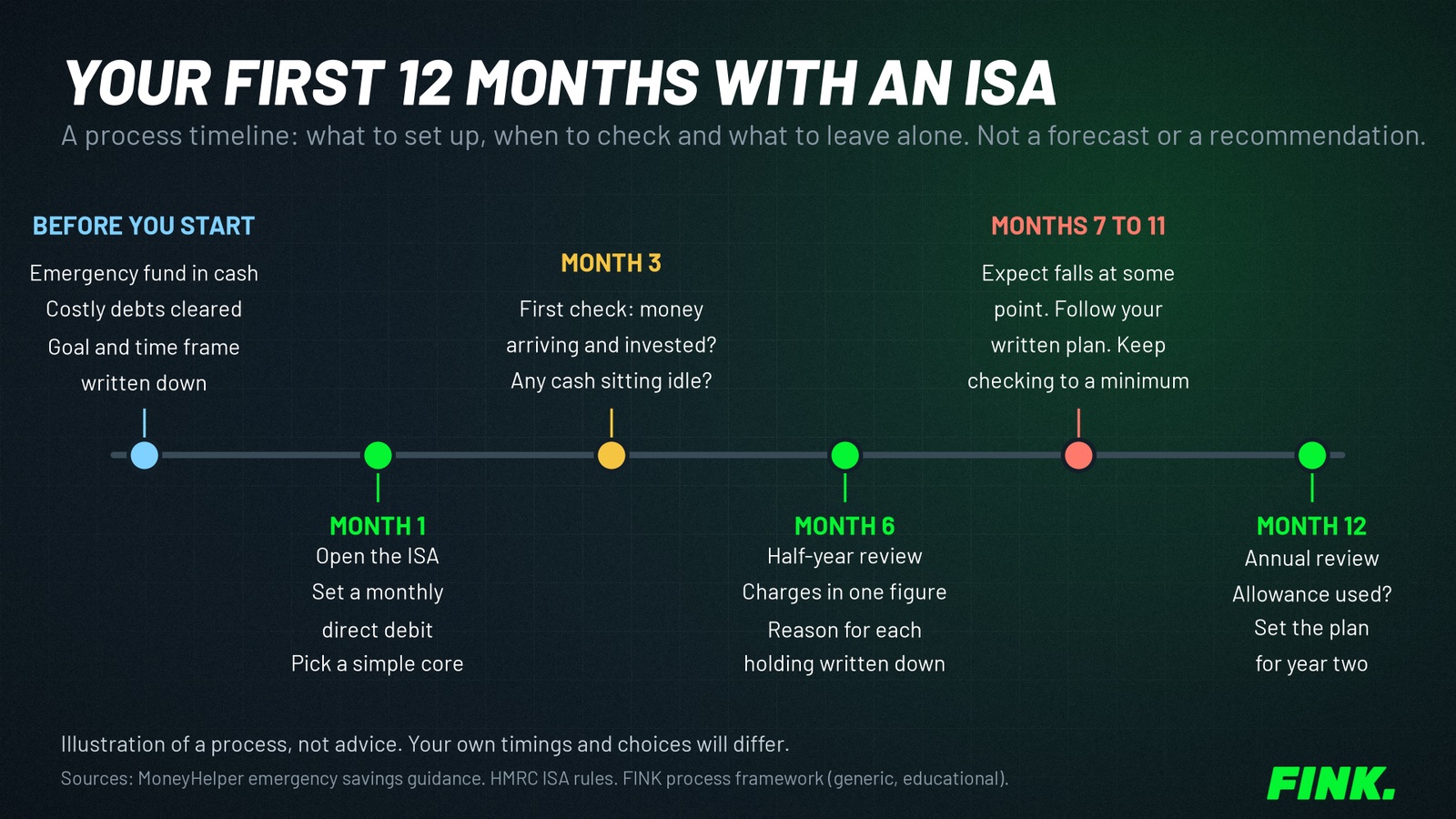
If the money comes from your salary, monthly is the natural choice. If you already have a lump sum, the evidence leans the other way. Vanguard's research found investing a lump sum straight away beat phasing it in about two times in three, though phasing reduces the regret of investing just before a fall. Our guide to lump sum or drip feeding into an ISA has both studies, the cash-rate question and a decision flow. If you're just getting started, our guide to your first year with a stocks and shares ISA sets out a step-by-step process.