How do the rules compare?
| Rule (2026/27) | Stocks and shares ISA | SIPP (personal pension) |
|---|---|---|
| Annual limit | £20,000 across all ISAs | £60,000 annual allowance, capped at 100% of earnings for relief. Lower if you've flexibly accessed a pension or have a very high income |
| Tax relief going in | None | 20% added by the provider. Higher and additional-rate taxpayers claim more through Self Assessment |
| Non-earners | Can pay in from savings | Relief on up to £2,880 a year net (£3,600 gross) |
| Tax on growth | None | None |
| Tax on withdrawals | None | 25% usually tax-free (up to £268,275). The rest is taxed as income |
| Earliest access | Any time | Usually 55, rising to 57 from 6 April 2028 |
| Unused allowance | Lost at 5 April | Can carry forward up to three previous years |
| Inheritance tax | Part of your estate | Most unused funds brought into scope from 6 April 2027 |
Sources: gov.uk ISAs, gov.uk tax on your private pension, gov.uk personal pensions, HMRC policy paper on minimum pension age, HMRC policy paper on inheritance tax and pensions.
A SIPP is a self-invested personal pension. gov.uk describes SIPPs as personal pensions that "allow you to control the specific investments that make up your pension fund." The tax rules are the same as any other personal pension. Most of the comparison below applies to workplace pensions too, with one big difference covered later.
How does pension tax relief work?
With a SIPP, you pay in from take-home pay and the provider claims basic-rate relief from HMRC. This is called relief at source. Pay in £80 and £100 lands in the pension. Pay income tax above 20% and you can claim the extra through Self Assessment. That's a further 20% on the part of your income taxed at 40% plus 25% on the part taxed at 45% (gov.uk).
Two limits apply. Relief is only available on contributions up to 100% of your earnings. And the annual allowance is £60,000, including any employer contributions.
It's tapered down for people with threshold income over £200,000 and adjusted income over £260,000. If you've already taken money flexibly from a pension, a lower money purchase annual allowance applies (gov.uk).
Even people who don't pay income tax get relief at source. A non-earner can pay in up to £2,880 a year and have it topped up to £3,600.
What does £100 of take-home pay become?
This is the core of the comparison. It doesn't need any growth assumption. Both wrappers shelter growth from tax, so the same investment growing at the same rate multiplies both pots by the same amount. What differs is the tax on the way in and on the way out.
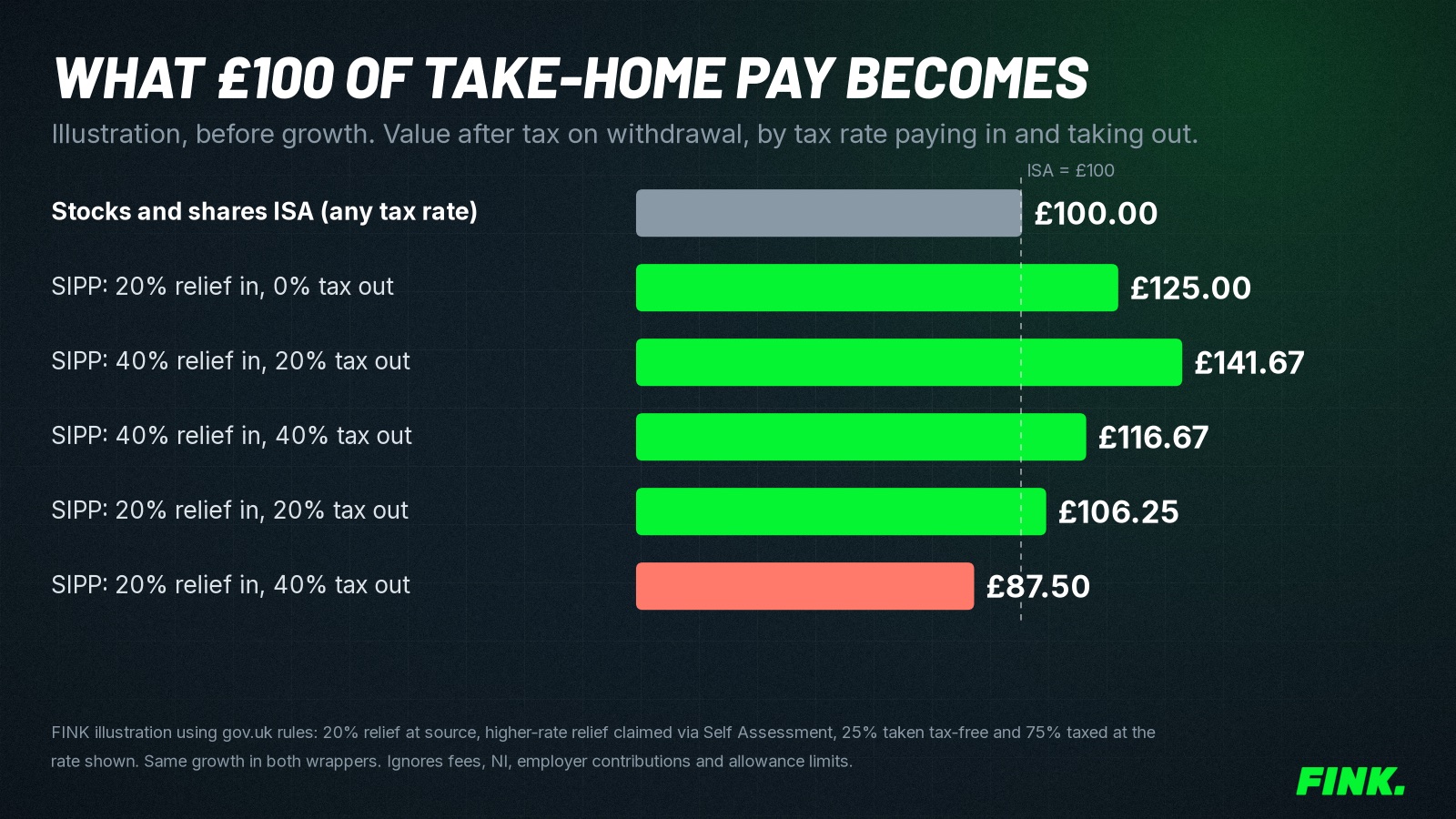 What £100 of take-home pay becomes after withdrawal tax, before growth. FINK illustration using gov.uk tax rules.
| Illustration: £100 of take-home pay | Gross amount invested | Tax-free 25% | Taxable 75%, after tax | Total after tax |
|---|---|---|---|---|
| Stocks and shares ISA | £100.00 | n/a | n/a | £100.00 |
| SIPP, 20% relief in, 0% tax out | £125.00 | £31.25 | £93.75 | £125.00 |
| SIPP, 20% relief in, 20% tax out | £125.00 | £31.25 | £75.00 | £106.25 |
| SIPP, 40% relief in, 20% tax out | £166.67 | £41.67 | £100.00 | £141.67 |
| SIPP, 40% relief in, 40% tax out | £166.67 | £41.67 | £75.00 | £116.67 |
| SIPP, 20% relief in, 40% tax out | £125.00 | £31.25 | £56.25 | £87.50 |
How we worked it out. With basic-rate relief, £100 of take-home pay becomes £125 in the pension (£100 ÷ 0.8). With higher-rate relief, the total cost to you of each £1 in the pension is 60p, so £100 buys £166.67 (£100 ÷ 0.6). On the way out, 25% is tax-free and 75% is taxed at the rate shown.
We ignored fees, National Insurance, employer contributions, the lump sum allowance and the state pension, which uses part of your personal allowance in retirement. The rates are marginal rates on that slice of income, not average rates.
Three points stand out from the arithmetic:
- The tax-free 25% does real work. Even paying 20% in and 20% out, the pension ends up 6.25% ahead. That edge comes entirely from the tax-free lump sum.
- Relief at 40% and tax at 20% is the strongest case. That's the classic higher-rate earner who becomes a basic-rate taxpayer in retirement.
- The pension can lose. If you pay 20% now and end up paying 40% on withdrawals, the ISA comes out ahead. This is more likely for people with large pensions or other income in retirement.
Nobody knows their future tax rate for certain. The rates and thresholds in force when you withdraw may differ from today's. That uncertainty cuts both ways.
When does access matter more than tax?
For many people, more than the arithmetic. ISA money can be withdrawn any time without losing tax benefits. In most ISAs it can't go back in without using new allowance (our ISA withdrawal rules guide explains flexible ISAs). Pension money normally can't be taken before the normal minimum pension age, except for ill health or a protected pension age. That age is 55 and rises to 57 from 6 April 2028 (HMRC). Pension ages have changed before: HMRC notes the minimum rose from 50 to 55 in 2010.
What do people do once they can access their pensions? The FCA's retirement income data for April 2024 to March 2025 shows 961,575 pension plans were accessed for the first time. Of those, 462,160 (48.1%) were fully withdrawn as cash. Most of these were small: 65.3% of full withdrawals were from pots under £10,000 and 89.7% from pots under £30,000 (FCA).
How we worked it out. We added the two half-year periods in the FCA's underlying data tables (Table 1 for totals and Table 6 for full withdrawals by pot size). The data counts plans, not people. Some people hold several pots.
The FCA data doesn't tell us why people cash in small pots. It does show that pension money often gets spent at the first opportunity, which suggests that for many savers access is a live concern, not a technicality.
Does an employer contribution change the answer?
Usually, yes. A workplace pension often comes with an employer contribution you only get by paying in. Under auto-enrolment, gov.uk sets the legal minimum at 8% of qualifying earnings in total, with at least 3% from the employer (gov.uk). Many employers pay more or match higher contributions.
Neither an ISA nor a SIPP you open yourself gets that. Our £100 illustration would look very different with an employer adding money on top, which is why many guides treat workplace pension matching as the first call on spare cash.
Salary sacrifice adds a National Insurance saving. The government has announced that from 6 April 2029, only the first £2,000 a year of salary-sacrificed pension contributions will be exempt from National Insurance (HMRC). Income tax relief is unchanged.
What about inheritance tax?
ISAs have always counted towards your estate for inheritance tax, although a surviving spouse or civil partner can inherit an additional ISA allowance (gov.uk). Pensions have largely sat outside it.
That changes from 6 April 2027. The government will bring most unused pension funds and death benefits into scope of inheritance tax, with personal representatives responsible for reporting and paying any tax due. Death in service benefits from registered schemes are excluded (HMRC).
For people who were using a pension mainly as a way to pass money on, the gap between the two wrappers narrows. Income tax can also apply to inherited pensions in some cases. This area is complex enough that the details matter for any individual estate.
Which suits which goal?
| Goal or situation | What the rules favour | The trade-off |
|---|---|---|
| Money you may need before your late 50s | Stocks and shares ISA | No relief, but full access |
| Retirement savings, higher-rate now, basic-rate later | Pension | Locked until 55, 57 from 2028 |
| Retirement savings, basic-rate now and later | Pension slightly, or a mix | Small tax edge against lost flexibility |
| Large expected pension income in retirement | Mix, with more weight on ISA | Pension withdrawals may be taxed at 40% |
| Employer will match contributions | Workplace pension up to the match | Same access limits |
| A bridge from early retirement to pension age | Stocks and shares ISA | Needs to be built before you stop work |
| First home | Lifetime ISA or stocks and shares ISA | Neither pension option helps |
This isn't a recommendation for any individual. It's what the rules reward in each case. Many people end up using both: a pension for the tax edge on retirement money and an ISA for flexibility. Our Lifetime ISA comparison covers the third wrapper that sits between them.
Does the wrapper change how you invest?
The wrapper is a tax decision. It doesn't make an investment good or bad. The same fund behaves the same way inside an ISA or a SIPP.
At FINK we look at it this way: once money is in either wrapper, the questions are the same. What you hold, why you hold it and when you'll review it. Pension money is easy to forget about precisely because you can't spend it. The holdings still have to be examined. Our guide to choosing and reviewing ISA holdings covers that side.
Where the wrapper does matter is the time horizon. Money that can't be touched for 25 years can carry more short-term volatility than money you might need in two. The long-run UK record shows shares beating cash far more reliably over ten-year periods than over two-year ones, as we set out in cash ISA vs stocks and shares ISA. Once the wrapper's chosen, how much to put in a stocks and shares ISA each month has a budget-first worksheet for the amount.