What's the difference between a cash ISA and a stocks and shares ISA?
A cash ISA is a savings account where the interest is tax-free. A stocks and shares ISA holds investments, such as shares, funds and bonds. Any income or gains are tax-free. The tax treatment is the same. The risk isn't.
| Cash ISA | Stocks and shares ISA | |
|---|---|---|
| What it holds | Bank and building society savings, some NS&I products | Shares, funds, bonds |
| Can the balance fall? | No, apart from any fees or penalties | Yes |
| What drives growth | The interest rate | Company profits, dividends and market prices |
| Main long-term risk | Inflation running ahead of interest | Falls in value, which may take years to recover |
| Tax on income and growth | None | None |
| Protection if the provider fails | FSCS deposit protection, up to its limits | FSCS investment protection, up to its limits. Not for falls in value |
Sources: gov.uk How ISAs work, FSCS.
Where are UK savers putting their ISA money?
Mostly into cash, more so recently. HMRC's latest figures show 16.8 million adult ISA accounts were paid into in 2024/25. Of those, 64% were cash ISAs (HMRC commentary).
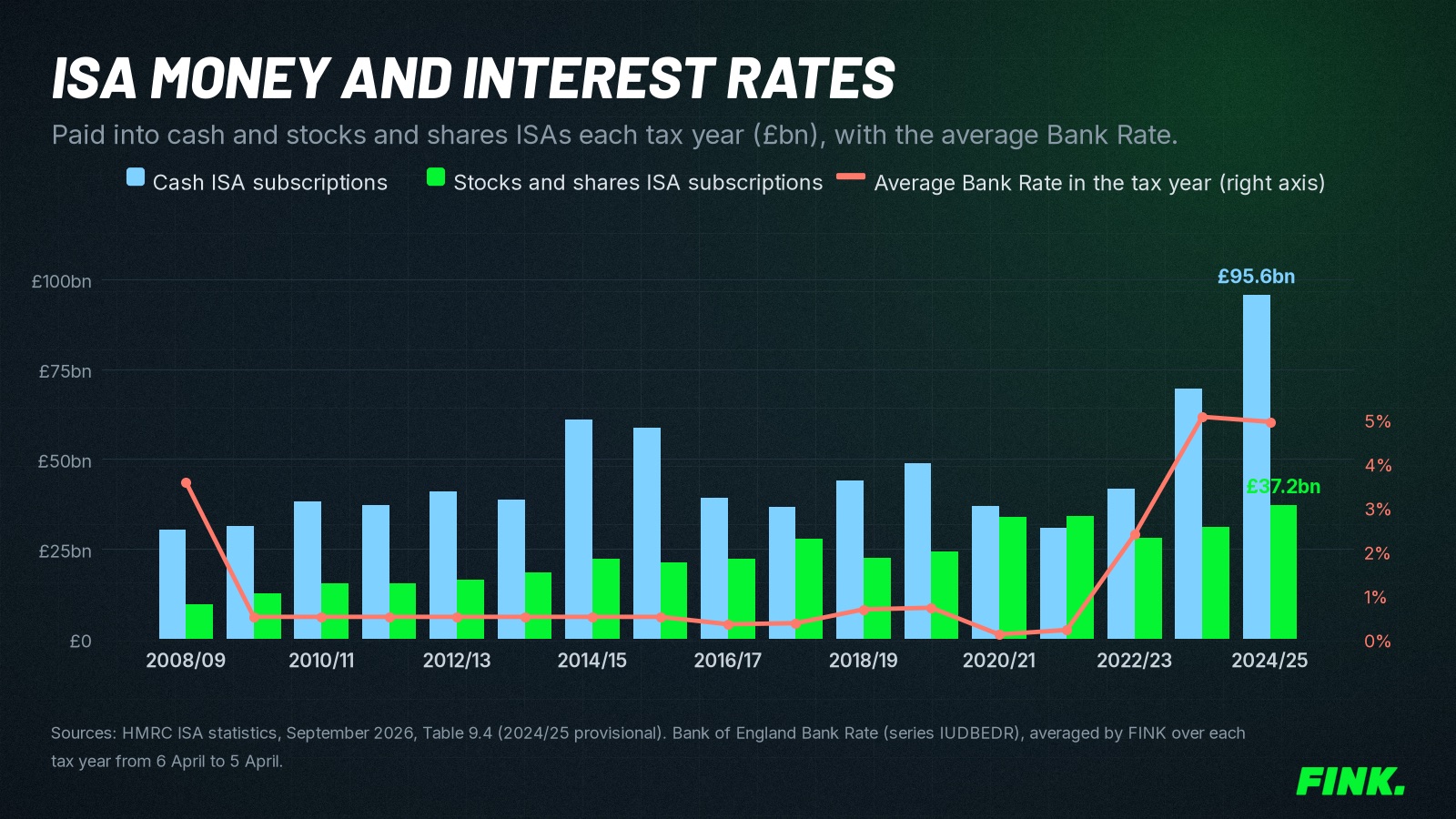 Sources: HMRC ISA statistics Table 9.4 (2024/25 provisional), Bank of England. FINK calculation of tax-year averages.
The pattern lines up with interest rates. In 2021/22, with Bank Rate averaging about 0.2%, more money went into stocks and shares ISAs (£34.2 billion) than cash ISAs (£30.9 billion). That was the only year since at least 2008/09 when that happened. By 2023/24 and 2024/25, with Bank Rate averaging around 5%, cash took about 70% of the money.
| Tax year | Average Bank Rate | Cash ISA (£bn) | Stocks and shares ISA (£bn) | Cash share |
|---|---|---|---|---|
| 2020/21 | 0.1% | 36.8 | 33.9 | 52% |
| 2021/22 | 0.2% | 30.9 | 34.2 | 47% |
| 2022/23 | 2.4% | 41.6 | 28.0 | 60% |
| 2023/24 | 5.0% | 69.5 | 31.1 | 69% |
| 2024/25 | 4.9% | 95.6 | 37.2 | 72% |
How we worked it out. Subscription figures are from HMRC Table 9.4. Bank Rate is the Bank of England's daily series IUDBEDR, averaged over each tax year (6 April to 5 April). Cash share = cash ÷ (cash + stocks and shares). It leaves out Lifetime and innovative finance ISAs, which are small by comparison. HMRC's own commentary says the jump in cash subscriptions "can be explained by" Bank Rate and swap rates being at their highest in those years. That's a correlation HMRC is pointing to, not proof that rates are the only reason.
None of this says what anyone should do. It shows that ISA choices move with interest rates. Worth knowing when you look at your own.
Who uses cash ISAs and who uses stocks and shares?
HMRC breaks down 2023/24 subscribers by age and sex. The gaps are wide. Of the 13.05 million people who paid into an adult ISA that year, 68.7% paid only into cash. The rest paid into a stocks and shares ISA, either alone or alongside cash (HMRC ISA statistics, Table 9.8).
| Group, 2023/24 subscribers | Paid only into cash | Paid into stocks and shares (alone or with cash) |
|---|---|---|
| Under 24 | 65.8% | 34.2% |
| 30 to 32 | 62.3% | 37.7% |
| 48 to 50 | 63.0% | 37.0% |
| 63 to 65 | 72.7% | 27.3% |
| 81 and over | 82.9% | 17.1% |
| Men | 62.5% | 37.5% |
| Women | 74.7% | 25.3% |
| All subscribers | 68.7% | 31.3% |
How we worked it out. From Table 9.8, we added the male and female figures for each age band. Stocks and shares share = (stocks and shares only + both) ÷ all subscriptions. It counts people who paid in that year, not everyone holding an ISA. Innovative finance ISAs are excluded by HMRC.
Two patterns stand out. Stocks and shares use peaks in the early 30s and falls steadily after 60, which fits shorter time horizons later in life. And a gap between men and women runs through every age band. The data doesn't explain why. It does show that even among under-24s, with the longest horizons of anyone, about two-thirds of subscribers used cash only.
Do stocks and shares beat cash over time?
Usually, over long periods. Not always. Not reliably over short ones either.
The Barclays Equity Gilt Study 2024 looked at UK asset returns from 1899 to 2023. Barclays reports that over two-year periods, shares beat cash 70% of the time. Over ten-year periods, that rose to 91% (Barclays Smart Investor).
Now read it the other way round. That's the part most articles skip. Cash won in 30% of two-year periods and 9% of ten-year periods. A decade is a long time to wait and still come out behind. It happened roughly one time in eleven. These are historical UK figures, based on a market and an interest-rate history that won't repeat exactly.
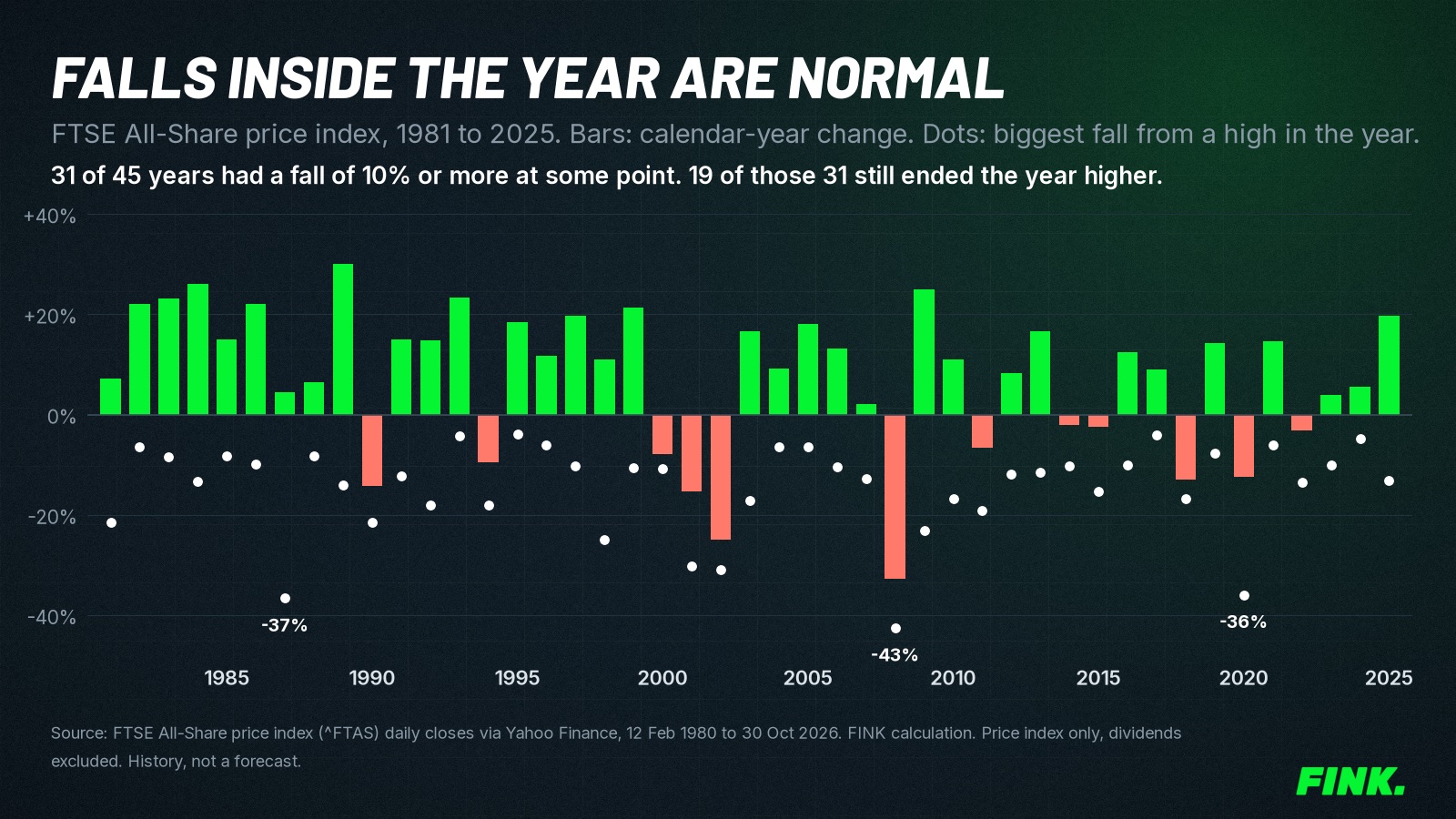
The shorter-term picture is bumpier still. In FINK's analysis of the FTSE All-Share price index, the market fell 10% or more from a high at some point in 31 of the 45 calendar years from 1981 to 2025. Our article on stocks and shares ISA losing money has the full data.
Cash has its own long-term risk, which is inflation. A balance that never falls in pounds can still buy less over time if interest rates sit below inflation.
Can you split your ISA allowance between cash and stocks and shares?
Yes, in any proportion. The £20,000 allowance can go into one account or be spread across several. You can also pay into more than one ISA of the same type in a tax year (gov.uk).
Gov.uk's examples include £15,000 in a cash ISA, £2,000 in a stocks and shares ISA and £3,000 in an innovative finance ISA, or £10,000 in one cash ISA, £3,000 in another and £7,000 in a stocks and shares ISA. If you have a Lifetime ISA, its £4,000 counts towards the £20,000 too. See Lifetime ISA vs stocks and shares ISA.
The cash ISA limit is also staying at £20,000. The planned £12,000 cap was scrapped in Budget 2026, so the full £20,000 can go into cash. Our guide to what Budget 2026 changed for ISAs has the full story, the sources and the new incentive for first-time investors.
Do you even need a cash ISA?
Not everyone does. Gov.uk explains that most people can earn some interest tax-free outside an ISA through the Personal Savings Allowance: £1,000 a year for basic-rate taxpayers, £500 for higher-rate and nothing for additional-rate (gov.uk).
Here's roughly how much cash that covers.
| Income tax band | Personal Savings Allowance | Savings covered at an illustrative 4% rate |
|---|---|---|
| Basic rate | £1,000 | £25,000 |
| Higher rate | £500 | £12,500 |
| Additional rate | £0 | £0 |
How we worked it out. Savings covered = allowance ÷ interest rate. So £1,000 ÷ 0.04 = £25,000. The 4% rate is an illustration, not a quoted rate. At a lower rate, more savings would be covered. At a higher rate, less.
The case for a cash ISA gets stronger from 6 April 2027, when the income tax rates on savings interest rise by 2 percentage points to 24%, 44% and 49% (HMRC newsletter 24). Interest above your allowance will cost more in tax. Inside an ISA it won't be taxed at all.
How should you split cash and stocks and shares?
By timeline, mostly. Money with a near and fixed job tends to suit cash. Money you won't touch for many years has more room to ride out falls. That's a general principle, not personal advice.
| Goal and timeline | Cash ISA | Stocks and shares ISA |
|---|---|---|
| Emergency fund | Accessible and stable. The usual home | Value could be down when you need it |
| Known cost in 1 to 3 years (deposit, wedding, car) | Stable. Interest may trail inflation | Barclays data shows shares lost to cash in 30% of two-year periods |
| Goal 3 to 10 years away | Safe in pounds, real value may slip | Better odds over time, still meaningful risk of a bad stretch |
| 10 years or more | Inflation is the main risk | Shares beat cash in 91% of ten-year periods historically. Not guaranteed |
| Already above your Personal Savings Allowance | Shields interest from tax, more so from April 2027 | Shields dividends and gains from tax |
Two things often get missed. First, you don't have to choose once. You can split this year's allowance and change the split next year. Second, you can transfer between ISA types without losing the tax status, as long as you use a transfer rather than withdrawing (gov.uk).
For a fuller plan, see our stocks and shares ISA strategy guide. And if you've already got more than one account, how many stocks and shares ISAs can I have covers the rules.