How many ISA millionaires are there in the UK?
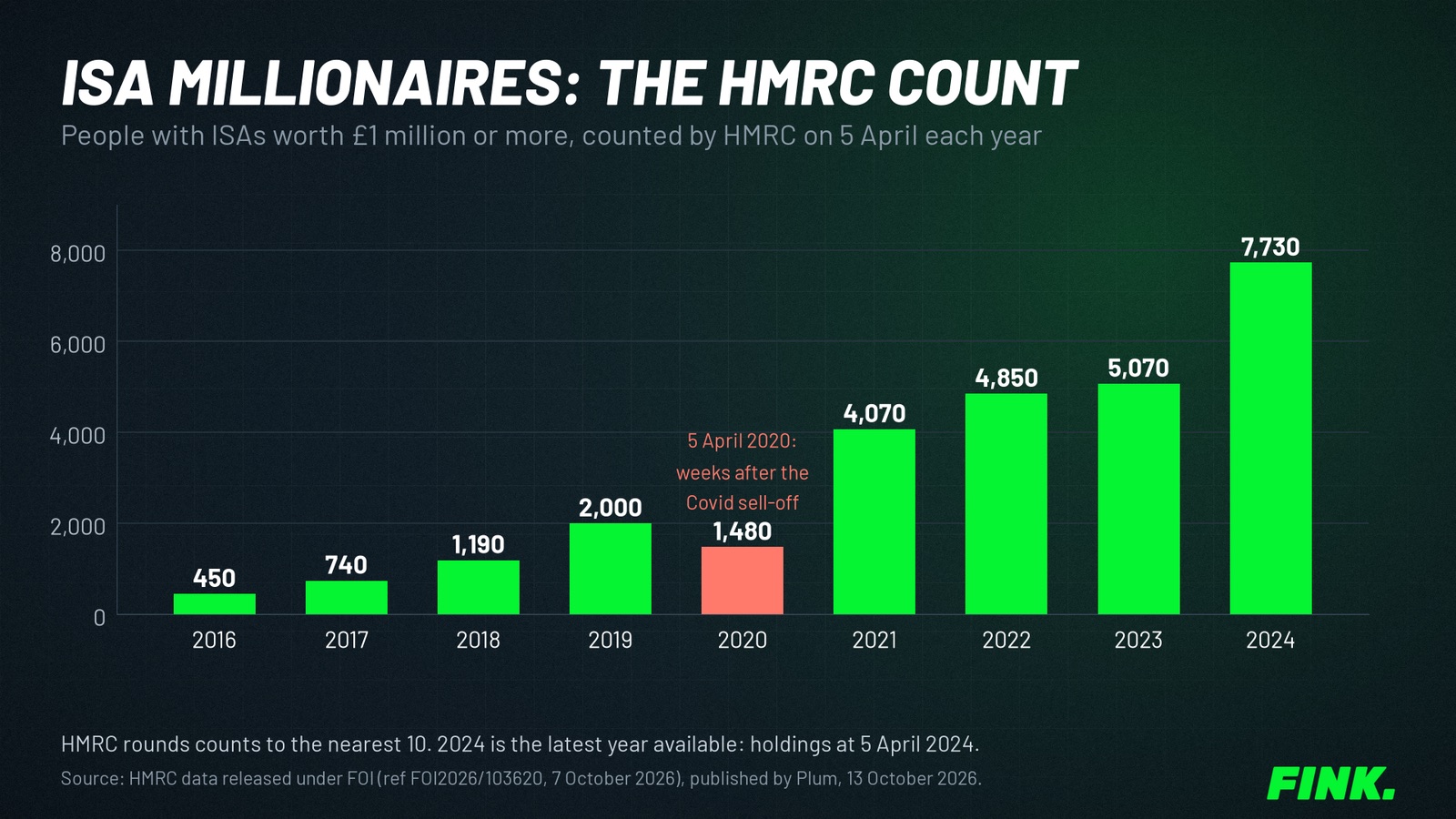
HMRC counted 7,730 on 5 April 2024, the latest date available. The figures come from HMRC data released under the Freedom of Information Act on 7 October 2026 and published by Plum on 13 October 2026.
A few details from the same release:
| Measure (5 April 2024) | Figure |
|---|---|
| ISA millionaires | 7,730 |
| Rise on a year earlier | 2,660 (52%) |
| Average ISA millionaire's pot | £1,348,000 |
| Average of the top 25 pots | £11,928,000 |
| Pots of £1m to £2m | 7,300 |
| Pots of £2m to £3m | 320 |
| Pots of £3m to £4m | 40 |
| Pots of £4m or more | 60 (average £7,708,000) |
Source: HMRC data released to Plum under FOI. HMRC rounds the number of people to the nearest 10 and values to the nearest £1,000, so bands may not add up exactly.
According to Plum, HMRC has said that all ISA millionaire pots were built through stocks and shares investing rather than cash. That's consistent with the arithmetic. Cash ISA allowances on their own, even fully used every year since 1999, wouldn't add up to £1 million without substantial growth.
How many are close to £1 million?
An earlier FOI release published by Rathbones gave the bands just below £1 million, as at 5 April 2023.
| ISA value (5 April 2023) | Number of people |
|---|---|
| £500,000 to £749,999 | 48,160 |
| £750,000 to £849,999 | 5,940 |
| £850,000 to £949,999 | 3,490 |
| £950,000 to £999,999 | 1,210 |
| £1 million or more | 5,070 |
Source: HMRC data released under FOI, published by Rathbones. Rounded to the nearest 10.
Rathbones also published a projection of how many ISA millionaires there might be by April 2026. That's a projection, not a count, so we haven't used it here.
How rare is a £1 million ISA?
Very rare. About 1 in 3,000 ISA holders had one in April 2024. HMRC's Annual Savings Statistics put the number of ISA holders at about 23 million in 2023 to 2024.
The wider picture from the same statistics:
| ISA holders in 2023 to 2024 | Figure |
|---|---|
| Total holders | 23,025,972 |
| Holders with £200,000 or more | 928,880 (4.0%) |
| Average value per holder | £37,831 |
| Average for holders of stocks and shares ISAs only | £66,165 |
| Average for holders of cash ISAs only | £16,715 |
| Average for holders of both | £82,136 |
Source: HMRC Annual Savings Statistics, September 2026, tables 9.10 and 9.11. FINK calculation for the percentage.
The gap between stocks and shares holders and cash-only holders is large, though it partly reflects who holds each type. People with bigger savings and higher incomes are more likely to hold stocks and shares.
How old are ISA millionaires?
Mostly in their seventies. Each platform that's published data reports an average age around 70 or above.
| Platform | Date of data | ISA millionaires | Average age | Other detail |
|---|---|---|---|---|
| interactive investor | 18 February 2026 | 2,869 | 72 | About 69% men. Up from 1,607 a year earlier |
| AJ Bell | December 2025 | Not published | 70 | Up 74% in a year. Youngest 33, oldest 100 |
| Hargreaves Lansdown | End of 2024 | More than 1,300 | Not published | Over half had already used the full allowance |
HMRC's own data shows how strongly ISA values rise with age across all holders, not just millionaires:
| Age group | Average ISA value (2023 to 2024) | Holders with £200,000 or more |
|---|---|---|
| Under 24 | £11,087 | 7,411 |
| 42 to 44 | £19,084 | 15,280 |
| 60 to 62 | £47,690 | 63,648 |
| 72 to 74 | £72,581 | Not shown |
| 81 and over | £75,895 | 153,706 |
Source: HMRC Annual Savings Statistics, September 2026, table 9.11.
Age matters for an obvious reason. ISAs began in 1999 and their predecessor, Personal Equity Plans, in 1987. The people with the largest pots are mostly those who've been putting money in for the longest.
What do ISA millionaires invest in?
More in individual shares and investment trusts than other ISA investors, less in funds and cash. interactive investor published the most detailed breakdown.
| Asset type | ii ISA millionaires | All ii ISAs |
|---|---|---|
| Investment trusts | 32.5% | 14.6% |
| Individual shares | 35.7% | 32.5% |
| Funds | 17.6% | 27.8% |
| ETFs and other exchange-traded products | 7.5% | 12.8% |
| Cash | 4.3% | 8.4% |
| Bonds | 2.3% | 3.8% |
Source: interactive investor, holdings at 18 February 2026.
The most widely held names among ii's ISA millionaires included Alliance Witan, Scottish Mortgage, Rolls-Royce, Shell, AstraZeneca, National Grid, GSK, City of London, Rio Tinto and Lloyds.
AJ Bell's figures point the same way. Its ISA millionaires held 83% in shares, including investment trusts, compared with 58% for its other ISA investors. They held 23 positions on average, though that ranged from more than 150 down to a single holding. Shell was the most widely held.
Hargreaves Lansdown found a mix. Just under half of its ISA millionaires held both shares and funds, just over a third held mainly funds and about one in five held mainly shares. It also noted that trading among them was infrequent.
A note on survivorship
All of this describes the people who got there. Nobody publishes data on the ones who held similar portfolios and didn't get there. A portfolio heavy in individual shares can produce a large pot or a large loss, so the data shows what the winners held but not what made them win. Our guide to how much of a portfolio to put in one company looks at the sizing side of that risk.
What the data can't tell you
Quite a lot. Read the figures with their limits in mind. Each source answers a narrow question.
- HMRC's count is a snapshot of market value on one date. It moves with markets, which is why the April 2020 figure fell.
- The latest HMRC count is from April 2024. Platform figures are newer but cover only each platform's own investors. Some people also use more than one platform.
- None of the sources splits pots into money paid in and growth. Some pots will include money transferred from old PEPs.
- Nothing is published on investors who took similar risks and ended up with less. That's the survivorship problem described above.
How long does it take to build a £1 million ISA?
Decades, on any reasonable assumption. The arithmetic below shows why, using the current £20,000 allowance. These are illustrations, not forecasts.
| Yearly contribution | Illustrative growth rate | Years to reach £1 million |
|---|---|---|
| £20,000 | 0% (no growth) | 50 |
| £20,000 | 3% | 31 |
| £20,000 | 5% | 25 |
| £20,000 | 7% | 22 |
| £10,000 | 3% | 47 |
| £10,000 | 5% | 36 |
| £10,000 | 7% | 30 |
Method: contribution added at the start of each year, then grown at the rate shown, counting the years until the pot first reaches £1 million. Real-terms results would take longer. Real markets don't grow smoothly either. Fees and tax are ignored.
Two things follow. Even full use of the allowance needs long periods of growth to reach £1 million. The pace of contributions also matters at least as much as the growth rate. That's the same point our guide to how much you need to be financially free makes for smaller sums.
The current allowance also hasn't always been £20,000. It's been at that level since April 2017 and is frozen until April 2031, according to HMRC. Earlier limits were lower, so today's millionaires had less room each year than a new investor does now.
What do the platforms say ISA millionaires have in common?
Long time in the market, regular contributions and low trading. These are the platforms' own conclusions. Each has an interest in encouraging people to invest, so they're worth reading alongside the data rather than instead of it.
- They started early and kept paying in. HL said over half of its ISA millionaires had already used their full allowance for the year when it looked.
- They traded infrequently. HL said trading activity among them was low.
- They held more in shares and investment trusts than other ISA investors, according to ii and AJ Bell.
- They spread their holdings. AJ Bell's average of 23 holdings is far more than a handful, though the range was wide.
- They used the allowance early in the tax year. ii said 28% of its investors' subscriptions for the year came in between 6 and 30 April 2025.
Treat that list as a description, not a recipe. It's drawn from people who already reached £1 million, so it can't show how many investors did the same things and didn't. The low-trading point does have independent support from studies of brokerage accounts, which we cover in individual shares or funds in your ISA. Whether paying in early in the tax year helps is the lump sum question, set out in lump sum or drip feed.
At FINK we look at it this way: the common thread isn't a particular stock. It's time, contributions and a process that kept people invested and stopped any single holding from sinking the plan. Our guide to how many shares to hold in a stocks and shares ISA and the stocks and shares ISA strategy guide look at those building blocks.