

Budget 2026 scrapped the planned £12,000 cash ISA cap, so the full £20,000 can still go into cash (see how the cash ISA cap was dropped). In the same paragraph, it said the government would look at rewarding people who start investing. Press coverage quickly gave the idea a name: the Starter ISA.
The name has run ahead of the detail. This guide sorts what the official documents say from what's been proposed. Then it looks at the numbers behind the policy and what research on savings incentives suggests. Everything here was checked on the 1st of November 2026. We'll update it as details are published.
What did Budget 2026 actually say about a Starter ISA?
The exact wording matters, so it's quoted in full. The Budget 2026 document says the government:
"will now go further, working with the investment industry to explore a new ISA incentive for people investing in a stocks and shares ISA for the first time. The detailed design will be developed with industry."
The policy annex repeats the same commitment under the heading "New ISA incentive". Three things stand out:
- The verb is "explore". It's a commitment to look at the idea, not to introduce it.
- It's an "incentive", not an account. The document doesn't describe a new type of ISA. The phrase "Starter ISA" comes from press coverage of the speech, not the Budget document.
- Industry designs it. No rate, cap, age limit, start date or funding source is given.
The policy costings document lists the cash ISA decision, the new First Time Buyer ISA and the Lifetime ISA withdrawal charge change. We couldn't find a line for a first-time investor incentive. That's consistent with an idea at an early stage. It also fits the possibility, raised by Martin Lewis, that the industry could fund it.
What's confirmed and what's speculation?
| Question | Status on the 1st of November 2026 | Source |
|---|---|---|
| Will the government look at an incentive for first-time investors? | Confirmed. "Explore a new ISA incentive" | Budget 2026 |
| Is the cash ISA limit staying at £20,000? | Confirmed | Budget 2026 |
| Is there a new account called a Starter ISA? | Not confirmed. The Budget describes an incentive within stocks and shares ISAs | Budget wording |
| How big is the bonus? | Unknown. Proposals range from 5% to 15% | MSE |
| Who pays for it? | Unknown. No costing line published | Policy costings |
| When does it start? | Unknown. No date given | Budget wording |
| Can existing investors use it? | Unknown. Wording says "for the first time" | Budget wording |
If you see a headline giving a rate or a launch date, check whether it's quoting a proposal or a government document.
Why does the government want more people to invest?
Because most ISA money still goes into cash. HMRC's Annual Savings Statistics show 10.7 million cash ISA accounts were subscribed to in 2024/25, against 4.9 million stocks and shares ISA accounts. Those figures are provisional and count accounts, not people.
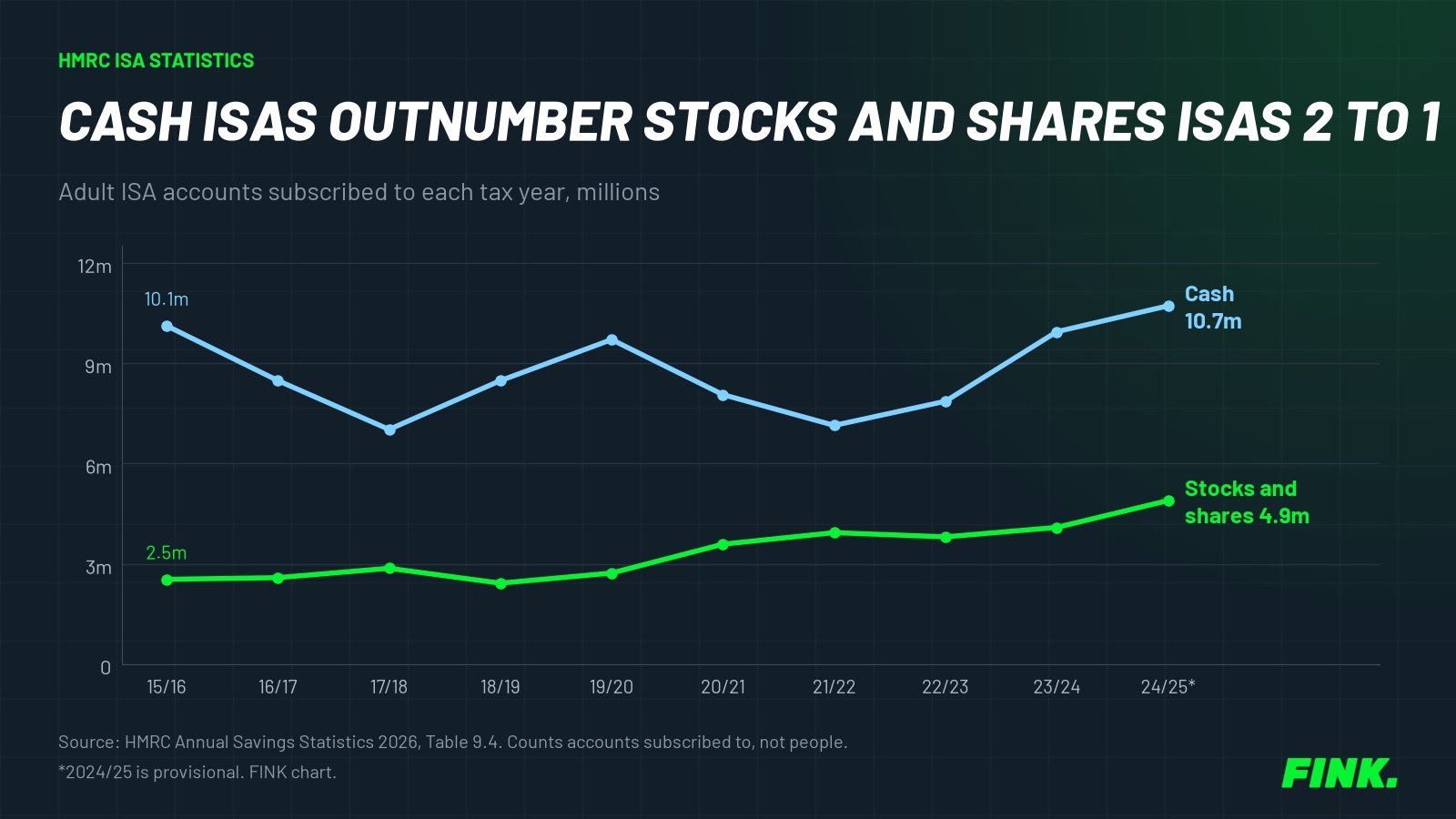
The same table shows the amounts. In 2024/25, £95.6 billion went into cash ISAs and £37.2 billion into stocks and shares ISAs. Stocks and shares ISA accounts have nearly doubled since 2015/16, from 2.5 million to 4.9 million, but cash accounts grew faster over the last three years.
Survey data points the same way. The FCA's Financial Lives 2024 survey found 90% of adults had cash savings but only 35% had investments. It also found 61% of adults with £10,000 or more in investible assets held all or at least three-quarters of it in cash, up from 58% in 2022.
None of this proves those savers would be better off investing. Cash does a clear job for emergency money and short-term goals. The policy question is whether some people stay in cash because of confidence or knowledge rather than a considered choice.
What proposals are on the table?
The most detailed public proposals come from Martin Lewis of MoneySavingExpert, who's said he put the idea to two chancellors.
| July 2025 proposal | October 2026 proposal | |
|---|---|---|
| Bonus | "For example" 5% | "Say" 10% or 15% |
| On how much | Up to £1,000 | The first £2,000 to £3,000 |
| Conditions | Money kept invested for a set time, for example one year | Not specified |
| Funding | Cost split between providers and the state | Possibly funded by the investment sector |
| Account | Same account usable as a normal stocks and shares ISA | Not a new ISA. A bonus in a shares ISA |
| Age | Possibly capped, for example at 40 | Not specified |
| Source | MSE, July 2025 | MSE, October 2026 |
Lewis describes both as conceptual. In the 2026 piece he says "research needs doing on what the sweet spot is". He also points out that some investment firms already offer introductory bonuses but calls these "patchy and marketing-driven". His argument is that a standard, always-available bonus would be easier to explain.
Industry reaction, as reported by MoneyWeek, has stressed simplicity. John Owen, chief executive of the Investment Association, said policymakers "need to learn lessons from the complexity and unpredictability of changes to ISA rules in recent years". Isabella Galliers-Pratt of Rathbones said the real barriers are "often confidence, understanding and fear of losing money, rather than a shortage of tax-efficient products". Hargreaves Lansdown called it "very much an idea in development with no detail announced".
Do bonuses actually get people investing?
There's direct evidence on matched contributions, though not from the UK ISA market.
One test is a randomised experiment published in the Quarterly Journal of Economics. In it, Duflo, Gale, Liebman, Orszag and Saez (2006) offered about 14,000 US tax filers a 0%, 20% or 50% match on retirement account contributions. Take-up was 2.9% with no match, 7.7% with a 20% match and 14.0% with a 50% match.
How to read it:
- A match more than doubled take-up. Moving from no match to 20% raised participation by 4.8 percentage points.
- Most people still didn't take part. Even at 50%, 86% of those offered the match didn't contribute.
- Framing mattered. The authors found responses to a similar incentive delivered through the US Saver's Credit were "much smaller". They concluded that "both incentives and information affect behavior".
- It isn't a perfect parallel. These were low and middle-income US tax filers saving for retirement, with a tax professional on hand. A UK investing bonus would reach different people in a different way.
The UK already runs a bonus scheme. The Lifetime ISA (compared with a stocks and shares ISA in our Lifetime ISA guide) pays a 25% government bonus on up to £4,000 a year, a maximum of £1,000. HMRC's Table 9.4 shows about 1.1 million Lifetime ISA accounts were subscribed to in 2024/25. Budget 2026 also confirmed that a new First Time Buyer ISA will replace the Lifetime ISA for new savers from April 2029, which shows how often incentive schemes get redesigned.
But a bonus only addresses the reward side of the decision. The industry comments above suggest the bigger barriers are confidence and understanding. The Budget itself links the incentive to "targeted support", the new form of help with investment decisions that launched in April 2026. It also mentions the industry-led "Invest for the Future" campaign.
How would a Starter ISA interact with the rules you already have?
Until the design is published, it's only possible to say how today's rules work:
- The overall allowance is £20,000 for 2026/27 and the cash ISA limit stays at £20,000 (Budget 2026).
- Any bonus in Lewis's proposals sits inside a normal stocks and shares ISA, so it would presumably count against the same allowance. That's an inference from the proposals, not a confirmed rule.
- "First time" needs defining. It could mean never having held a stocks and shares ISA, never having subscribed to one or something else. That will decide who qualifies.
- Lock-in periods change the risk. The 2025 proposal suggested the money stay invested for a set time. Markets can fall over a year, so a bonus would cushion, not remove, the chance of getting back less than you put in.
Our guide to the ISA changes in Budget 2026 covers the wider rule changes, including higher tax on savings income outside ISAs from April 2027.
What can first-time investors do while they wait?
This isn't a recommendation to invest or to wait. It's a list of questions that matter whatever the scheme ends up looking like:
- Is your emergency fund in place? Investing is usually done with money you won't need for several years.
- What's your timescale? The shorter your timescale, the more weight a fall in markets carries.
- Would you qualify? If the final rules only cover people who've never held a stocks and shares ISA, opening one now could rule you out. That's not yet known.
- What would waiting cost or save? A bonus of 5% to 15% on £1,000 to £3,000 is between £50 and £450 on the proposed figures. That's the sum to set against your own plans.
- Is there a written process? A written plan for what you'll buy, how much and how you'll review it matters more than a one-off bonus.
At FINK we look at it this way: an incentive can make the first step easier, but the habits after that step decide most of the outcome. Our step-by-step stocks and shares ISA strategy sets out a process you can adapt. The lump sum or drip feed guide covers how to get money invested once you've started. Your first year with a stocks and shares ISA sets out the first twelve months step by step.
Update log
- The 1st of November 2026: first published. Budget 2026 document and policy costings checked. No design, rate, date or costing for the incentive published. Proposals from MSE (July 2025 and October 2026) summarised.