When does it make sense to sell a stock at a loss?
When the same tests you'd apply to any sale say yes. The loss doesn't change the questions. It makes them harder to answer honestly.
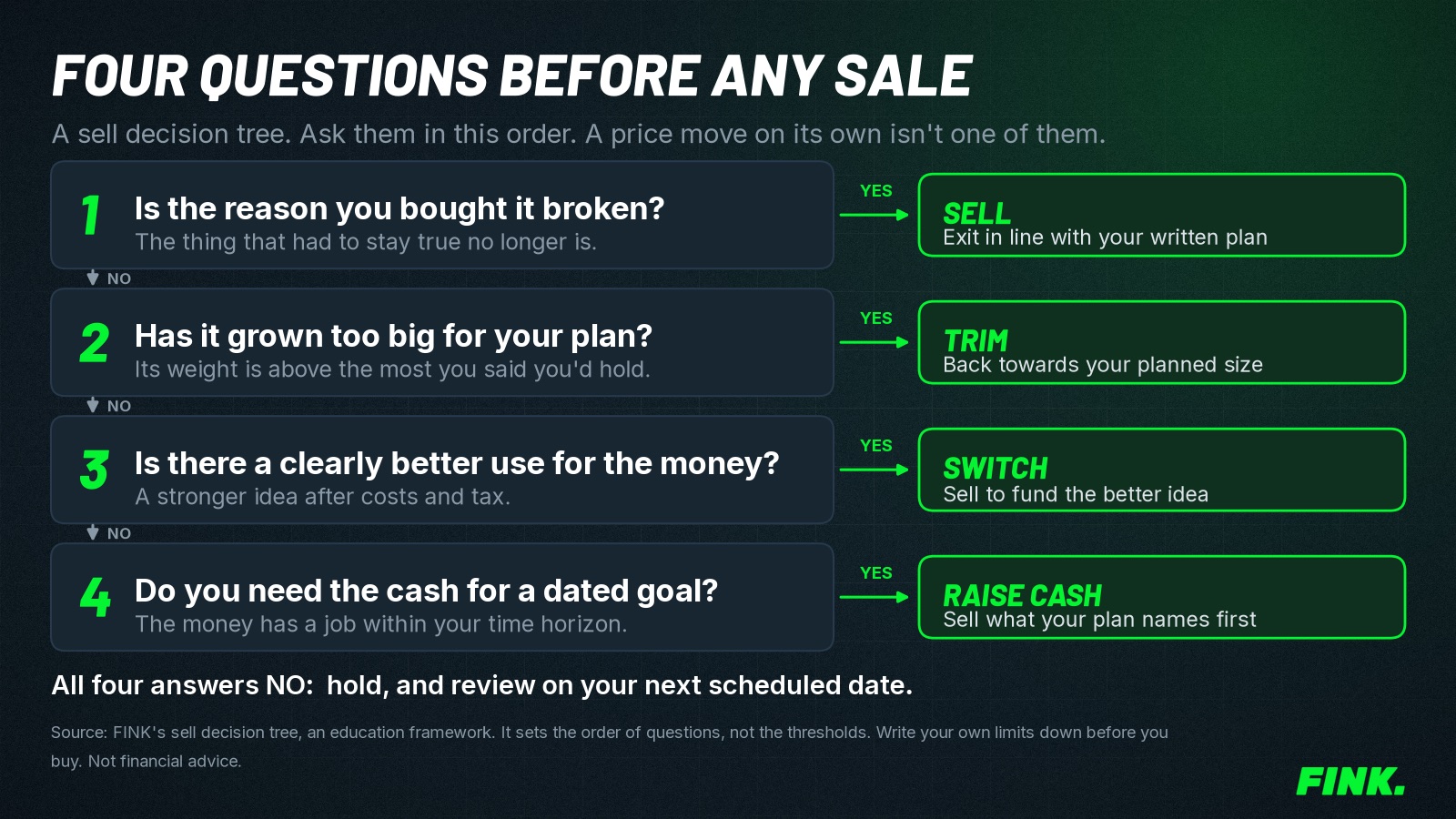
Our guide to when to sell a stock sets out four questions, asked in order:
- Has the reason you bought it broken? If the facts you relied on are gone, the loss is a sunk cost and the case for holding has gone with it.
- Has it grown too big for your plan? Less likely with a loser, but possible if you've added more on the way down.
- Is there a clearly better use for the money? After costs and after any tax effect of selling.
- Do you need the cash? A dated goal doesn't care whether a holding's up or down.
What's missing from that list is "it's down X%". A share that's fallen 40% with its business intact and a share that's fallen 40% because its main product failed are completely different situations. The number is the same.
Why is selling at a loss so hard?
Because losses hurt more than equal gains feel good. Selling makes the loss official.
Amos Tversky and Daniel Kahneman's work on prospect theory put a number on it. In their 1992 experiments, the median participant weighed losses about 2.25 times as heavily as equal gains (Journal of Risk and Uncertainty, 1992).
Later work suggests that figure is on the high side. A 2024 meta-analysis of 607 estimates found an average closer to 2 (Brown et al., Journal of Economic Literature). Either way, a £1,000 loss tends to feel worse than a £1,000 gain feels good.
In the market, that shows up as the disposition effect: selling winners too soon and holding losers too long. Terrance Odean's study of US brokerage accounts found it. It also found that the losers people kept went on to trail the winners they sold (Journal of Finance, 1998). Our guide on when to sell a stock has the full numbers alongside the professional data.
There's a second trap: sunk cost. Money already lost feels like a reason to stay, so you can get it back. The share doesn't know what you paid. The only question that matters for the future is whether this is still where you want the money.
How do you tell a falling price from a broken thesis?
Write down what had to stay true when you bought, then check the facts against it. The grid below separates the two questions.
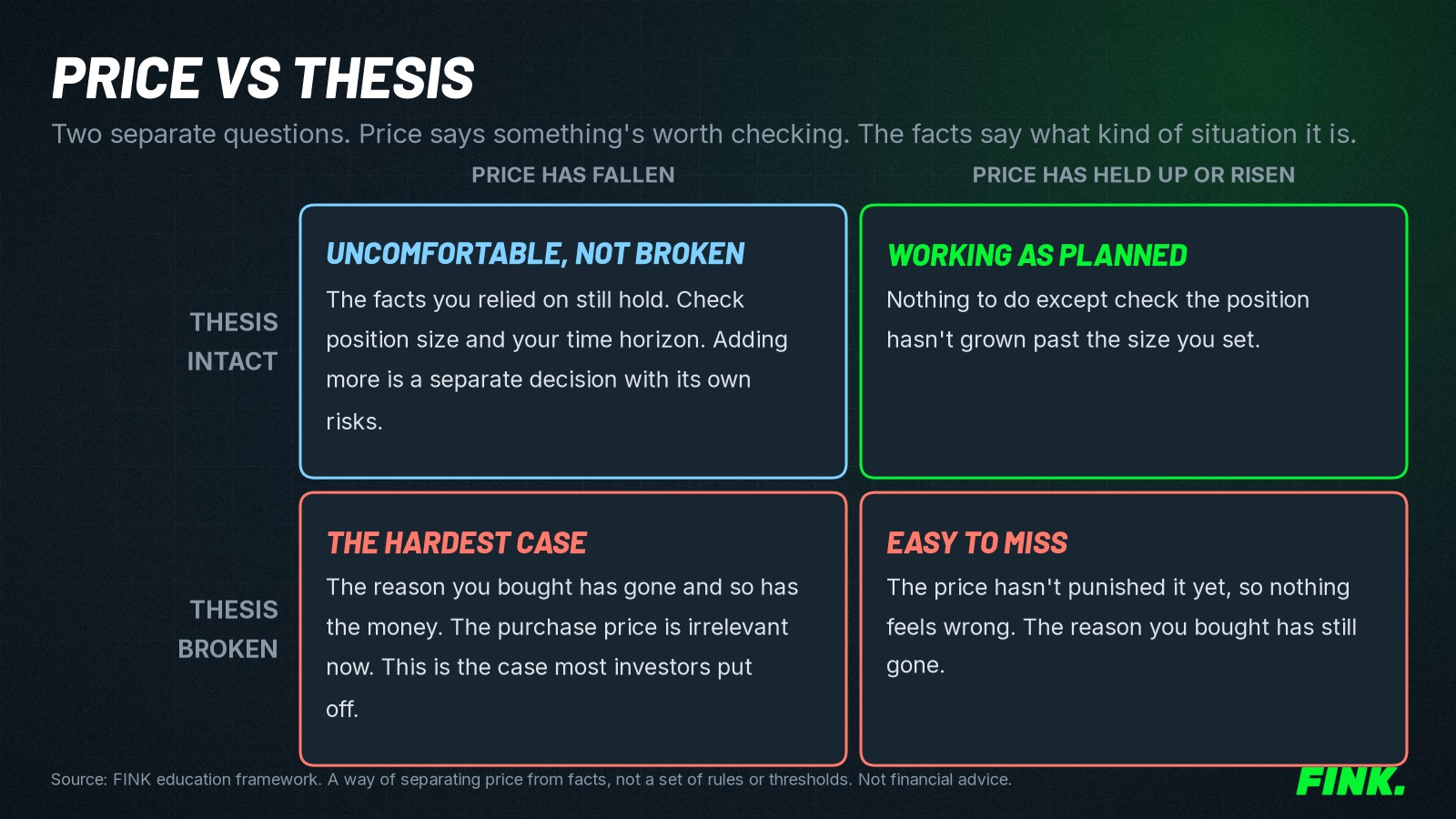 Source: FINK education framework.
The bottom row is where losses get expensive. When the thesis has broken and the price has fallen, the temptation is to wait for a bounce. When the thesis has broken and the price hasn't fallen yet, nothing prompts you to look. Both end the same way if you ignore them.
Examples of facts that can break a thesis:
| Thesis was built on | What breaking looks like |
|---|---|
| A reliable dividend | A cut or suspension, or cover falling well below what you'd accepted |
| Revenue growth from a key product | The product loses share, is withdrawn or stops growing |
| A strong balance sheet | Debt rising sharply, a rescue rights issue, a breach of lending terms |
| Management's plan | The strategy's abandoned or the people behind it leave |
| A takeover or recovery story | The deal collapses or the recovery stalls for reasons you didn't foresee |
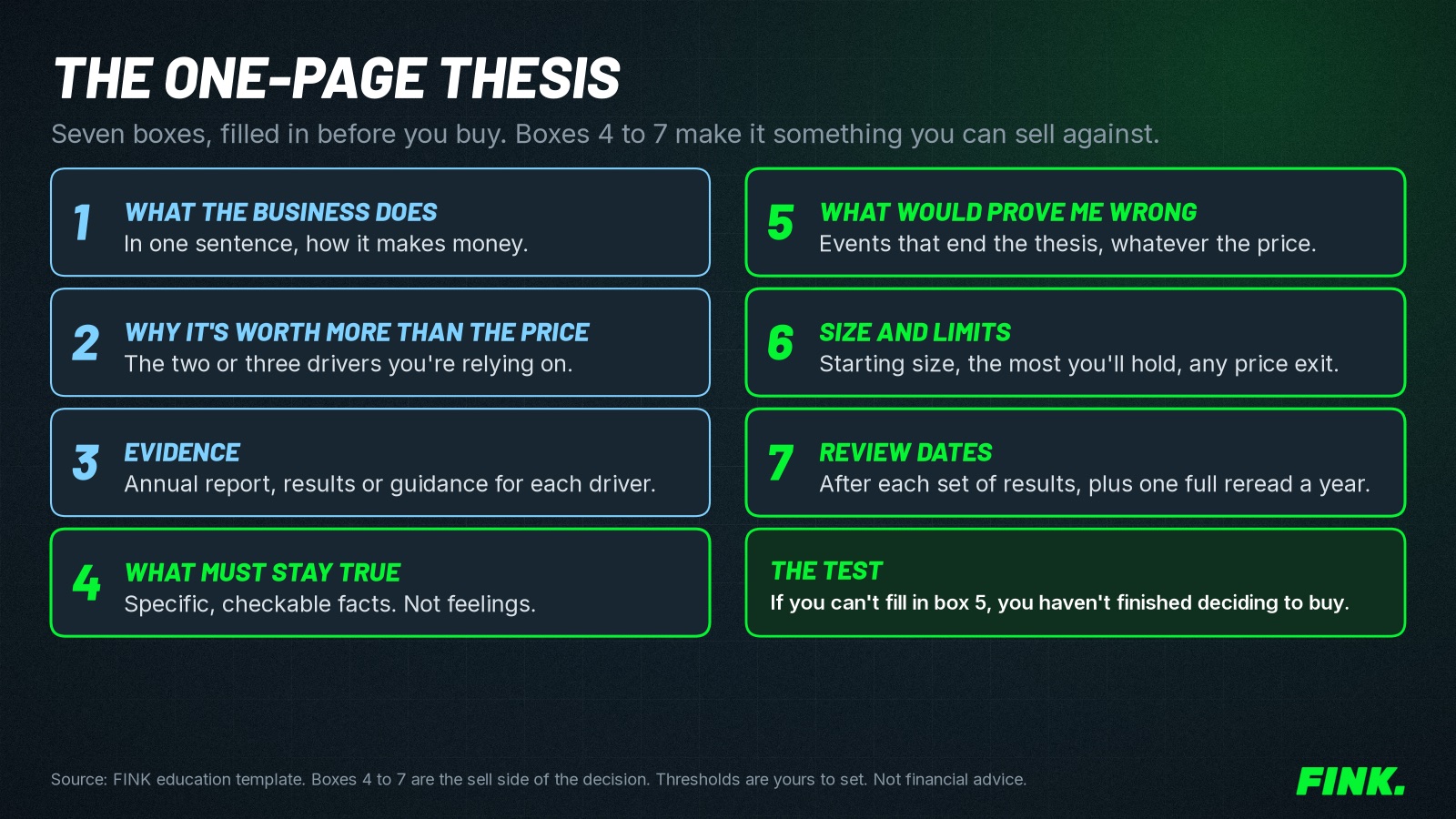
A thesis that was never written down can't break. It just keeps shifting to fit the price. Our investment thesis template shows how to write one you can actually check.
What does the research say about holding losers?
That it depends on the time frame, which is why no blanket rule works.
Over months, losers have tended to keep losing. Narasimhan Jegadeesh and Sheridan Titman looked at US stocks with the worst returns over the previous 3 to 12 months. They tended to keep underperforming over the next 3 to 12 months (Journal of Finance, 1993). This is the momentum effect. It's been found in many markets since.
Over years, extreme losers have tended to rebound. Werner De Bondt and Richard Thaler grouped US stocks by their returns over the previous three years. The biggest losers went on to outperform the market by an average of 19.6% over the next 36 months (Journal of Finance, 1985). They read it as the market overreacting to bad news.
For individual companies, total loss is common. Hendrik Bessembinder studied every US stock from 1926 to 2016. Rounded to the nearest 5%, the single most common lifetime outcome was a loss of 100% (Journal of Financial Economics, 2018). That's the main reason a loser can't be treated like a falling index. It's also why position size caps the damage in advance.
Put together, those findings don't say "always cut losers" or "always hold them". They say a group of losers, on average, behaves differently over different horizons and that any single loser might never come back. That's why the facts of the business matter more than any rule based on price.
Why do bigger losses need even bigger gains to recover?
Because the gain is calculated on a smaller base. Lose 50% and £100 becomes £50. Getting back to £100 means that £50 has to double.
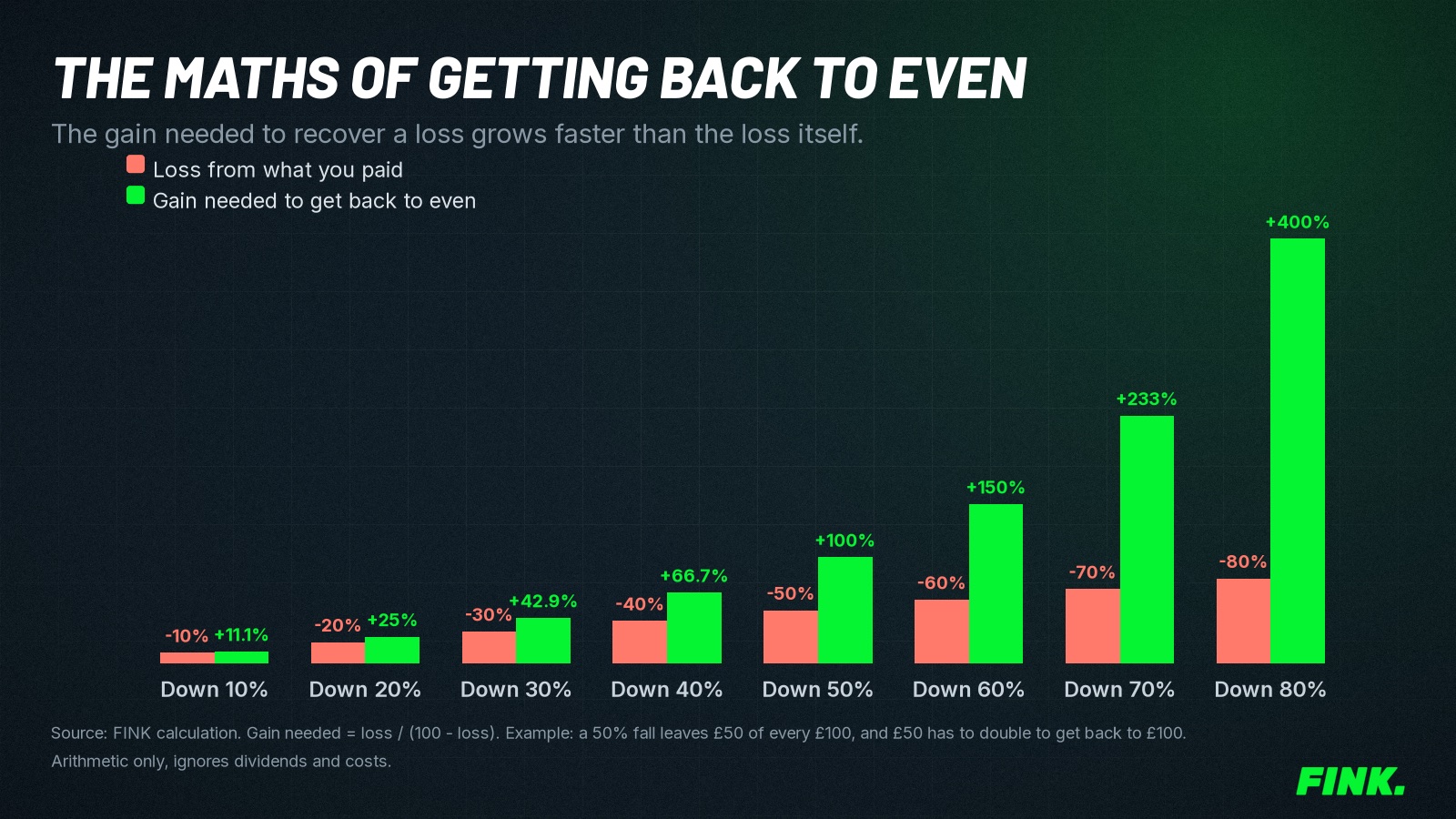 Source: FINK calculation. Gain needed = loss ÷ (100 − loss).
How we worked it out. If a holding falls by L%, what's left is (100 − L) for every 100 you started with. To get back to 100 you need a gain of L ÷ (100 − L).
So a 30% loss needs 30 ÷ 70 = 42.9%. It's arithmetic only and ignores dividends and costs.
This chart gets misused. It's often shown as a reason to sell quickly. What it actually shows is why position size and early review matter, before a loss gets large.
Once you're already down 50%, the 100% hurdle is a fact about the past. The decision now is about what you expect from here, compared with the other places that money could go.
Should you average down on a losing stock?
The usual test is whether you'd buy the share today on its merits, within the position size you set before you bought. Averaging down lowers your average cost. It doesn't change the business.
| The case for | The case against | |
|---|---|---|
| Thesis intact, price fallen | More shares for the same money in a business you still rate | Momentum research suggests recent losers often keep falling for months |
| Position size | Can bring a small position up to its planned weight | Easily turns one holding into an outsized bet |
| Psychology | Can be a deliberate plan written before the fall | Often driven by wanting to get back to even faster |
| Thesis broken | None | You're adding money to a reason that no longer exists |
The test some investors use: ignore your average price completely. If you'd be happy opening a new position of this size today, adding is consistent. If you're only adding because it lowers your break-even, that's sunk cost in action.
How do UK tax rules treat losses?
It depends entirely on the account. Inside an ISA, losses have no tax value. Outside one, they can reduce your Capital Gains Tax bill.
| Stocks and shares ISA | General investment account (GIA) | |
|---|---|---|
| Can a loss reduce tax? | No. HMRC says ISA losses can't be set against gains outside an ISA (gov.uk) | Yes, as an allowable loss (gov.uk) |
| Order of use | Not applicable | Deducted from same-year gains first, in full |
| Carry forward | Not applicable | Unused losses carry forward and are used only to bring gains down to the £3,000 allowance |
| Time limit to claim | Not applicable | Up to 4 years after the end of the tax year of the sale |
| Shares now worthless | Not applicable | A negligible value claim may be possible without selling |
| Selling and buying back | No tax effect | Buying the same shares within 30 days means the sale is matched to the new shares (HS284) |
A worked example (illustration only)
Alex has a general investment account and sells two holdings in the same tax year: one at an £8,000 gain and one at a £4,000 loss. Alex has no other gains or losses.
- Net gain: £8,000 − £4,000 = £4,000.
- After the £3,000 annual exempt amount: £1,000 taxable.
- Tax: £180 at 18% or £240 at 24%, using 2026/27 rates (gov.uk).
If Alex hadn't sold the losing holding, the taxable gain would have been £5,000 and the tax £900 or £1,200. Realising the loss cut the bill by £720 or £960.
There's a catch. Same-year losses are deducted in full, even if that wastes your allowance. If Alex's gains had only been £2,000, the £4,000 loss would wipe them out and the remaining £2,000 would carry forward. The £3,000 allowance for that year would go unused, so timing matters.
Tax is a reason to look at a sale more closely, not a reason to make it. Selling a share you'd otherwise keep just for the tax means you can't buy it back in the same account for 30 days without the rule kicking in. That's a trade-off worth thinking through.
Selling in a GIA and buying back inside an ISA is a different transaction. It uses ISA allowance. Our guide to selling shares in a stocks and shares ISA covers the ISA mechanics. If your whole ISA is down rather than one holding, see stocks and shares ISA losing money.
What should you decide before a loss happens?
As much as possible. Decisions made in advance are easier to follow than ones made mid-fall. Psychologists Peter Gollwitzer and Paschal Sheeran found if-then plans had a medium-to-large effect on follow-through across 94 tests (Advances in Experimental Social Psychology, 2006). None of those tests involved investing, but the principle carries over.
Before you buy, write down:
- What has to stay true. Two or three specific facts, not a feeling.
- What would prove you wrong. The events that would make you sell regardless of price.
- The most you'll hold. As a share of your portfolio, including any adding on the way down.
- Whether you'll use a price-based exit. If so, at what level and how you'll act on it. If not, how often you'll review instead.
- Your review dates. After results is a natural point, because it forces you to look at the facts.
At FINK we look at a loss as information about the price, not a verdict on the decision. A good decision can lose money and a bad one can make it. What you can control is whether the decision followed the plan you wrote down.