

Why is selling harder than buying?
Buying feels like hope. Selling means taking the ego hit on a loss or giving up upside you might have had on a winner, so most people put it off and decide on the day.
The research says that's expensive. A study of 783 professional portfolios found their buys added value but their sells trailed a random-selling benchmark by about 0.8 percentage points a year (Akepanidtaworn et al., 2023). Private investors do something similar. In Odean's study of 10,000 US brokerage accounts, the winners people sold went on to beat the losers they kept (Journal of Finance, 1998).
If professionals with research teams sell worse than chance, more knowledge won't fix it. Deciding the sell before you need it gives you a better shot. The full evidence is in when to sell a stock: what the evidence says plus a four-question test.
What are the reasons to sell that hold up?
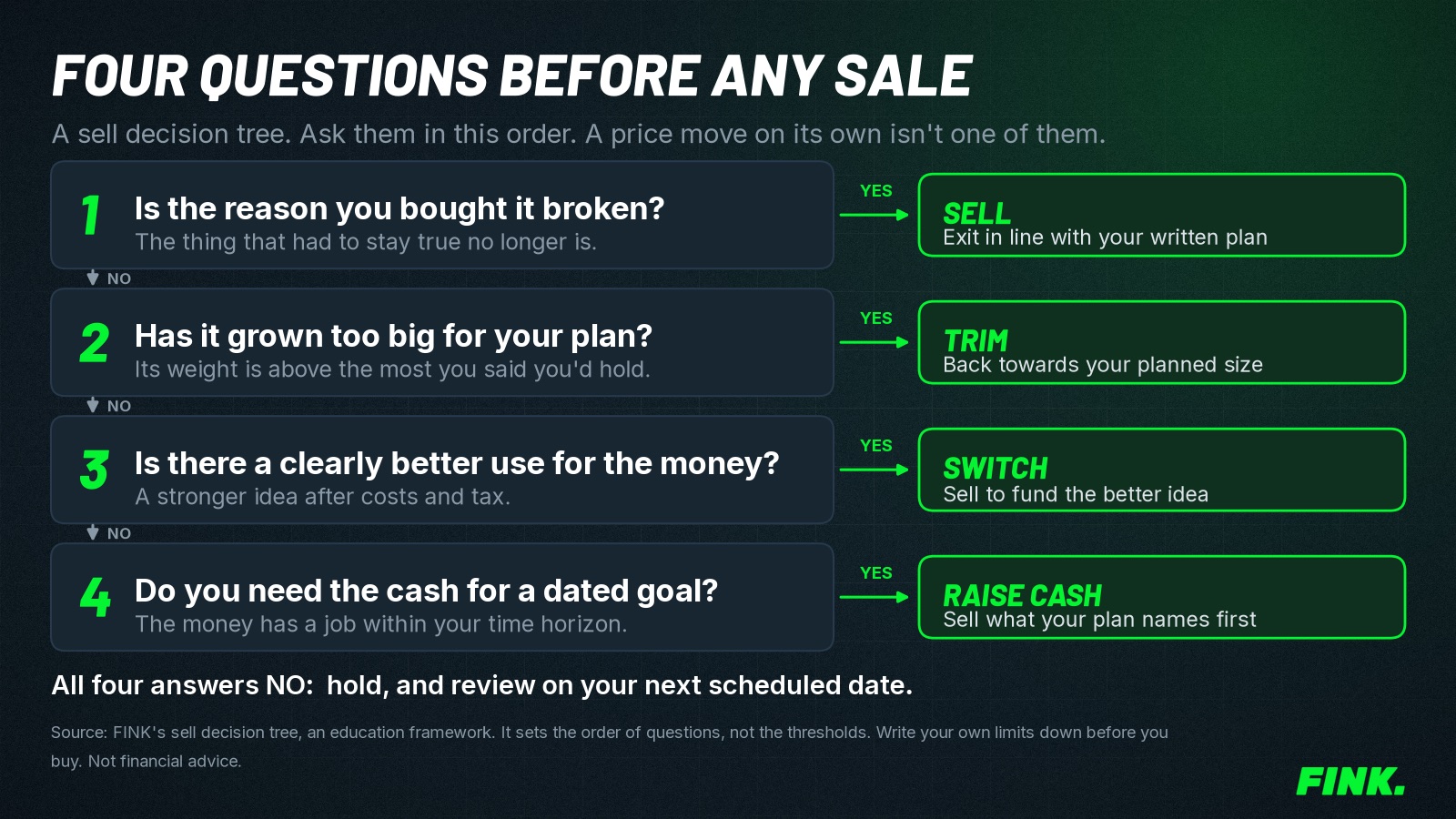
We ask four questions, in this order, before any sale.
- Is the reason you bought it broken? The thing that had to stay true no longer is.
- Has it grown too big for your plan? Its weight is above the most you said you'd hold.
- Is there a clearly better use for the money? A stronger idea, after dealing costs and any tax.
- Do you need the cash for a dated goal? The money has a job inside your time horizon.
If all four answers are no, the default is to hold and look again on your next review date. That default matters as much as the questions, because it stops a sharp move turning into a decision by itself.
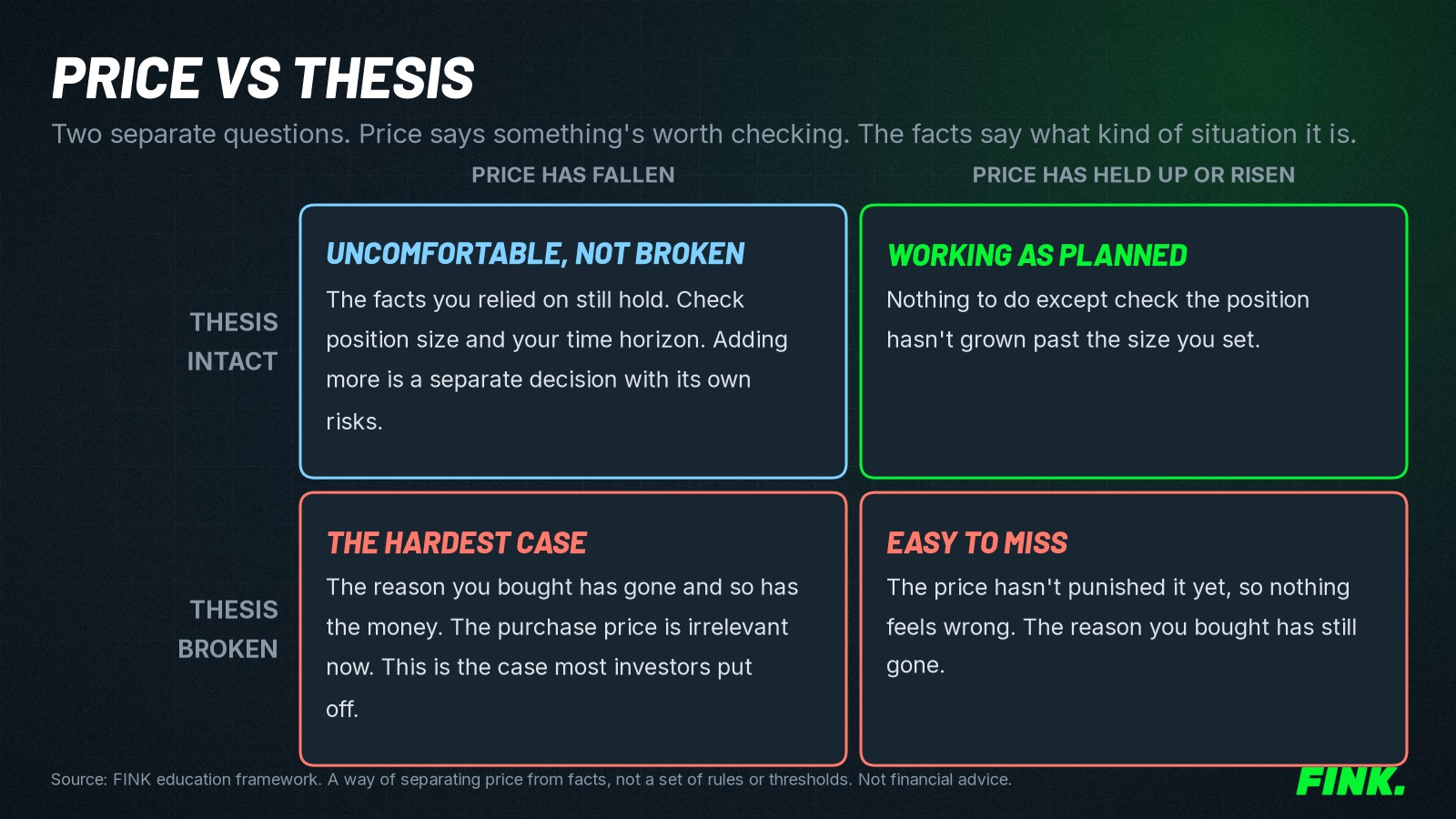
Notice what isn't on the list. A share being up a lot, or down a lot, doesn't answer any of the four.
Should you sell a stock that's fallen?
Only if one of the four answers has changed. The price you paid has no bearing on what the share does next. It mainly changes how the decision feels.
The maths of losses is still worth knowing. A 50% fall needs a 100% gain to get back to even. That's an argument for sizing positions properly and reviewing early, not for holding or selling today.
Outside an ISA a realised loss can be set against gains. You have four years to claim it (gov.uk). Inside an ISA it can't. Buying the same shares back within 30 days in a general account gets matched to the new purchase under HMRC's 30-day rule (HS284), so selling to bank a loss and buying straight back doesn't work the way people expect.
Stop-losses are their own debate. Kaminski and Lo found they lower expected returns when prices move randomly and can help when prices trend (Journal of Financial Markets, 2014). The full guide is when to sell a stock at a loss.
When should you take profits on a winner?
There's no price that automatically means it's time. Market gains are very concentrated. Hendrik Bessembinder studied every US common stock from 1926 to 2016. The best-performing 4% of companies accounted for all of the net wealth the market created over Treasury bills (Journal of Financial Economics, 2018). Selling a great business early can cost more than one bad buy.
That doesn't mean never trim. Selling part of a winner cuts the downside and the upside together, so it's a trade, not a free lunch. The usual reasons are a broken thesis, a position that's grown past your limit or a valuation that's run well ahead of the business. Our guide to taking profits on long-term stocks has a checklist you can use.
How big should one holding get before you sell some?
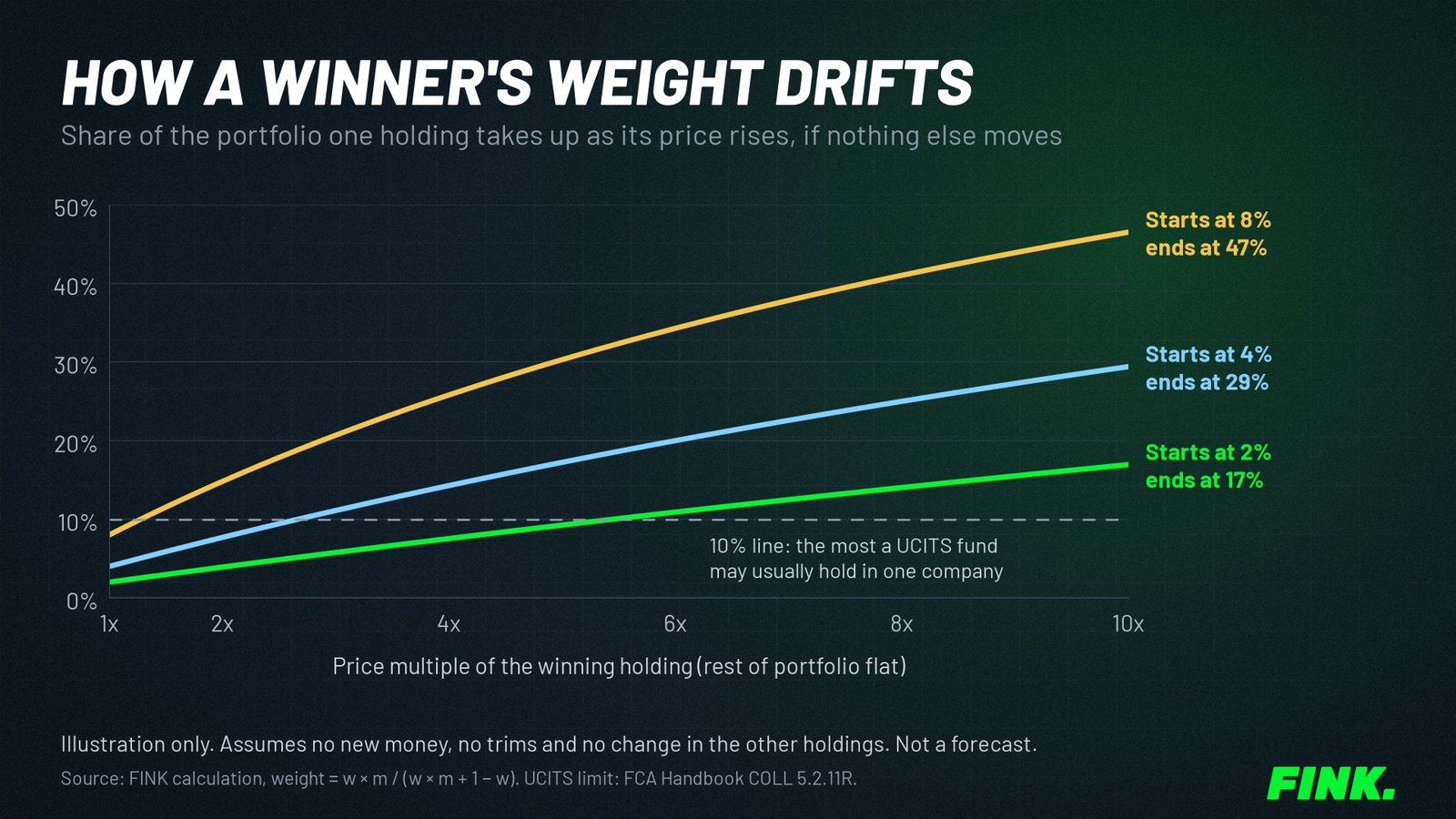
Winners grow into risks without you doing anything. A holding that starts at 4% of a portfolio and goes up tenfold, while the rest stays flat, ends up at about 29%. That's almost three times the usual 10% single-company limit for UK funds under the UCITS spread rule (FCA Handbook COLL 5.2).
Rules of thumb from UK platforms put a typical single share at 2% to 5% of a portfolio. They're starting points, not laws. What matters is that you write down a ceiling before you buy and decide what happens when it's hit. Our position sizing guide shows how to set one from the loss you're willing to take.
How does tax change when you sell?
The wrapper changes the sums more than people think. The table shows the same £10,000 gain, sold in 2026/27 with no other gains that year.
| Where you hold it | Capital Gains Tax on a £10,000 gain |
|---|---|
| Stocks and shares ISA | £0 |
| General account, gain inside the basic-rate band (18%) | £1,260 |
| General account, higher or additional rate (24%) | £1,680 |
The general account figures are (£10,000 minus the £3,000 annual exempt amount) times the rate (gov.uk). Tax shouldn't be the reason you sell. It can change which holding you sell first and when.
What happens when you sell inside an ISA?
You don't pay Capital Gains Tax or report the sale to HMRC. Selling and buying again inside the ISA doesn't use any allowance, because the £20,000 limit only counts money going in (gov.uk).
UK share sales currently settle two business days after the trade, moving to one business day from 11 October 2027 (HM Treasury).
Withdrawing works differently. Unless your ISA is flexible, cash you take out can't go back in without using new allowance. If you're moving provider, transfer the ISA rather than withdrawing. The details are in selling shares in a stocks and shares ISA.
How do you put it all together?
Write your sell rules on the day you buy, while you're not under pressure. Keep them short and write them as if-then lines, such as "if the reason I bought breaks, I sell" or "if it passes my ceiling, I trim back to it". Across 94 tests, plans written that way had a medium-to-large effect on follow-through (Gollwitzer and Sheeran, 2006).
Then pick review dates and stick to them. Check the thesis after each set of results and look at sizes and cash needs across the whole portfolio at least once a year. Between those dates, the default is to do nothing, which is harder than it sounds.