

By David Belle (about David), founder of FINK, 15+ years in broking, trading and fintech
Quick answer: why invest in infrastructure? Because governments can't put building off any more. AI data centres, grids that fall over, water shortfalls and missing homes have turned the build from optional to forced, McKinsey puts the bill at $106 trillion between 2025 and 2040 and somebody gets paid for every cable, transformer and reservoir that goes in.
Somebody gets paid for every transformer and reservoir the world now has to build. McKinsey puts the bill at $106 trillion between 2025 and 2040 (McKinsey, The infrastructure moment, 9 September 2025) and I think it's the biggest opportunity sitting in plain sight for the next ten years.
If you've ever wondered why invest in infrastructure when it sounds about as thrilling as a council drainage report, my answer is short. For forty years governments could put building off and now they can't.
Why governments can't put building off any more
When the sums don't add up, capital spending is the first thing a finance minister cuts and honestly I get why. A substation that never gets built doesn't make the six o'clock news, while a closed hospital ward is on it by teatime. For years that worked because power demand in rich countries barely moved. McKinsey says US demand grew by under 1% a year for almost fifteen years, so you could sweat the old kit and the lights stayed on.
The demand has now turned up in person. The International Energy Agency says data centres used 415 TWh of electricity in 2024 and its base case has that more than doubling to 945 TWh by 2030, a little more than Japan uses today (IEA, Energy and AI, April 2025). One typical AI data centre uses as much power as 100,000 households, so you're not hooking up a building, you're dropping a small city somewhere that never planned for one.
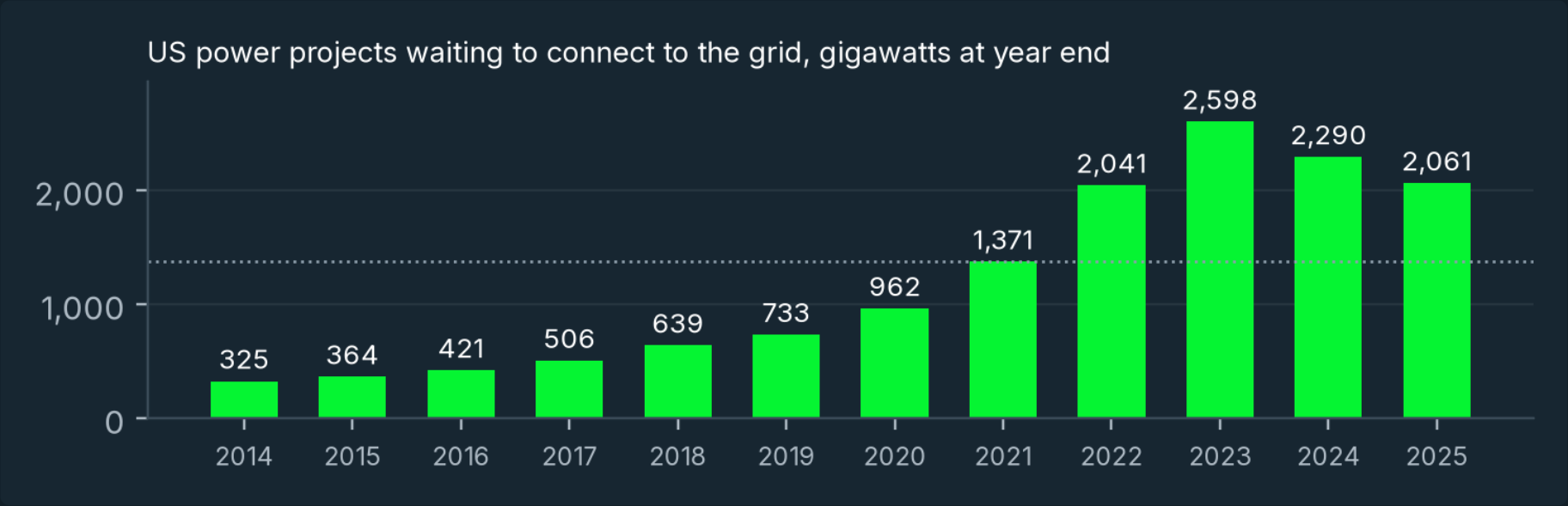
How long is the queue? In the US anyone who wants to build a power plant or a battery has to wait for a grid connection and at the end of 2025 there were 2,061 GW of projects in that line (Lawrence Berkeley National Laboratory, Queued Up 2026). The whole country has 1,374 GW of generation installed. The waiting list is bigger than the power system itself and the median project that switched on in 2025 had waited more than five years.
Who pays when the grid falls behind
Virginia shows you where the bill lands. PJM runs the grid for thirteen states plus Washington DC and once a year it holds an auction that pays power plants just for being there at the peak. For 2024/25 it cleared at $28.92 per megawatt-day and for 2025/26 it cleared at $269.92 (PJM auction reports). Every auction since has hit the cap. Those payments land on household bills and once it's on people's bills it stops being a planning debate and turns into a political one. In my experience that's about the only thing that gets a government moving.
The kit is short as well. On the US government's own producer price index, power and distribution transformers cost 86% more than they did in January 2020 (FINK sum from BLS series PCU335311335311). When demand is forced and the factories need years to catch up, whoever owns the supply gets to set the price. I pay a lot of attention to the dull kit makers for exactly that reason.
Britain supplies the comedy. England hasn't completed a major reservoir since 1992 (BBC) and the Environment Agency now warns of a public water shortfall of 5 billion litres a day by 2055 (Environment Agency, June 2025). Its advice to the public included shorter showers and deleting old emails to take pressure off data centres. I'd rather they built the reservoir.
West London is the one that really got me. In 2022 the Greater London Authority said data centres along the M4 had used up what was left of the power capacity in Ealing, Hillingdon and Hounslow and big housing schemes heard they might wait until 2035 for a connection (Greater London Authority, July 2022). Can you picture it? Approved homes, in a capital city with a housing crisis, stuck behind servers in a queue for the grid.
What the Spain and Portugal blackout showed investors
At 12:33 Spanish time on 28 April 2025 mainland Spain and Portugal lost power. Within hours half the internet had decided too much solar caused it. The panel of 49 experts that ENTSO-E set up says otherwise. Its final report on 20 March 2026 found an uncontrolled, rapid rise in voltage and a loss of voltage control, followed by a cascade of generators tripping off (ENTSO-E).
Why does that matter for your money? If the problem had been too much solar, the fix would be less solar. It was control, so Spain needs more grid and a lot more kit to run it.
In May 2026 the European Commission approved a €9 billion Spanish capacity mechanism, roughly €900 million a year for ten years and storage can win contracts of up to fifteen years (European Commission). A government-backed payment for being available, locked in for fifteen years, is something a bank will happily lend against. It turns a battery from a punt on power prices into something that looks a lot more like infrastructure.
Why invest in infrastructure when governments are skint?
Most governments are already up to their eyeballs in borrowing. In October 2025 the IMF said global public debt was heading above 100% of GDP by 2029, which would be the highest since 1948 (IMF, October 2025).
So the money has to come from somewhere else and it's already on its way. Private infrastructure funds raised nearly $200 billion in 2025, beating the previous record set in 2022 (McKinsey Global Private Markets Report 2026).
I'd take the market picking projects over a ministry picking them, every time. Private money asks the annoying questions about cost and delays that governments tend to skip and what it wants back from the state is simple enough. Tell me how I get paid and don't move the goalposts once the concrete's poured.
The projects I like best have forced demand and revenue that somebody has already signed for. Think of a battery with a fifteen-year capacity contract, or a grid upgrade the regulator has approved. If you want the bigger picture of why Britain has been so slow to build, read why UK investment is so low.
Where a good theme goes wrong
The theme isn't a secret any more and that's where managing the position earns its keep. By late 2025 Germany's four transmission operators had 545 applications for large batteries totalling 211 GW, against a network plan that sees a need for 41 to 94 GW by 2037 (German transmission operators, February 2026). That's what a crowded theme looks like. When a story gets obvious, too much money chases the same connection points and plenty of those projects will never get built.
So a strong theme only gets an idea through the door. At FINK every idea goes through the same five layers, Qualify, Enter, Size, Manage and Exit and a good theme only helps with the first one. We decide how much goes in and what would make us leave before we buy, not after the news. If you're wondering where a theme like this fits next to the boring core of a portfolio, the core and satellite split is a good place to start.
If AI spending stalls, or voters turn on their bills and a regulator caps returns, you want that decision made already. Rates matter too, because a thirty-year income stream is worth less when money gets dearer.
Britain could be on the list of winners if it learned to build quickly. The Lower Thames Crossing spent £295.1 million just getting through planning and its environmental assessment ran to about 12,000 pages before anyone picked up a shovel (Hansard, November 2024).
The money is already committed and the demand is already standing in the queue.
Questions people ask
Is infrastructure a good investment?
It depends on the project and the price you pay and nobody can promise a result. What I look for is forced demand plus revenue somebody has already agreed to pay, like a regulated network or a long capacity contract. The big risks are interest rates, regulators capping returns when bills rise and too much money crowding into the same theme.
How much does the world need to spend on infrastructure?
McKinsey estimates $106 trillion of cumulative investment between 2025 and 2040. Transport is the biggest share, energy and digital together come to about $42 trillion and more than half of the total is in Asia (McKinsey, September 2025).
Why is AI driving demand for power and grids?
Data centres used 415 TWh of electricity in 2024 and the IEA's base case has that reaching 945 TWh by 2030. A typical AI data centre uses as much power as 100,000 households, so each new site needs new generation and new wires (IEA, April 2025).
What caused the Spain and Portugal blackout?
ENTSO-E's expert panel found an uncontrolled, rapid rise in voltage and a loss of voltage control, followed by a cascade of generators disconnecting. Its final report came out on 20 March 2026 (ENTSO-E).
Who pays for new infrastructure when governments are already borrowing so much?
More and more of it comes from private money, paid back through regulated returns, payments for being available, long contracts with big buyers or backing from government. In the end households and businesses usually pay through their bills, which is why the politics of bills matters so much.
This is education, not financial advice. Investments can fall as well as rise, and you may get back less than you put in.


