

On 9 September 2025 Oracle told the world its remaining performance obligations had jumped 359 per cent to $455bn and the next day the market bolted about $244bn onto the company's value, its best session since 1992 (Oracle, 9 September 2025, CNBC, 10 September 2025). I'd bet a pint most of the people piling in couldn't have told you what the line actually means. That's the opportunity, because the number everyone gets giddy about and the number that tells you something useful sit in the same note and hardly anyone reads the second one.
Quick answer
Remaining performance obligations, or RPO, are revenue a company has signed contracts for but hasn't earned yet. It's a promise of revenue, not revenue, so the figure I care about is how much of it lands in the next 12 months and who signed it.
What are remaining performance obligations, really?
Picture a wedding venue with every Saturday booked for the next nine years. You'd pay more for that than for a place whose diary runs dry in March, but you'd also want to know how many couples can walk away, what each booking pays and whether half the diary belongs to one very rich family with a temper.
The US revenue standard has made public companies disclose RPO since 2018, along with when they expect to earn it (PwC Viewpoint on ASC 606 disclosures). It covers money already billed plus money contracted but not yet invoiced. It leaves out orders a customer can cancel without a real penalty and companies can skip any contract with an original length of a year or less.
That last exemption is why Nvidia can sell $303.0bn of chips in a year and report $3.2bn of RPO (Nvidia 10-Q, quarter to 26 July 2026). A gym rammed with day-pass punters can take more cash than one full of 12-month contracts and still show almost no backlog. RPO measures commitment rather than demand and if you mix the two up your own spreadsheet will mug you.
Which backlog number are they quoting?
Dell is the comedy example. In the three months to 31 July 2026 it took $60.9bn of new AI server orders, had $95bn of AI server orders still waiting to ship and reported about $132bn of RPO across the whole business (Dell results release, 1 September 2026, Dell 10-Q). A headline can make Dell look less than half the size just by picking the smallest, so when someone quotes me a backlog, my first question is which bloody one.
How many years of sales are already signed?
Divide RPO by the last four quarters of revenue and you get a rough count of years of sales already under contract. Figures come from each company's latest 2026 10-Q via SEC EDGAR.
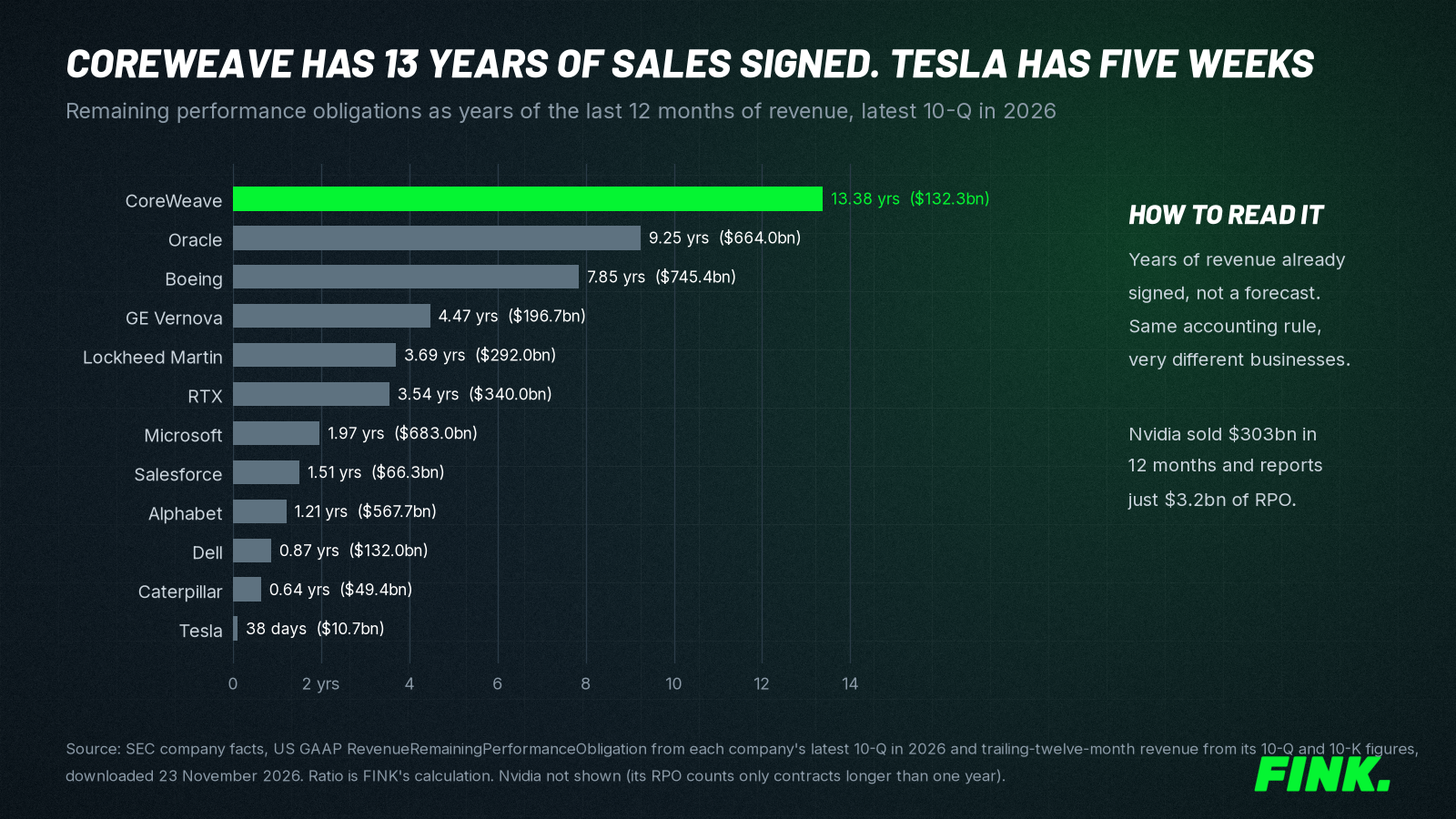
CoreWeave comes out at 13.38 years and Tesla at about 38 days, with Oracle's $664bn worth 9.25 years of sales (Oracle 10-Q). The gap mostly tells you how each company sells, because CoreWeave rents out Nvidia chips on multi-year deals while Dell ships servers within months. A 2024 study of US companies found a higher backlog-to-sales ratio actually went with lower future earnings (Banker, Barber, Hollie and Park, 2024), so a fat ratio on its own proves sod all.
Does the market overpay for backlog?
For decades, according to the research. Shivaram Rajgopal, Terry Shevlin and Mohan Venkatachalam studied 21,891 company-years of US firms from 1981 to 1999 and found backlog did help predict next year's earnings, but share prices weighted it more than four times as heavily as that link justified (Rajgopal, Shevlin and Venkatachalam, 2003).
Boeing shows how fast a signed order book can shrink. Its RPO fell from $491.2bn in September 2018 to $363.4bn in December 2020. In 2020 airlines cancelled $34.6bn of orders, mostly 737 MAX and Boeing struck off another $54.5bn because it doubted those buyers were good for it (Boeing 2020 Form 10-K). The book is back at a record $745.4bn and the latest filing still flags significant uncertainty over when it turns into revenue (Boeing 10-Q).
How do you run the 12-month cover test?
Open the revenue note in the 10-Q, search for remaining performance obligations (Alphabet calls it revenue backlog) and find the sentence saying how much the company expects to recognise in the next 12 months. Multiply the total by that percentage, then divide by the last 12 months of revenue and you've got how much of next year is already in the bag.
| Company | RPO | Due in 12 months | Last 12 months' revenue | Cover |
|---|---|---|---|---|
| Oracle | $664bn | about 13%, about $86bn | $71.8bn | about 1.2x |
| Microsoft | $683bn | about 30%, about $205bn | $346.4bn | about 59% |
| Dell | $132bn | about 77%, about $102bn | $151.2bn | about two thirds |
Oracle's $664bn sounds like a decade-long party until you clock that only about 13 per cent of it arrives next year, while Dell needs fresh orders worth about a third of last year's sales just to stand still (Microsoft 10-Q).
Then two more checks. Compare RPO with the same quarter a year earlier, never the one before, because renewals bunch up. Salesforce's RPO fell from $72.4bn at 31 January 2026 to $66.3bn at 31 July and was still up 11 per cent on a year earlier (Salesforce 10-Q). And check who signed. Two customers made up 24 per cent and 30 per cent of CoreWeave's revenue in the quarter to 30 September 2026 (CoreWeave 10-Q). A builder with one developer filling his five-year diary looks marvellous right up until the developer runs out of cash, which is the same logic as how much to invest in one stock.
Write down what would change your mind before the next filing lands, whether that's a cancelled contract, a big customer cutting back or a falling 12-month share. Each one goes in your investment thesis template as a line that proves you wrong and our exit guide covers how you'd weigh it up.
A lot of the biggest order books sit in the AI and power build-out, where a handful of giant buyers sign the cheques and our piece on why invest in infrastructure looks at who gets paid. Our free report The $106 Trillion Trade follows that bill down to the grid kit and the builders.
An order book tells you what customers have promised and what it's worth depends on whether they keep the promise.
Questions people ask
Is RPO the same as revenue?
No. It only becomes revenue as the company delivers. Oracle expects about 13 per cent of its $664bn to arrive in the next 12 months.
What is current RPO (cRPO)?
It's the share a company expects to recognise in the next 12 months. Salesforce reported $33.5bn of current RPO out of $66.3bn at 31 July 2026.
Do UK companies report RPO?
UK listed companies report under IFRS 15, which asks for a similar disclosure, so the same 12-month cover test works on a UK annual report.
Sources
See the sources line in the footer.
This is education, not financial advice. Investments can fall as well as rise, and you may get back less than you put in.


