

Own an S&P 500 tracker in your ISA and you've got two bets running, one on 500 American companies and one on the US dollar and most people only signed up for the first. The hedged vs unhedged ETF choice is how you decide whether you want the second. The opportunity is choosing it on purpose instead of letting the cheapest fund on the platform choose it for you.
Quick answer
An unhedged ETF gives you the index plus whatever the dollar does against the pound. A hedged ETF uses currency forwards to strip most of that dollar move out, leaving you close to the index's move in dollars. The hedge costs roughly the UK interest rate minus the US rate and neither version is better in general.
What's the difference between a hedged and an unhedged ETF?
Both versions own every company in the index and the hedged share class bolts a layer of currency contracts on top.
Think of a fortnight in Florida. You can buy your dollars today at today's rate, or wait and buy them the week you fly and take whatever the market gives you. An unhedged tracker is the second option, every single day you own it, so its value in pounds moves every time the exchange rate does.
A hedged share class is closer to fixing the rate in advance. The fund agrees today to swap dollars back into pounds a month from now, then rolls that agreement over each month end, which is how MSCI builds its hedged indexes (MSCI Hedged Indexes methodology, August 2021). That monthly reset is why a hedged fund never removes every penny of currency movement. Hold US shares directly and there's no hedged version at all, one more thing to weigh between individual shares or funds in an ISA.
How much did the pound change an S&P 500 tracker in 2022?
By about 20 percentage points, which is frankly mental for two funds holding the same shares. The S&P 500 closed 2021 at 4,766.18 and stood at 3,719.04 on 28 September 2022 (S&P Dow Jones Indices via FRED). Over the same stretch the Bank of England's daily rate went from $1.3477 per pound to $1.0745, its lowest reading since March 1985, days after the mini-budget (Bank of England, series XUDLUSS). Westminster managed to do to the pound in a week what most bear markets take months to do to shares.
Move in pounds = (new index level ÷ old index level) × (old exchange rate ÷ new exchange rate) − 1
So (3,719.04 ÷ 4,766.18) × (1.3477 ÷ 1.0745) − 1 gives 0.7803 × 1.2543, which is 0.9787. The index fell 22.0 per cent in dollars and the unhedged holder lost 2.1 per cent in pounds. Put £10,000 in on the last day of 2021, purely as an illustration and unhedged you'd have had about £9,787 on 28 September, while fully hedged (before costs) you'd have had about £7,803.
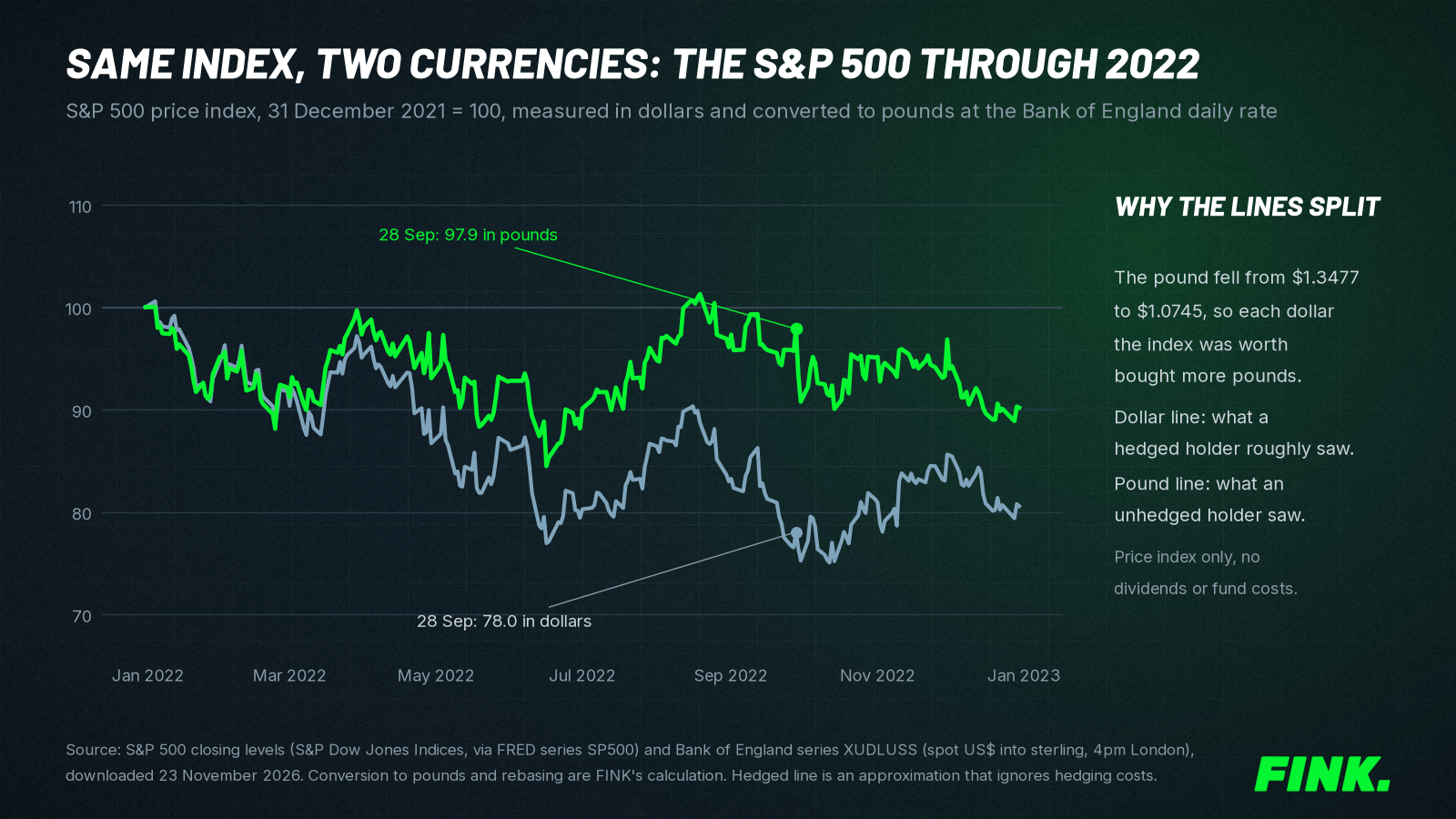
The unhedged holder got bailed out by the pound falling apart, which is a strange thing to be grateful for. These are price index figures only, with no dividends, charges or hedging costs.
Does a rising pound hurt an unhedged tracker?
Yes and it bites the other way just as hard. From that low of $1.0745 to $1.3102 on 20 November 2026 the pound climbed 21.9 per cent, so any dollar asset held over that stretch was worth 18.0 per cent fewer pounds than its dollar value alone would suggest. American companies did their work in dollars and the currency nicked a chunk on the way home.
The referendum shows how fast it can happen. The pound bought $1.4798 on 23 June 2016 and $1.3621 the next day and anyone holding US shares in pounds woke up 8.6 per cent richer on paper without a single American company lifting a finger. Which way will sterling go next? I've no idea and anyone who tells you they know is talking bollocks.
What does currency hedging cost right now?
Close to nothing, for once. A sterling hedged fund roughly earns the UK rate and gives up the US rate, so when US rates are higher it costs you and when UK rates are higher it pays you a little.
| Date | Bank Rate | US fed funds target | Gap for a sterling hedger |
|---|---|---|---|
| 2 Jan 2019 | 0.75% | 2.25% to 2.50% | costs 1.50 to 1.75 points a year |
| 20 Nov 2026 | 4.00% | 3.75% to 4.00% | adds 0 to 0.25 points a year |
Sources: Bank of England and Federal Reserve.
In 2019 a sterling hedger paid well over a point a year for the privilege and that can flip at the next meeting of either committee, with the fund's own charges on top.
Does hedging pay off over the long run?
It smooths the ride over months and does much less over many years. Kenneth Froot looked at about 200 years of US returns from a British investor's view and found that over five years or more, hedged foreign stocks were actually more volatile than unhedged ones (Froot, NBER working paper 4355, 1993). Campbell, Serfaty-de Medeiros and Viceira found the dollar tended to rise when world shares fell (Journal of Finance, 2010) and 2022 was a textbook case. Vanguard's 2014 paper argues many investors could still hedge part of their foreign equity (Vanguard Research, To hedge or not to hedge?, September 2014).
If you like breakdowns where every number comes from the source and the decisions stay yours, you'll like Unreasonably Good, our free email. You can join it here.
What should you check on your own fund tonight?
Pull up the factsheet and key information document and work down this.
- Read the share class name. Look for GBP Hedged in the fund name or share class line. If it doesn't say it, it almost certainly isn't.
- Add up your total dollar. An unhedged S&P 500 tracker plus a global tracker stacks the dollar twice and US shares held directly pile more on. Check how many funds you really need before adding another.
- Write down when you need the money in pounds. Cash you'll need in two years is exposed to a currency swing in a way a pension pot you won't touch for 25 years mostly isn't.
- Compare the ongoing charges of both share classes side by side, plus any currency conversion fee your platform charges on each deal, covered in selling shares inside an ISA.
- Note the Bank Rate minus fed funds gap and look again after each meeting, because that's your hedging cost moving.
The wider framework sits in our stocks and shares ISA strategy guide. The dollar's already in your tracker and keeping it or hedging it out is your call.
Questions people ask
Is a hedged or unhedged ETF better?
Neither in general. Unhedged gives you the index plus the dollar's move against the pound and hedged removes most of that for a cost tied to the UK and US rate gap.
Sources
- Bank of England Database, series XUDLUSS and Bank Rate history, downloaded 23 November 2026
- Federal Reserve FOMC statement, 28 October 2026 and target range via FRED
- S&P 500 closing levels, S&P Dow Jones Indices via FRED, downloaded 23 November 2026
- MSCI Hedged Indexes methodology, August 2021
- Kenneth Froot, Currency Hedging over Long Horizons, NBER working paper 4355, 1993
- Campbell, Serfaty-de Medeiros and Viceira, Global Currency Hedging, Journal of Finance, 2010
- LaBarge, Thomas, Polanco and Schlanger, To hedge or not to hedge?, Vanguard Research, September 2014
Figures checked on 23 November 2026. Charts are FINK calculations from the data above.
This is education, not financial advice. Investments can fall as well as rise, and you may get back less than you put in.


