What's an investment thesis?
It's the reason you own a share, written down in a form you can check later. Most people have one in their head.
The trouble is that a thesis in your head moves. If the share rises, the reasons you bought get stronger in memory. If it falls, they get vaguer.
A written thesis fixes the reasons at the point you made the decision. Months later, you can compare what's happened with what you said had to happen. That comparison is what you're writing it for.
There's evidence that selling needs this more than buying. Klakow Akepanidtaworn and colleagues studied 783 institutional portfolios from 2000 to 2016 (Journal of Finance, 2023). The managers' buys beat a random-buying benchmark by more than 100 basis points a year. Their sells did about 80 basis points a year worse than selling a different holding at random.
The authors found that sells made on company results days, when managers had to look at the business, did more than 150 basis points a year better than other sells. Attention, not skill, seemed to be the gap.
What should an investment thesis include?
Seven parts. The first three explain why you're buying. The last four are what let you sell against it.
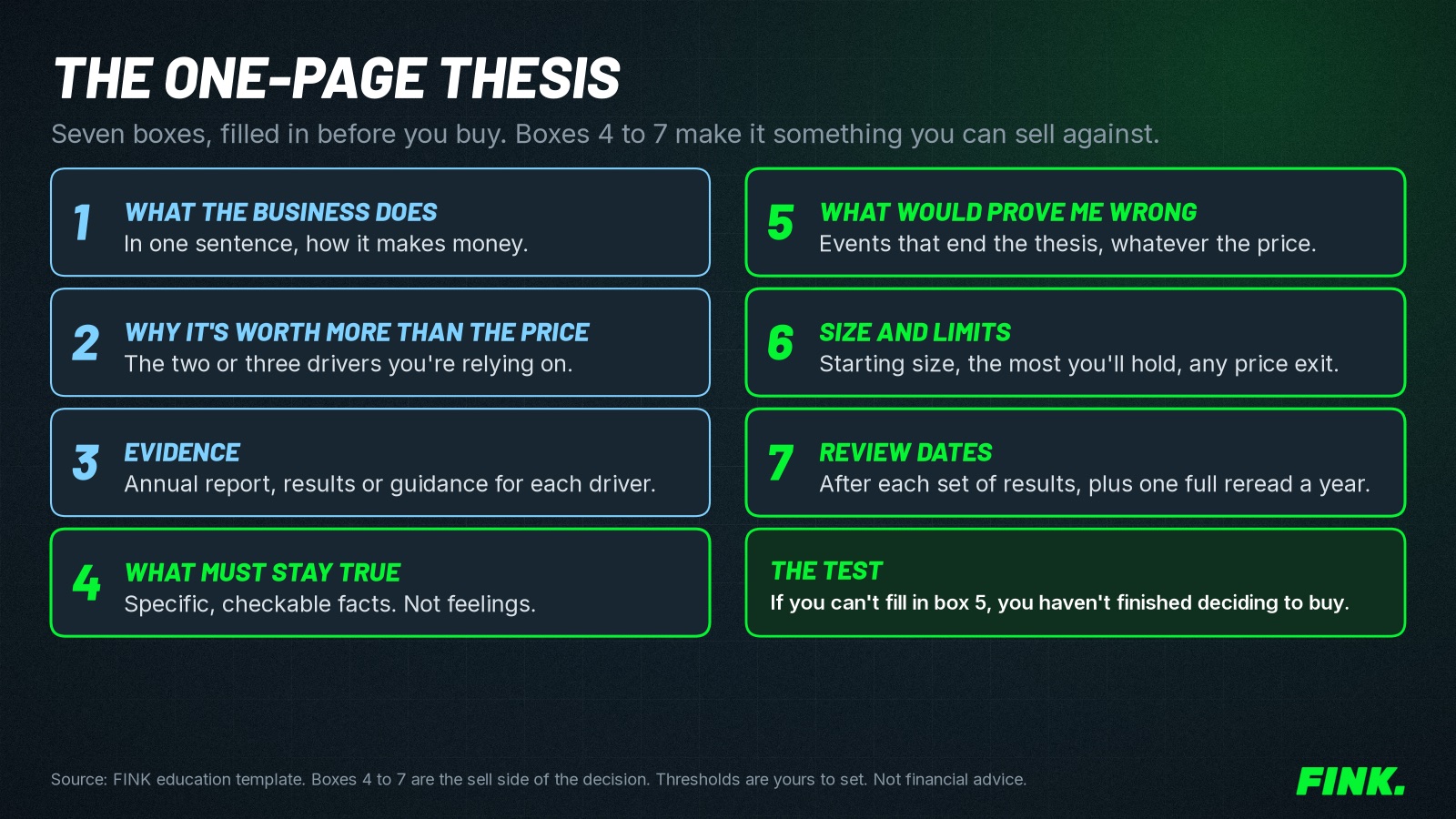 Source: FINK education template.
- What the business does. One sentence on how it makes money. If you can't write it, that's useful information.
- Why it's worth more than the price. The two or three drivers you're relying on. Fewer is better. A thesis with ten reasons can't be tested because one of them will always look fine.
- Evidence. Where each driver comes from: a page in the annual report, a results statement, published guidance. Your own estimate is fine as long as you label it as yours.
- What must stay true. Specific, checkable facts. "Management is good" isn't checkable. "Operating margin stays above the level reported last year" is.
- What would prove me wrong. The events that end the thesis regardless of price. This is the part you sell against.
- Size and limits. How much you'll start with and the most you'll ever hold. Our guide to setting a maximum position size covers sizing.
- Review dates. After each set of results, plus a full reread once a year.
At FINK we look at box 5 as the test of whether the buy decision is finished. If you can't say what would make you sell, you haven't finished deciding to buy.
Where do you find the evidence in a UK annual report?
In a handful of standard sections. UK company law requires a strategic report. For quoted companies it has to cover the main trends and factors likely to affect the business, along with principal risks and key performance indicators (Companies Act 2006, s.414C). Companies that apply the UK Corporate Governance Code also publish a viability statement looking further ahead (FRC).
| Template box | Where to look | What you're looking for |
|---|---|---|
| 1. What the business does | Strategic report: business model | How revenue is earned and from whom |
| 2. Drivers | Strategic report: strategy, market review | What management says will drive growth |
| 3. Evidence | KPIs, segment notes, results statements, guidance | Numbers you can check again next year |
| 4. What must stay true | KPIs, segment notes | The two or three numbers your drivers depend on |
| 5. What would prove me wrong | Principal risks, viability statement | Which risks would break your drivers if they happened |
| 6. Size and limits | Balance sheet, debt notes | How much damage a bad year could do |
| 7. Review dates | Financial calendar on the investor site | When results and trading updates are due |
Two habits help. Note the page number next to each piece of evidence, so next year's comparison takes minutes.
And read the principal risks section with box 5 in mind. The company has already listed what could go wrong. Your job is to pick which of those would break your particular reasons for owning it.
How do you know a thesis is broken?
When one of the facts in box 4 stops being true, or an event in box 5 happens. That's why both need to be specific enough to check.
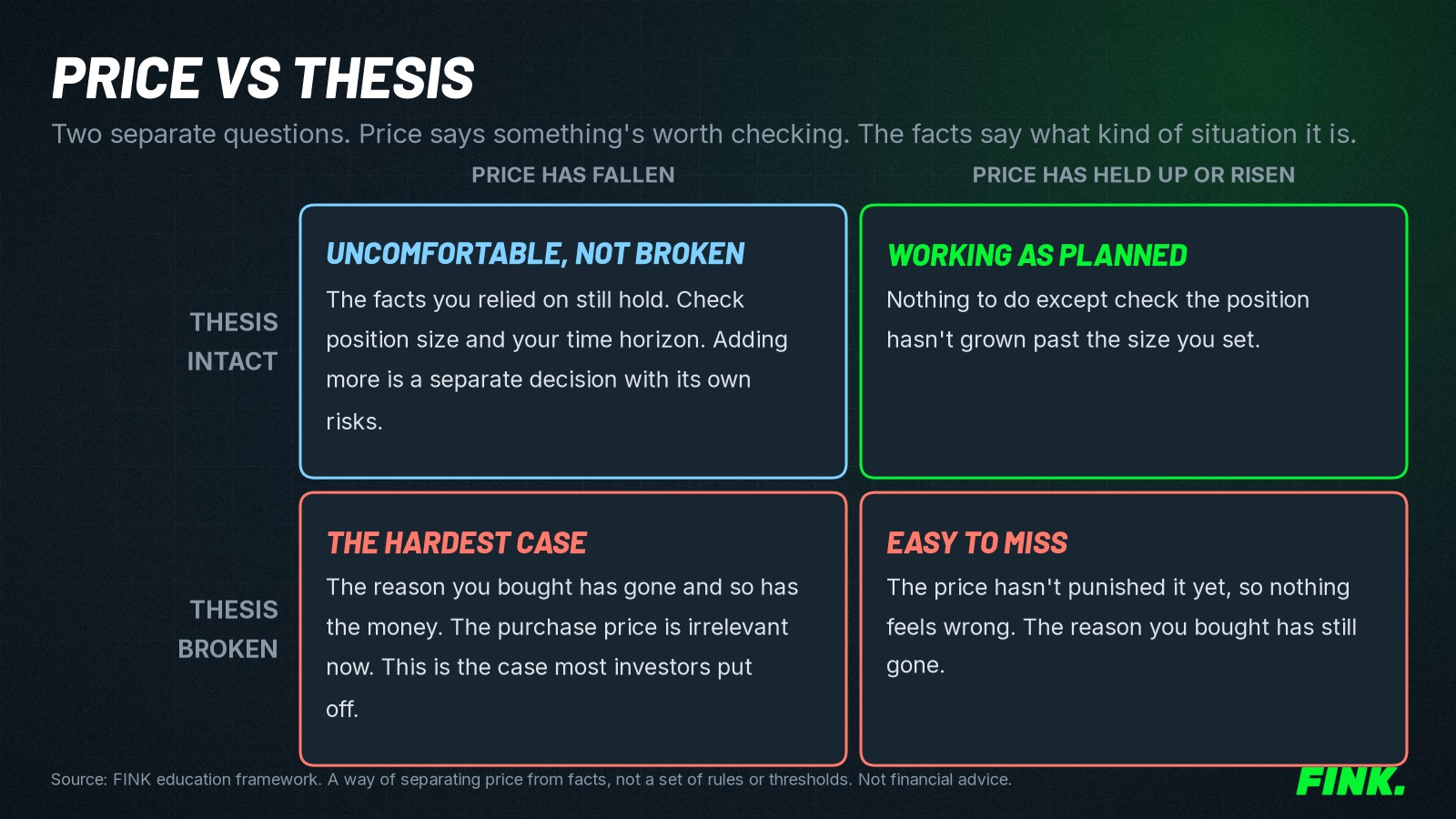
It helps to separate three situations:
| Situation | What it looks like | What it means for the thesis |
|---|---|---|
| Price falls, facts unchanged | The share drops but your box 4 facts still hold | Uncomfortable, not broken |
| Facts weaken, still within your limits | A KPI slips but stays above the level you wrote down | Watch it, note it at the next review |
| A box 5 event happens | The event you wrote down in box 5 has happened | Broken. Go back to what you wrote |
The middle row is the hardest. A thesis rarely breaks in one clean event. More often, a number drifts.
That's why writing the level down in advance matters. Without it, you'll find a reason the drift doesn't count.
A technique that helps when writing box 5 is the pre-mortem. Imagine it's two years from now and the investment has gone badly, then write down why.
Deborah Mitchell, Edward Russo and Nancy Pennington tested this idea (Journal of Behavioral Decision Making, 1989). Imagining an event had already happened led people to come up with more reasons for it.
A caution on that study: the often-quoted 30% figure refers to the number of reasons people generated, not to how accurate they were. It's a way to widen your list, not a forecast.
A worked example: Estée Lauder in 2023
This example uses The Estée Lauder Companies' published statements to show how a written thesis gets tested. It's education, not a view on the shares then or now. We've picked it because the company's own filings make the test unusually clear.
It's a US-listed company, so its results come as Form 8-K filings on the SEC's EDGAR database rather than UK regulatory announcements. The boxes work the same way.
The thesis, as a hypothetical investor might have written it in August 2023. On 18 August 2023, Estée Lauder reported its fiscal 2023 results. The same release set out its outlook for the year to June 2024 (Estée Lauder results, Form 8-K, 18 August 2023). It forecast organic net sales growth of 6% to 8% and adjusted earnings per share growth of 4% to 12% in constant currency.
It expected net sales growth to improve each quarter as stock levels in its Asia travel retail business were rebalanced. An investor relying on that outlook might have filled in the template like this:
| Box | Hypothetical entry |
|---|---|
| 1. Business | Makes and sells prestige skin care, make-up, fragrance and hair care through brands such as Estée Lauder, Clinique and M·A·C |
| 2. Drivers | Asia travel retail recovering once retailer stock is rebalanced, mainland China returning to growth, pricing power in prestige beauty |
| 3. Evidence | FY23 results and FY24 outlook: organic sales growth of 6% to 8%, adjusted EPS growth of 4% to 12% in constant currency |
| 4. Must stay true | The full-year outlook holds. Asia travel retail and mainland China improve through the year |
| 5. Proves me wrong | Full-year sales or earnings outlook cut, or the company lowering its expectations for mainland China or Asia travel retail |
| 6. Size | Starting size and maximum written down (blank here deliberately) |
| 7. Review | After each quarterly results statement |
What happened next. On 1 November 2023, with its first-quarter results, Estée Lauder lowered its full-year outlook (Estée Lauder results, Form 8-K, 1 November 2023). It said:
- Organic net sales fell 11% in the quarter, mainly because of the expected pressure in Asia travel retail plus a slower-than-expected recovery in prestige beauty in mainland China.
- It was lowering its fiscal 2024 expectations for mainland China and Asia travel retail.
- Full-year organic net sales were now forecast to range from a fall of 1% to a rise of 2%, against growth of 6% to 8% in August. Adjusted earnings per share were now expected to fall by 25% to 33% in constant currency, against growth of 4% to 12%.
- It also pointed to "the potential risks of further business disruptions in Israel and other parts of the Middle East as well as currency headwinds". Its revised outlook still assumed "a return to net sales growth in the second half of fiscal 2024".
Reuters reported the shares fell as much as 21% during the day, to their lowest in more than six years (Reuters, 1 November 2023). They closed down 18.9% (Reuters market report, 1 November 2023).
Running the test. The hypothetical investor checks box 4 and box 5:
- Full-year outlook holds? No. Both the sales and the earnings outlook were lowered, by the company's own wording.
- Asia travel retail and mainland China improving? No. The company lowered its expectations for both.
- Box 5: outlook cut, or lower expectations for China or travel retail? Yes, on both counts.
Under this investor's written plan, the box 5 event has happened. The template doesn't say what to do with the shares. It says the reasons written down in August no longer hold, so that thesis is finished.
What to do with the shares is a separate decision that depends on the investor's whole plan and circumstances. Keeping them would mean writing a new thesis from scratch, not stretching the old one.
The counter-argument. A different investor could reasonably read the same update and hold.
In the same filing, the company said the quarter had beaten its own expectations for profitability. Sales grew in the United States and in nearly all of its markets in Europe, the Middle East and Africa. It was also accelerating a plan to rebuild profitability in fiscal 2025 and 2026.
Someone whose thesis rested on the brands rather than on one year's China recovery might have written a different box 5. That's a legitimate view. What matters is that the decision is made against what was written in advance, not in the middle of a big one-day fall.
If the second investor's box 5 had said "brands losing ground in their biggest markets" instead of "outlook cut", the same update would have read very differently.
The template doesn't tell you whether Estée Lauder was a good investment. It makes you decide what would change your mind while you're calm, then gives you something to check against.
How often should you review a thesis?
After each set of results or trading update, plus a full reread once a year. Results days are when the facts in box 4 change. They're also when the Akepanidtaworn study found professional sells did better than on other days.
A review doesn't mean a decision. Most reviews end with nothing to do except write the date. A simple routine:
- Reread boxes 4 and 5 before looking at the share price.
- Check each fact against the new results. Note the page number.
- Mark each one as holding, weakening or broken.
- Check the size against box 6.
- Write the outcome and date at the bottom, even if it's "no change".
Over a few years, that log tells you something no single decision can. It shows whether your theses tend to break in the ways you expected and whether you followed your own plan when they did.
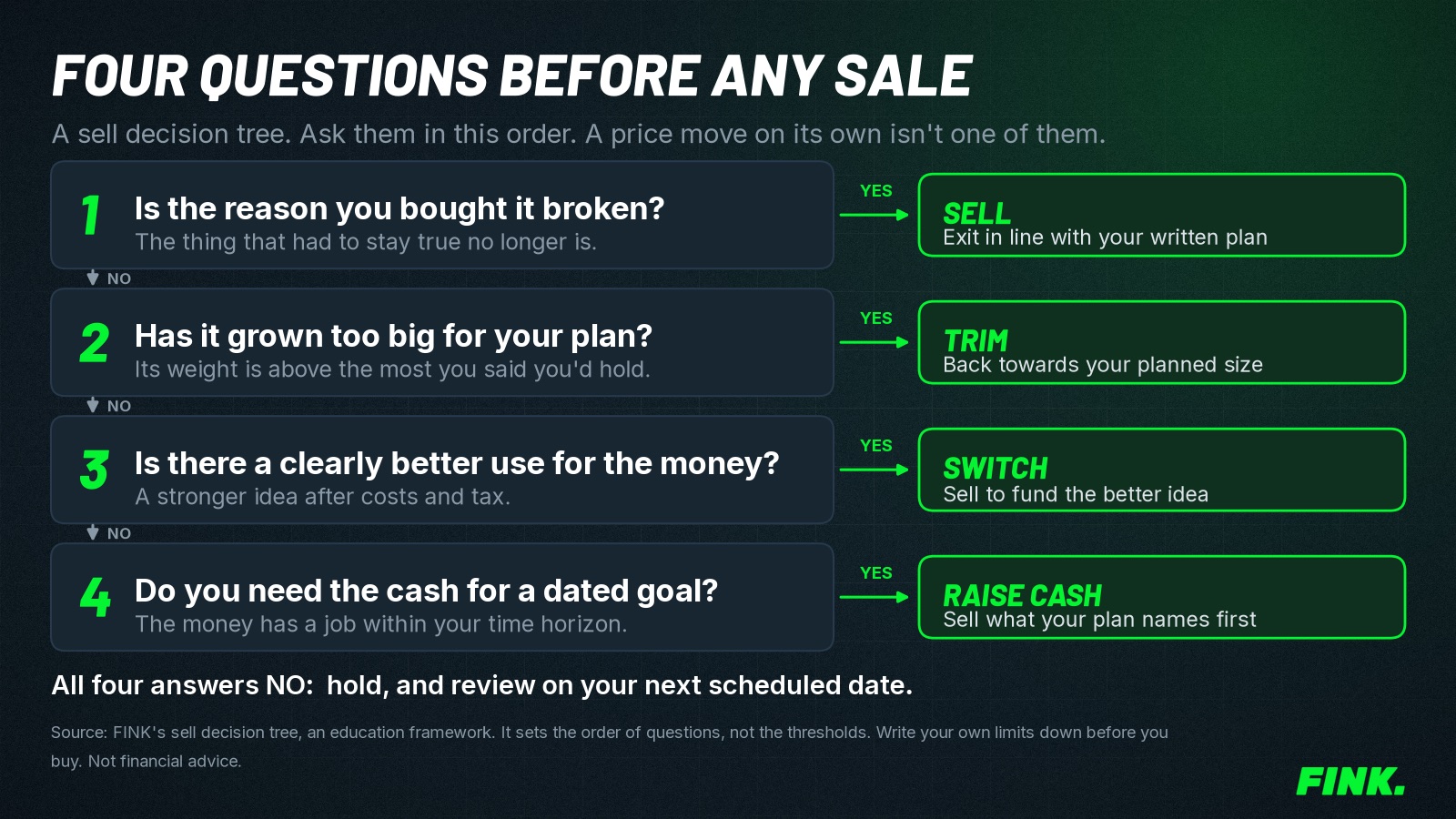
For the sell decision itself, our guide on when to sell a stock sets out four questions in order. If a holding's already down, when to sell a stock at a loss covers the extra traps. For an ISA-wide check, see our annual ISA review checklist. For how many holdings you can realistically review, see how many shares to hold in a stocks and shares ISA.